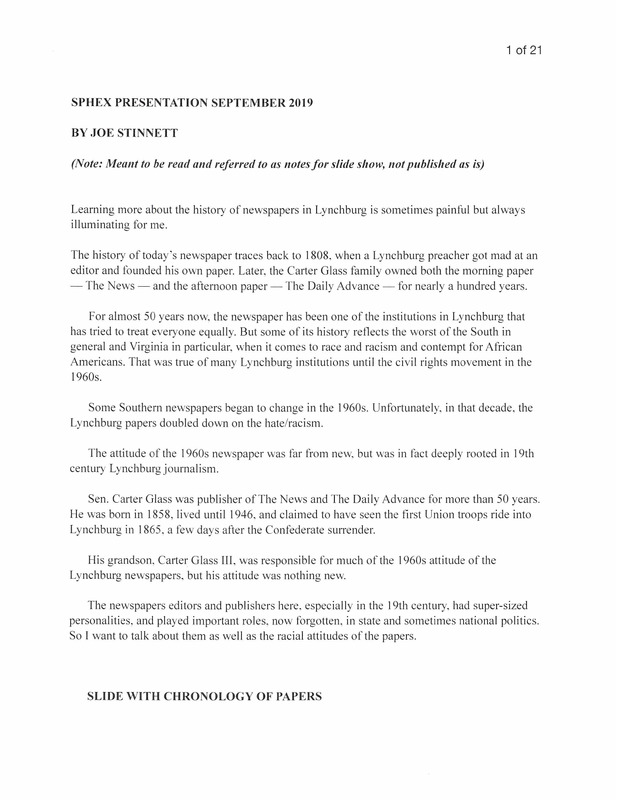
Text of a lecture delivered to the Sphex Club in Lynchburg.The paper discusses the history of newspapers in Lynchburg, Virginia, focusing on their role in local and national politics and their racial attitudes from the 19th century to the 1960s. It details the evolution of various newspapers, key figures like Carter Glass, and their influence on racial segregation and civil rights. Notable incidents, personalities, and the transition of attitudes through different eras are highlighted.
James B. Noell described the English Inns of Court. Originating in the fourteenth century, they became the great schools of law in the later Middle Ages. Of the two strands of lawyers, barristers and solicitors, the Inns of Court were concerned only with the barristers. Organization and functions of the Inns were described, as well as the environs and the Royal Courts of Justice Building. The talk included a discussions of the development of English law and the many prominent names associated with it.
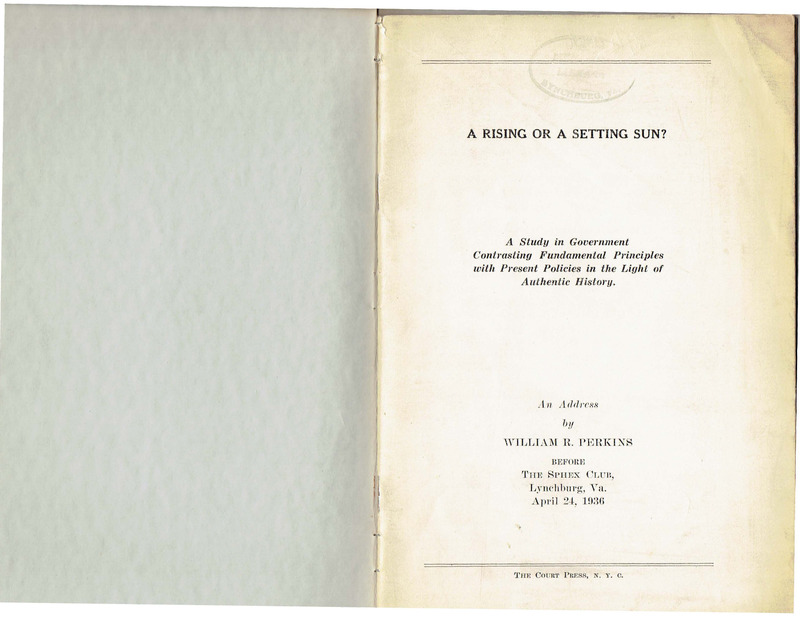
Text of a paper delivered to the Sphex Club in Lynchburg. The author begins by discussing the remarkable success of the United States, attributing it to the educated elite who framed its constitution and the fundamental principles upon which it was based. He then discusses those principles in details, beginning with a recognition of the individuality of man and the right of men to accumulate wealth. From this principle is derived the right of self-government and the Constitution. He cites causes for concern, including the cost of government, an unbalanced budget, increasing debt, concluding that prosperity can only come from private enterprise. He decries the Roosevelt administration’s effort to concentrate power in the federal government, arguing that the constitution vests complete power in the masses, the majority of whom are least capable of exercising that power responsibly.
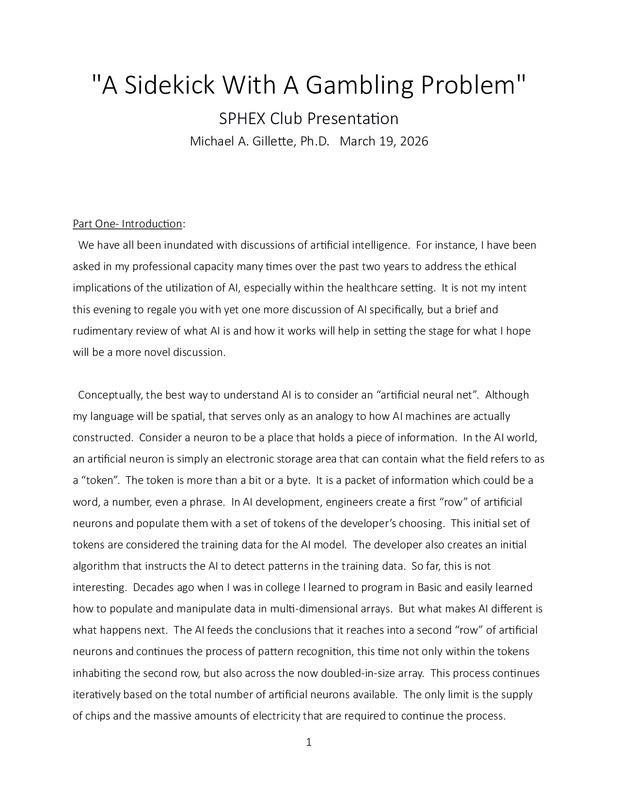
Text of a lecture delivered to the Sphex Club on March 19, 2026. Michael A. Gillette explores whether artificial intelligence can truly think or even become conscious. After explaining how AI systems use deep learning and probabilistic pattern recognition, he argues that current AI lacks intention, creativity, and self-awareness despite its impressive conversational abilities. Drawing on Alan Turing, John Searle, and theories of consciousness, Gillette examines whether consciousness depends on information integration, self-reflection, learning, and subjective perception. He proposes “graduated pluri-psychism,” the idea that consciousness exists on a continuum across living organisms and perhaps advanced machines. Examples from plant learning experiments and AI behavior support his argument that rudimentary consciousness may emerge from complex information processing. He concludes by discussing AI-generated creativity and experiments in which AI models developed irrational gambling behaviors, suggesting that subjective biases and internal perspectives may indicate the earliest forms of machine consciousness and moral standing.
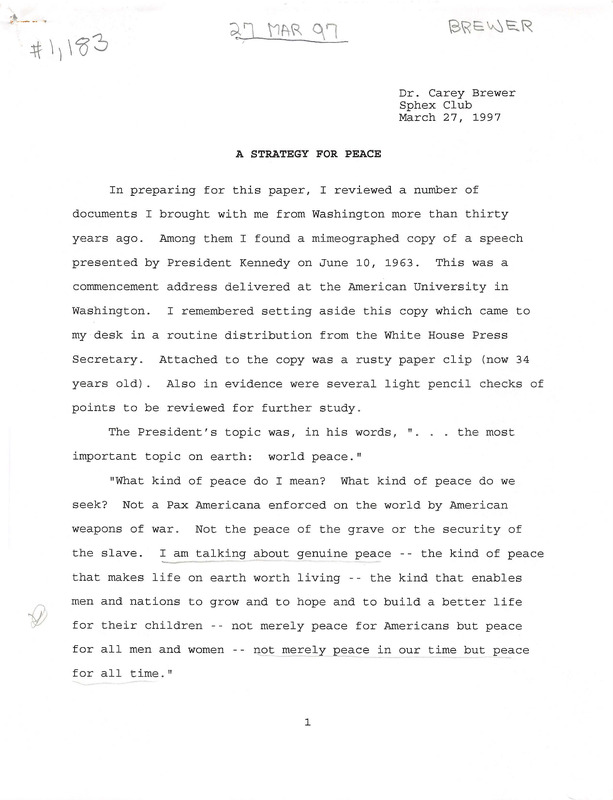
Carey Brewer's paper, "A Strategy for Peace," discusses historical U.S. foreign policy during the Cold War, highlighting the evolution from Truman's initial response to Soviet aggression to collective security efforts. Emphasizing the influence of Kennedy's peace approach, Brewer reflects on personal experiences in government, detailing key events such as the Cuban Missile Crisis and the development of secret facilities. The paper underscores a strategy of peace through strength and international cooperation.