James R. Caskie's paper explores the Kohler Company's labor relations history, emphasizing its fair labor practices and innovative community-building efforts by its founder, John Michael Kohler, in Sheboygan, Wisconsin. It details the prolonged conflict and strike with the UAW, highlighting the subsequent violent acts and legal struggles, and criticizes the National Labor Relations Board's controversial decisions. Caskie utilizes Sylvester Petro's comprehensive analysis to critique the NLRB's handling of the case, suggesting political motivations and systemic bias against the company.
This academic paper offers a detailed narrative of Linker's personal experience climbing the Matterhorn. It encompasses the planning, execution, and reflections on the ascent, providing insights into the challenges and risks involved in mountain climbing. The paper is organized chronologically, starting from the anticipation and preparation, the climb itself, and concluding with post-climb reflections. The key points include the importance of physical preparation, the unpredictability of mountain weather, the significance of having a skilled guide, and the personal fulfillment derived from achieving such a feat. The narrative emphasizes the climber's interaction with nature, the technical aspects of mountaineering, and the emotional journey of overcoming physical and psychological barriers.
This paper by Joan S. Jones, presented on October 18, 1990, at the SPHEX Club, delves into the evolution of education from elementary through higher education, focusing on the shift towards more dynamic and student-centered learning approaches. It discusses the transition from traditional teaching methods to those that cater to the developmental stages of children, as outlined by educational theories such as those of Piaget. The paper also touches on the implications of these educational shifts for teacher training, curriculum development, and the fostering of a more cooperative and interactive learning environment. Emphasis is placed on the need for educational reform to accommodate diverse learning styles and to prepare students effectively for future challenges.
The paper, presented by George W. Dawson at the Sphex Club, delves into the life of Robert Frost, emphasizing the profound impact of three key women on his life and poetic works. It explores Frost's formative years, his struggles with education and financial stability, his complex family dynamics, and his tenure at prestigious institutions despite no formal degree. The narrative reveals Frost as a man marked by fame yet driven by personal insecurities and a quest for public validation, ultimately questioning whether Frost was truly "A Man for Our Times."
Text of a lecture delivered to the Sphex Club in Lynchburg. This paper provides a comprehensive review of the evolution of life and speculative insurance from the 18th century to modern financial instruments like Credit Default Swaps (CDS) and Collateralized Debt Obligations (CDOs). Kevin Smith delves into the historical context of insurance legislation, highlighting the transition from gambling-like speculative insurance to laws requiring insurable interest, and connects these concepts to contemporary financial crises, particularly the role of CDSs and CDOs in the 2008 financial meltdown. He advocates for stronger regulation, concluding that while recent measures have mitigated risks, significant challenges remain.
Text of a lecture delivered to the Sphex Club in Lynchburg. The paper "A Neglected Factor in History" by Maurice Moore (April 1925) examines how climate and its changes have historically influenced the rise and fall of civilizations. Moore argues that despite technological advances, civilizations, like Egypt and Greece, flourished under favorable climatic conditions, which eventually shifted, leading to their decline. He discusses the impact of climate on agriculture, disease prevalence, and overall societal energy, suggesting that climatic conditions directly correlate with a civilization's vitality and progress. Through extensive examples across various continents and eras, Moore highlights the overlooked yet critical role of climate in shaping human history. The paper is organized into a comprehensive overview of civilizations' achievements, followed by detailed analyses of climatic effects on societal development and decay, concluding with a call to recognize climate as a pivotal historical factor.
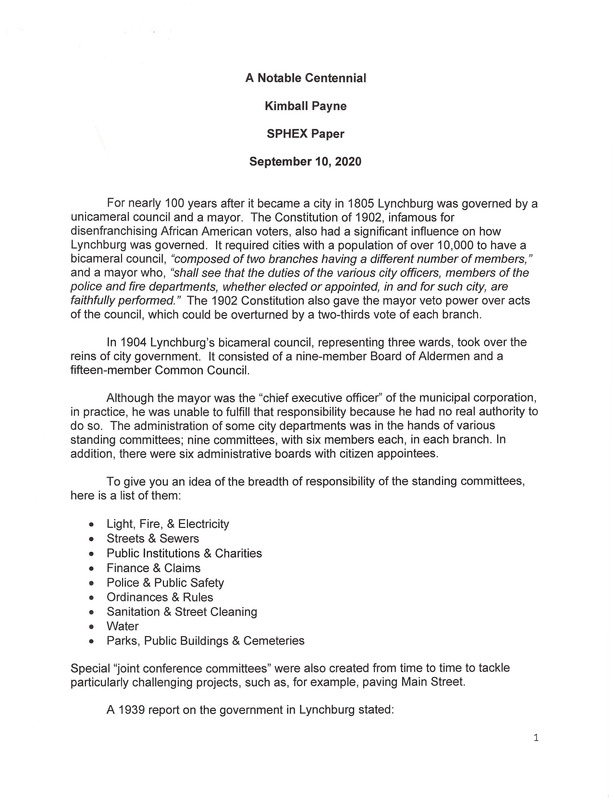
Text of a lecture delivered to the Sphex Club of Lynchburg. The genesis of the City Manager form of government in Lynchburg upon its centennial, including comments for and against by prominent citizens in advance of the successful 1919 referendum.