Dr. Elson's lecture explores the characteristics and challenges of four American generations: the Silent Generation, Baby Boomers, Generation X, and Millennials. He highlights the unique aspects of the Silent Generation, known as the "Lucky Few," and discusses retirement challenges facing Boomers and subsequent generations. Elson concludes with practical advice, emphasizing the importance of planning. Dr. Elson did not submit the text of his paper, only a summary.
The presentation by Charles F. Zimmer on January 2, 1992, at the SPHEX Club, titled "A Few Skills Needed to Work with Adolescents," covers the challenges and complexities of dealing with adolescents, particularly in the context of a drug crisis at Virginia Episcopal School (VES). Zimmer details a specific incident involving cocaine and alcohol, explaining the sequence of events, the school's response, interactions with law enforcement, and the aftermath. He uses this case to underscore the broader issue of drug use among youth, incorporating statistics and historical context to highlight the prevalence and dangers of substance abuse. Zimmer advocates for education, discipline, patience, and a strong community approach to address these issues, concluding humorously on the skills needed to work effectively with adolescents.
Robert Wimer discussed the fascinating Virginian from Nelson County, Thomas Fortune Ryan (1851-1928). Ryan “proved to be one of the shrewdest builders of wealth Wall Street had ever seen. At his death at the age of 77, Ryan was the richest native southerner and a man of spectacular generosity.” However, his manipulation of the corporations that he swept into his empire aroused a storm of criticism. Wimer discusses several topics related to Ryan including his nearby Oak Ridge estate.
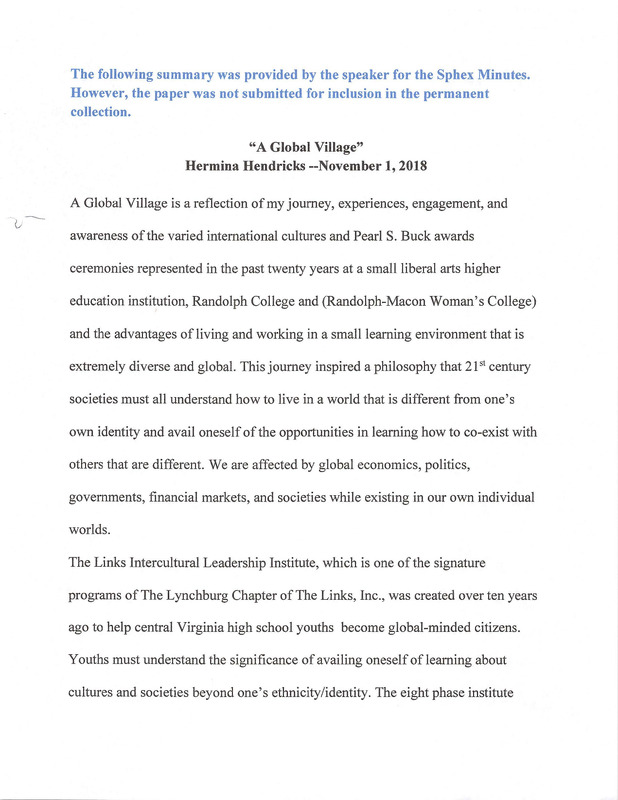
Text of a talk delivered to the Sphex Club of Lynchburg about The Links Intercultural Leadership Institute, which fosters awareness and engagement with international cultures.
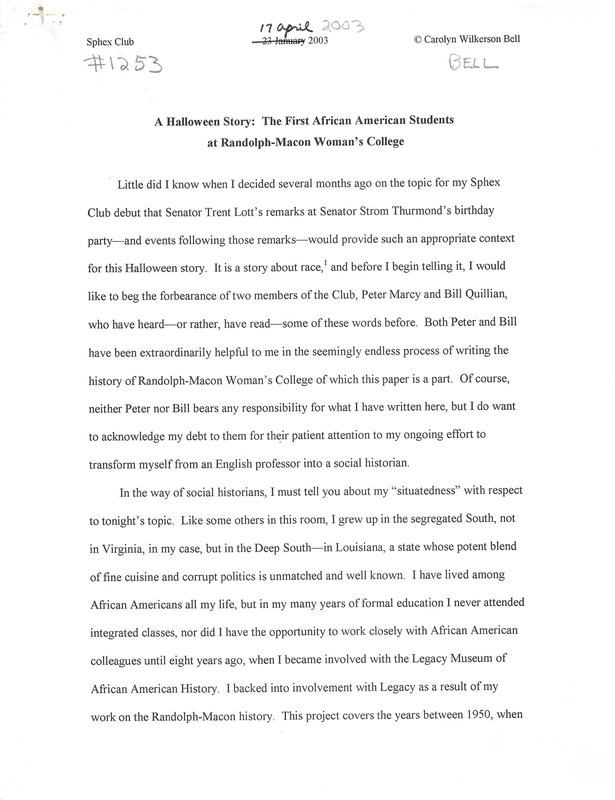
A history of the integration of Randolph-Macon Women's College beginning in 1964.
A history of the integration of Randolph-Macon Women's College beginning in 1964.
Theodore J. Craddock's paper, "A Hot Time in a Cold Place," delivered to the Sphex Club, examines the Korean War, detailing its origins, key figures, and outcomes. Craddock explores the strategic mistakes and political maneuvers that defined the conflict, emphasizing the war's unresolved nature and its impact on U.S. foreign policy and military strategy. The paper also reflects on the war's legacy, particularly the contrast between North and South Korea, and critiques the underestimation of Chinese involvement by U.S. leadership.
Thomas Ledford offers a history of the railroad companies that ran through or influenced Lynchburg, and Lynchburg’s early efforts to take advantage of railroads despite the strong opposition by canal advocates. Lynchburg influenced the Civil War because of their railroad strengths, but experienced the devastation of the railroads by the war’s end. Changes in the railroads after the Civil War included the move of the railroad center to Roanoke, the 1891 financial panic, and the coming of Amtrak.