This paper, presented by James R. Caskie at the Sphex Club, explores the Maccabean struggle from 168 to 63 B.C., focusing on the resistance against Hellenistic influences in Judea and the quest for religious and political independence. The paper extensively details the leadership of figures like Judas Maccabeus and his successors, who fought to preserve Jewish traditions against external pressures, leading up to Roman conquest. Key themes include the resilience of Jewish faith, the impact of Hellenistic culture, and the pivotal role of leadership in national identity preservation.
This academic paper by E. Campbell Russell, titled "A Britisher Looks Back," delivered on November 16, 1962, at the SPHEX Club, is a personal narrative reflecting on his life's journey, including his career transitions, the impact of the Great Depression, and significant global events leading up to and during World War II. Russell narrates his transition from working with the Anglo-Persian Oil Company to navigating the business world during economic downturns, and finally, his personal experiences and observations on international relations and warfare. The narrative also touches on his emigration to the United States, his contributions during the war, and post-war reflections, encapsulating the broader historical context of the 20th century through a personal lens.
This paper by E. Campbell Russell provides a detailed autobiographical account of his varied and extensive experiences in the oil industry, focusing on his roles and travels while working for the Asiatic Petroleum Company in India, the formation and operation of the United British West Indies Petroleum Syndicate in Trinidad, and his subsequent involvement with the Anglo-Persian Oil Company. Russell's narrative encompasses his efforts in oil exploration and company mergers across diverse geographies, including Trinidad, Venezuela, Argentina, Germany, Italy, China, and Japan, highlighting both successes and failures. His story reflects the challenges of international business in the early 20th century, marked by geopolitical influences, technological advancements, and the personal trials of adapting to different cultures and overcoming operational obstacles in the pursuit of oil.
This paper is a detailed autobiographical narrative spanning the author's life from his birth in 1876 in Chislehurst, Kent, to his varied experiences throughout the late 19th and early 20th centuries. Russell offers a rich account of his upbringing, education, and multiple careers, including his service in the Boer War, his work as a solicitor, and later endeavors in the petroleum industry and beyond, culminating in significant time spent in India. He reflects on historical events, social changes, and personal growth, intertwining his life story with broader themes of British colonial history, global conflict, and the complexities of cultural and economic exchange in a rapidly changing world.
Text of a lecture delivered to the Sphex Club in Lynchburg. This paper, presented at the SPHEX Club meeting by Thomas C. Tiller on November 2, 2000, examines the 1789 election in Virginia's fifth congressional district post-U.S. Constitution adoption, focusing on a campaign promise made and kept. It recounts the political climate, debates around the Constitution's ratification, and James Madison's campaign, highlighting the importance of promises in elections. The narrative illustrates the transition from the Articles of Confederation to the Constitution, emphasizing the role of amendments and the Bill of Rights. Tiller's analysis offers insights into early American political dynamics, election practices, and the foundational debates that shaped the U.S. political system.
Judge Sweeney opened his presentation on the use of cameras in the courtroom: “The purpose of this paper is to try to present an unbiased evaluation of the program by someone who was there and has first-hand knowledge of the experiment as conducted in Bedford County.” Sweeney reviews the reactions of all relevant groups. Judges and the Virginia Supreme Court opposed the presence of cameras. But in 1992 Virginia’s General Assembly permanently approved the use of cameras.
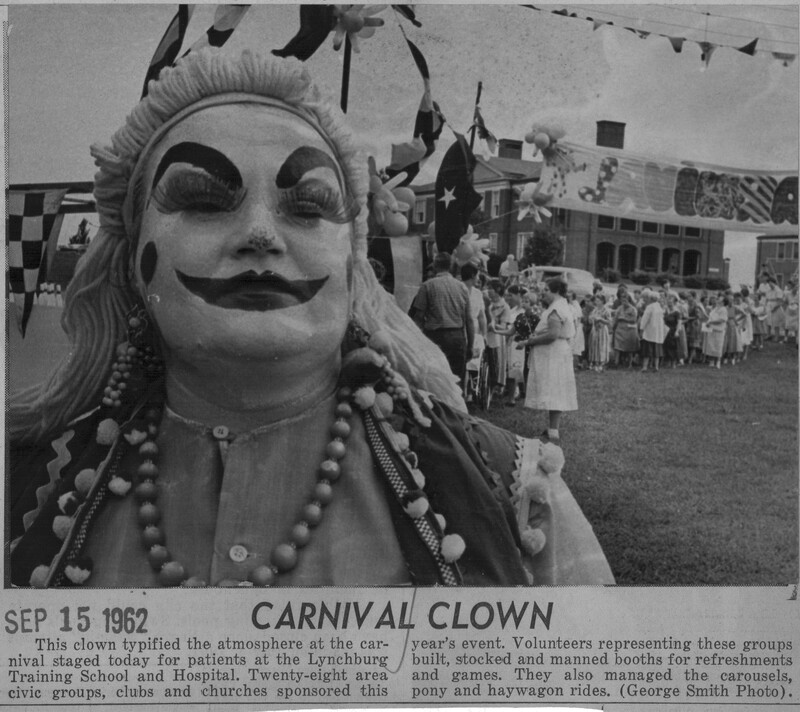
John D. Capron's lecture to the SPHEX Club on February 3, 1961, detailed the evolution of manufacturing in Lynchburg, Virginia, over one and a half centuries. Starting from basic survival-driven crafts by early settlers using simple technologies, the industry evolved significantly, driven by geographical advantages and restrictive colonial policies. Over the centuries, varied manufacturing entities emerged, reflecting the adaptability and changing economic strategies of the community, despite challenges posed by external control and local cultural tendencies.
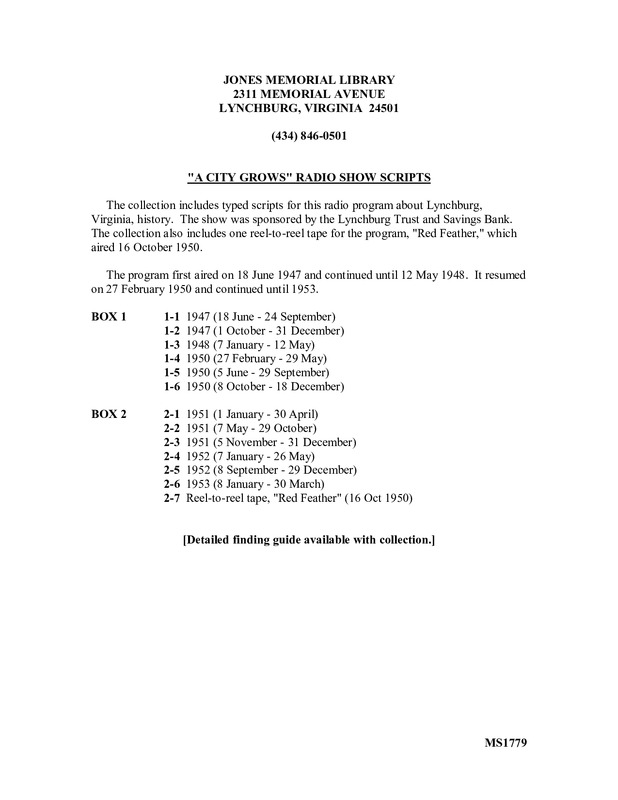
"A City Grows" Radio Show Scripts Held At Jones Memorial Library In Lynchburg, Virginia. The Radio Show Aired In The 1940S And 1950S And The Show Was About Lynchburg History.
Text of a lecture delivered to the Sphex Club of Lynchburg. Robert Chambliss Light's presentation explores the history and unique characteristics of Siena, Italy. The talk highlighted Siena's division into 17 Contradas, the famous Palio horse race, the city's historical figures like St. Catherine of Siena, and compared Siena's community aspects to those of Lynchburg, considering how similar unity and identity could be achieved in Lynchburg.
Joan Foster's presentation, "A Culture of Care… Walking in Another’s Shoes," focused on Lynchburg's response to intergenerational poverty over the last decade. It highlighted the city's efforts, including the Poverty to Progress initiative and the merging with Bridges to Progress, forming task forces to tackle poverty-related barriers. The talk also covered grassroots initiatives addressing various aspects of poverty and concluded with the positive outcomes of these community-driven efforts, though acknowledging the challenges ahead.
Robert Wimer focused on the death of Thomas Jonathan “Stonewall” Jackson and on the day that his body traveled through Lynchburg on its way to his final resting place in Lexington. Wimer described what was going on in Lynchburg and the surrounding counties as Jackson's casket passed through the city on May 13, 1863. He concludes with a discussion of the packet boat Marshall and his hope that Lynchburg will preserve it as perfectly as possible.