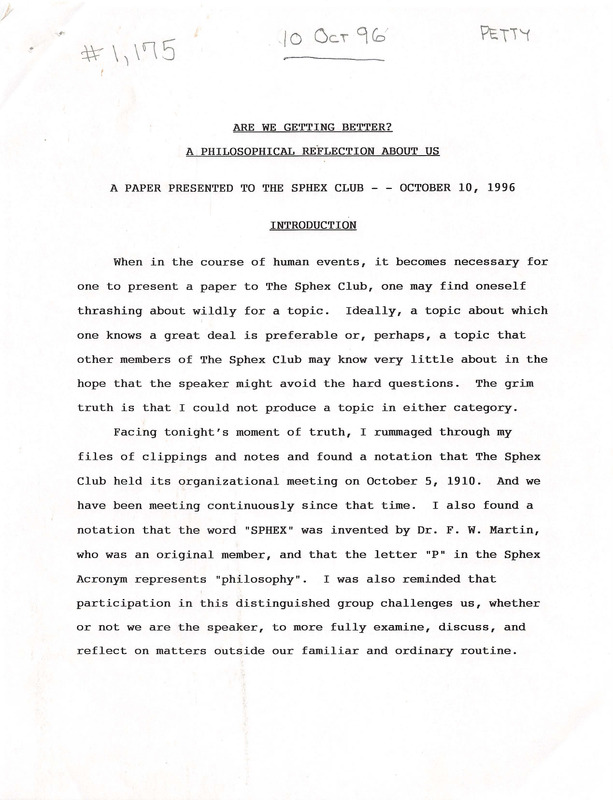
Text of a lecture delivered to the Sphex Club in Lynchburg. This paper, presented by David T. Petty, Jr., explores the erosion of secular humanism and the impact of chaos theory on the concept of progress. Petty draws from historical philosophies, particularly those of John Locke, to discuss the Western belief in rational progress and its challenges in contemporary times. He references the uncertainty principle and chaos theory to illustrate the growing skepticism towards the predictability and control over nature and society. The paper prompts a reevaluation of humanism, suggesting that advancements in science and a deeper understanding of chaos may lead us to question our place in the universe and the inherent nature of progress. It calls for a philosophical discussion on whether the disillusionment with secular humanism signifies a temporary phenomenon or a permanent shift in our worldview.
The paper by Charles F. Church, titled "Are We Our Brother's Keeper?" examines the contentious debates and legislative changes surrounding welfare reform in the United States. It focuses on the shifting public responsibility for welfare from a broad interpretation of "general welfare" to more targeted initiatives aimed at promoting self-sufficiency among welfare recipients, highlighting the introduction of the U.S. Personal Responsibility and Work Opportunity Act of 1996 and the Virginia Initiative for Employment Not Welfare (VIEW). Church details how these reforms emphasize work requirements, time-limited benefits, and sanctions to encourage employment and reduce dependency.