Justice of the Supreme Court of the United States from 1789-1796; address given at special session of U. S. Circuit Court of Appeals for the Third Circuit, on the occasion of the presentation of portrait
Dr. Sally Selden is involved with the Government Performance Project that assesses the management capacity of all 50 states. The GPP is designed to identify the link between how well governments manage available resources and how well they deliver services. Dr. Selden’s primary focus is Human Resource Development. HRD evaluates the policies, systems, and practices that influence employees’ behaviors, attitudes and performance, and subsequently the performance of the organization.
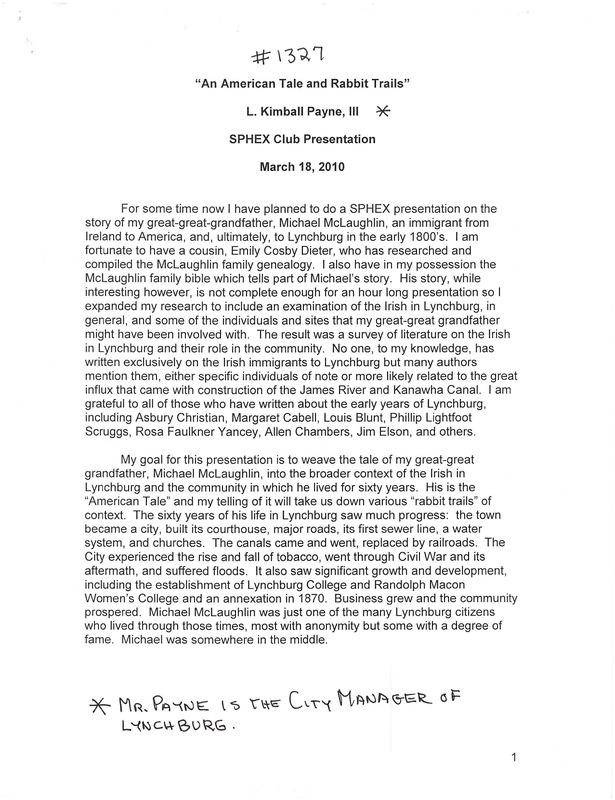
Text of a lecture delivered to the Sphex Club in Lynchburg. A look at early Irish settlers in Lynchburg, including the author's great-great-grandfather Michael McLaughlin
James A. Huston lists the ten women who have left the greatest mark on history. Then he adds one more – Florence Nightingale (1820-1910). He explains that when she became abhorred by the medical treatment of soldiers, she dedicated her life to healing. The major changes she made were frequently opposed by established doctors. Huston shares how beloved she was by patients and how she greatly reduced the death rates of soldiers and patients today.
An Appeal Of The Congregation Of The St. Paul'S Episcopal Church For Funding In 1887. The Appeal Is Held At Jones Memorial Library In Lynchburg, Virginia.
Born Grafton County, New Hampshire, son of Nathan and Mary DAVIS; "constructed...the first coal-burning locomotive steam engine ever produced in the United States" in 1831; member of the Society of Friends; built the steamboat CODORUS in 1828, first steamboat on the Susquehanna River
Richard P. Gifford's paper presented to the SPHEX Club explores the parallel between energy and information, drawing on historical trends, physical laws, and societal impacts. He discusses the increasing input and overload of information in modern life compared to energy consumption and warns of the potential negative consequences of an information-dominated society. Gifford highlights the need for tools to manage information overload and examines the future challenges of maintaining freedom and control in an information-centric world.
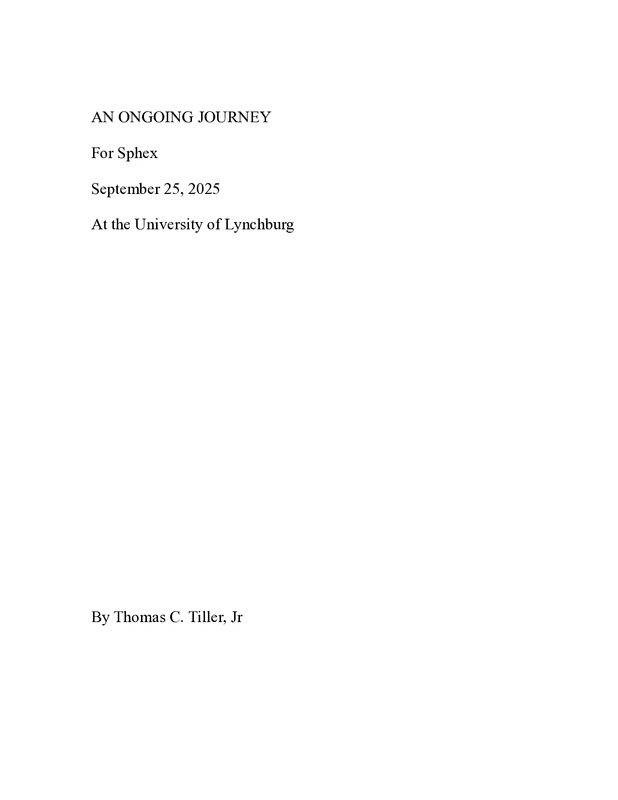
Text of a lecture delivered to the Sphex Club of Lynchburg on September 25, 2025. In this autobiographical and historical talk, Thomas C. Tiller, Jr. recounts his long engagement with the history and moral implications of nuclear weapons through the life of Setsuko Nakamura Thurlow, a survivor of the atomic bombing of Hiroshima who attended University of Lynchburg in 1954–55. Tiller traces Setsuko’s journey from wartime Hiroshima, through the devastation and trauma of the atomic bomb, to her education in Lynchburg and later career in Canada as a social worker and leading advocate for nuclear disarmament. The talk highlights influential figures in her life, including Kiyoshi Tanimoto and Joseph Boone Hunter, and examines broader issues of war memory, racism, reconciliation, and international nuclear policy. Tiller concludes by arguing for sustained global efforts toward gradual, verified nuclear disarmament.
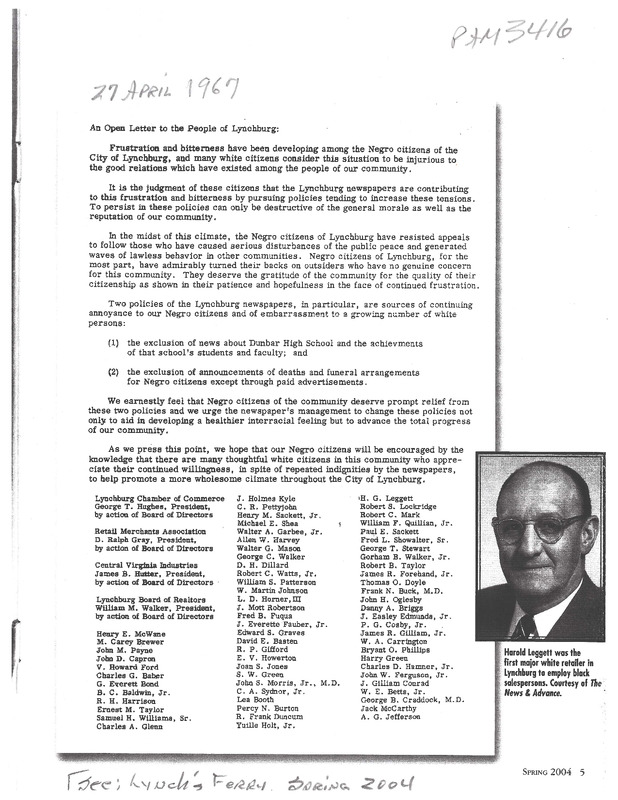
Scanned image of a Spring 2004 reproduction of An Open Letter to the People of Lynchburg dated 27 April 1967. The letter protests the policies of the Lynchburg newspapers to exclude news coverage of Dunbar High School and to exclude announcements of deaths and funeral arrangements for Negro citizens.
The open letter was signed by several members of the Jones Memorial Library board of trustees at the time, including the board president Robert C. Watts, Jr. and members Charles G. Baber, B.C. Baldwin, Jr., C.R. Pettyjohn, and James R. Gilliam, Jr.
This paper by Elisabeth S. Muhlenfeld delves into the rich history of the dictionary, anchored by the provocative act of Becky Sharp from William Makepeace Thackeray's 1848 novel "Vanity Fair". Dr. Muhlenfeld traces the evolution of dictionaries from their inception in 2800 BCE with the Sumerians, through various cultures and eras, to the creation of Samuel Johnson's seminal 1755 Dictionary, and beyond to the modern Oxford English Dictionary (OED). Highlighting key developments, such as Noah Webster's American Dictionary and the perceived need for the American Heritage Dictionary in response to Merriam-Webster's "permissiveness", Muhlenfeld paints a comprehensive picture of how dictionaries have shaped and been shaped by society, culminating in the monumental achievement of the OED—a project of over seventy years that reflects the monumental effort akin to historical explorations and achievements.