In 2018 California has more irrigated acreage and produces a wider variety of commercial crops than any other state in the USA. Enough useable water has always been the greatest challenge for California since the Gold Rush of 1849. A history is traced of the complex challenge of providing water to such a diverse state which sometimes seems to experience overwhelming needs for clean water.
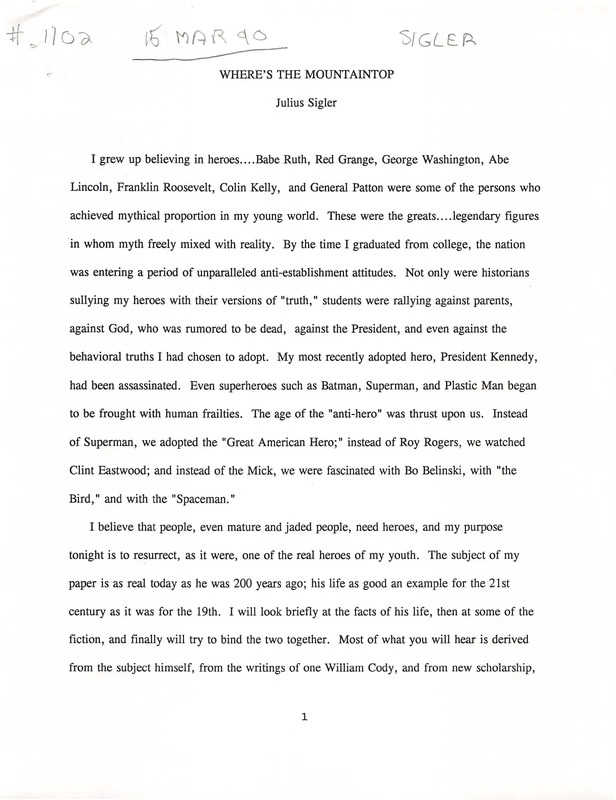
Text of a lecture delivered to the Sphex Club in Lynchburg. The paper, "Where's the Mountaintop" by Julius Sigler, offers an in-depth exploration of the American hero archetype, exemplified by the life and legend of David Crockett. Sigler juxtaposes the historical Crockett, a pioneer, legislator, and Alamo martyr, with the mythologized "Davy" Crockett, a folk hero woven into the American cultural fabric through tall tales, plays, and television. Through the examination of Crockett's real exploits alongside his legendary feats, Sigler illustrates the profound impact of Crockett's legacy on American identity and the concept of heroism. The narrative is structured around Crockett's biography, highlighting key events from his upbringing, political career, and eventual heroic stand at the Alamo, while also delving into the creation and perpetuation of his larger-than-life legend.
Where Did My Hero(es) Go? by George M. Snead, Jr. discusses the life and legacy of Charles Augustus Lindbergh, Jr. It traces Lindbergh's journey from his early life through his historic flight and subsequent contributions to aviation, highlighting the challenges he faced with public perception and media scrutiny. Snead examines the evolution of Lindbergh's heroism and the impact of misinformation on his public image.
Text of a lecture delivered to the Sphex Club in Lynchburg. Eric Sorenson, Sr. examines the scientific searches for the existence of extra-terrestrial life. Then he explains logical reasons why we have not yet found life elsewhere. Sorenson ends by quoting the scientist Martin Rees, “The absence of evidence is not evidence of absence."
The paper "When You Think You Are Right - You Are Wrong and When You Think You Are Wrong - You Are Right" by George M. Snead, Jr., examines the moral dilemmas faced by soldiers during wartime, particularly during World War II and the Korean War. It discusses the challenges of following orders versus personal moral responsibility, illustrated by the Nuremberg Trials and incidents like No Gun Ri. The paper emphasizes the complexities of combat morality and the need for clear guidelines and understanding in military contexts.
William A. McIntosh's 2003 presentation, "When Illusion Becomes Reality," examines the blurred lines between truth and perception in historical narratives, focusing on the romanticization of Major General James Wolfe's death during the Battle of the Plains of Abraham. McIntosh contrasts the commitments to truth among philosophers, historians, and artists, using artistic depictions and literary references to explore how history is often colored by the latter's commitment to narrative and emotional impact over factual accuracy. He concludes that while historians strive for factual correctness, artists prioritize conveying broader truths through illusion.
Michael A. Gillette's paper, "What's Good for the Goose...", explores ethical theories through the lens of fairy tales and idioms. He uses stories like "The Little Red Hen" and "Goldilocks" to introduce complex ethical principles such as Locke's theory of property and the Aristotelian Golden Mean. Gillette further delves into moral reasoning, arguing against the theoretical model and advocating for a casuistic approach. He applies this to contemporary issues like terrorism, emphasizing the importance of ethical consistency in our response to terrorist acts.
What's a Nice Girl Like Juliana Barnes Doing in a Place Like...? by Joel Keyes explores the history and essence of fly fishing through the lens of Juliana Barnes, a 15th Century figure credited with pioneering literature on the subject. Keyes weaves social and psychological perspectives into the narrative, highlighting the sport's evolution, its social etiquette, and the personal fulfillment it offers beyond mere technique. He discusses the shift in fly fishing's demographic and its implications, emphasizing the sport's deeper values over contemporary commercialization and competitiveness. The paper ultimately serves as both a tribute to Barnes's legacy and a contemplation on the intrinsic rewards of fly fishing, advocating for a return to its roots in respect, solitude, and connection with nature.
This academic paper explores the author's philosophical reflections on fate, destiny, and human agency through a narrative blending personal experiences, historical events, and contemplation of life's mysteries. Russell delves into the extent to which human lives are shaped by their actions versus predetermined destiny, inspired by his own life's highs and lows. The paper discusses the impact of significant events, such as President Kennedy's assassination, and integrates Russell's musings on spirituality, scientific progress, and changing societal norms on religion and morality. Through a mix of anecdotal evidence and speculative reasoning, Russell probes the essence of existence and the interplay between choice and fate.
Richard P. Gifford's paper "WHAT WE HAVE HERE IS A FAILURE TO COMMUNICATE," explores the evolution of human society through the development of tools of production, transportation, and communication. Gifford emphasizes the significant role of communication tools in societal progress and advocates for their increased public support to counteract the negative effects of urbanization and enhance human connection.