Text of a lecture delivered to the Sphex Club in Lynchburg. Eric J. Sorenson discusses the early development of Christian dogma, particularly focusing on the nature and identity of Jesus Christ. It traces the ambivalence about Jesus's divinity, the impact of the crucifixion and resurrection, and the subsequent doctrinal disputes among early Christians. The paper highlights key figures, heresies, and theological debates that shaped orthodox Christian beliefs, culminating in the Council of Nicea.
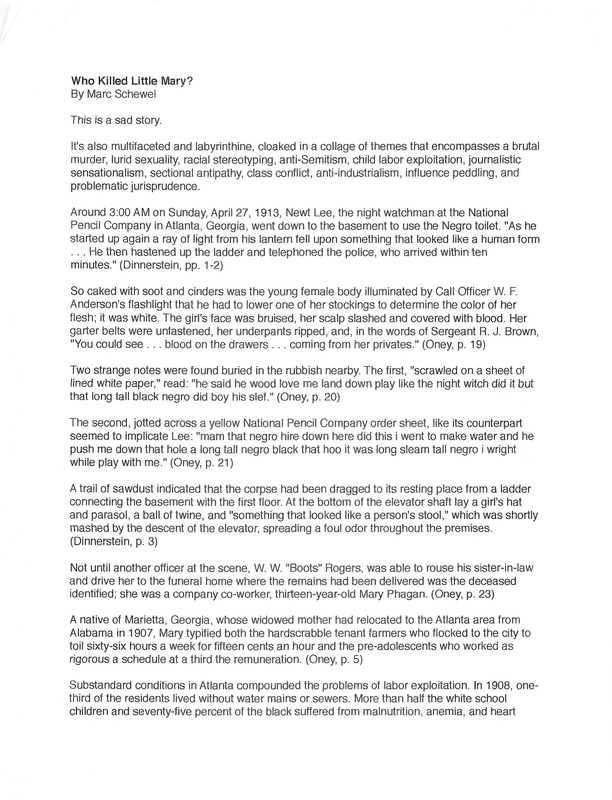
Text of a lecture delivered to the Sphex Club in Lynchburg. This paper, titled "Who Killed Little Mary?" by Marc Schewel, delves into the complex and harrowing case of Mary Phagan's murder in 1913, highlighting the societal and judicial intricacies that led to the conviction of Leo Frank. Schewel explores themes such as racial prejudice, anti-Semitism, and the impact of media sensationalism on the legal process. Through a detailed examination of the investigation, trial, and public reaction, the paper reveals the multifaceted nature of justice and its susceptibility to external influences. Schewel's work underscores the intertwining of social attitudes with the pursuit of justice, offering a nuanced perspective on a historically significant legal case.
Demographic and other trends are increasing demands placed on the judicial system. History of the evolving requirements to provide legal representation for the indigent and the various mechanisms to address the need.
Text of a lecture delivered to the Sphex Club in Lynchburg. Thomas C. Tiller's paper "WHO GOES THERE?" examines the complex issue of dissent in wartime, specifically focusing on the balance between national security and the protection of civil liberties. Tiller explores historical instances where the U.S. government has restricted freedom of speech during times of war, such as the Alien and Sedition Acts of 1798, Lincoln's suspension of habeas corpus during the Civil War, and the Espionage and Sedition Acts during World War I. By referencing Geoffrey R. Stone's "Perilous Times: Free Speech in Wartime," Tiller underscores the recurring theme of governments curtailing civil liberties under the guise of national security. The paper emphasizes the importance of maintaining a robust dialogue on governmental policies and actions, especially in times of conflict, to prevent the erosion of fundamental freedoms. Tiller argues that open debate is crucial for a democratic society to avoid "tragic blunders" and to ensure that security measures do not undermine the very principles they aim to protect.