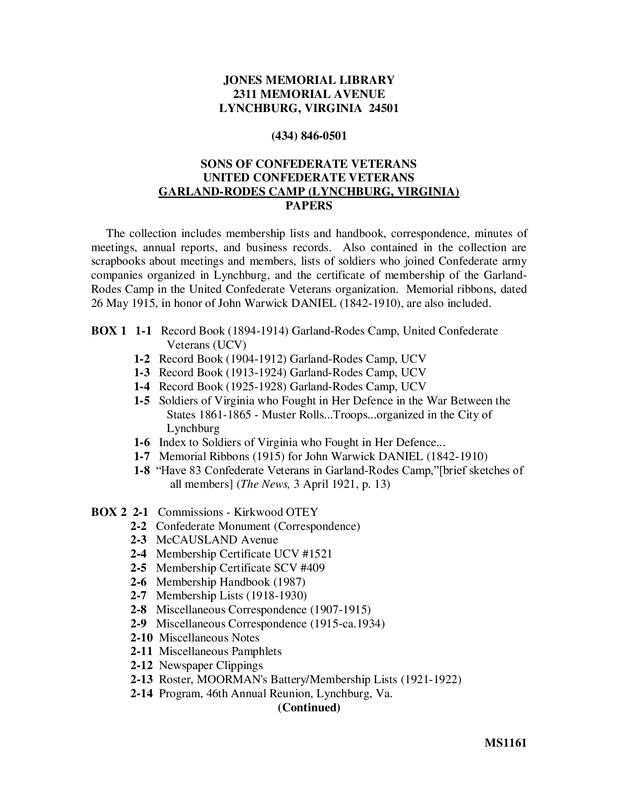
Songs Of Confederate Veterans And United Confederate Veterans Garland-Rodes Camp Papers Held At Jones Memorial Library In Lynchburg, Virginia.
For photographs of the Garland-Rodes Camp members, see the Garland-Rodes Camp Photo Montage (digitized) under the Garland-Rodes Camp of Confederate Veterans ITEM SET.
This paper by Col. William McIntosh titled "Songs from the Wood," focused on the Cherry Tree Carol's origins, symbolism, and cultural journey through music and illustration. McIntosh's speech, enriched by historical slides and audio clips, explores the carol's roots in European folklore, its portrayal in medieval woodcuts, and its depiction in Jeanyee Wong's illustrated book from 1951. He discusses the song's evolution from William Byrd to Jethro Tull and its symbolic representations, emphasizing the transition of the cherry tree's imagery and its speculated significance. The actual paper was not submitted. This summary was written for the minutes.
James R. Caskie's lecture to the SPHEX Club on "Moses and the Law" elucidates the Mosaic Code's depth and relevance. Caskie argues that the laws, often viewed as arbitrary religious commands, were strategically designed to govern a theistic state through democratic principles, ensuring social, moral, and governmental integrity. He emphasizes that the laws, including the iconic Ten Commandments, provided a foundation for individual responsibility and national identity, profoundly influencing subsequent legal systems worldwide.
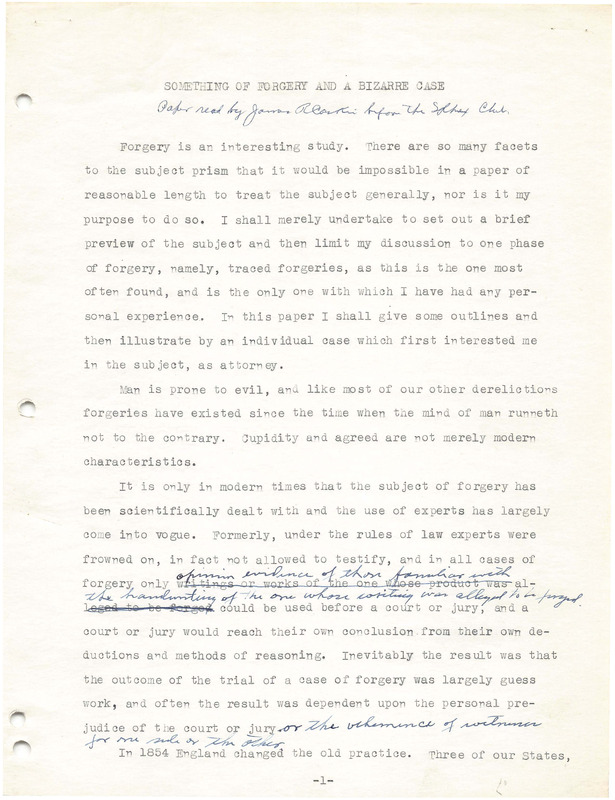
Text of a lecture to the Sphex Club in Lynchburg. Caskie's 1946 paper focuses on traced forgeries, a common type of forgery characterized by close imitation of original signatures. It discusses the role of experts in forgery detection, changes in legal practices regarding expert testimony, and specific features of traced forgeries, illustrated through a case study.
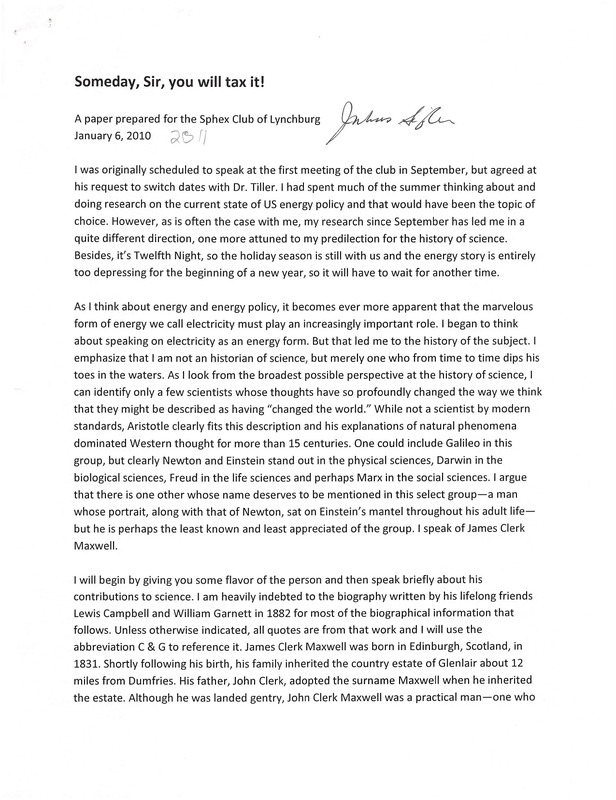
Text of a lecture delivered to the Sphex Club in Lynchburg. This academic paper provides an in-depth exploration of James Clerk Maxwell's life, his groundbreaking contributions to the field of electromagnetism, and the profound impact his work has had on both the scientific community and the world at large. The paper delves into Maxwell's early life, his education, and the evolution of his scientific thought, leading to his development of the four partial differential equations known as Maxwell's equations. These equations fundamentally changed our understanding of electricity, magnetism, and light, predicting the existence of electromagnetic waves beyond those visible to the human eye, thereby laying the groundwork for modern physics and technologies like radio communication. The author emphasizes Maxwell's role as a pivotal figure in science, whose theories have significantly influenced subsequent developments, including Einstein's theory of relativity.