Kenneth R. Garren's paper, "The Beauty of Three," explores the relationship between academic performance and participation in varsity sports, focusing on Division I and III athletes. It highlights that Division III athletes, who receive no financial compensation, are often more academically inclined than Division I athletes. The study also examines graduation rates and academic performance across different sports and institutions, suggesting that high-profile athletes tend to underperform academically compared to non-athletes and lower-profile athletes.
The paper by W. Martin Johnson, titled "To Catch a Fox: The Battles of North Africa in World War II", explores the significant impact of the Allied victory in North Africa on the overall outcome of World War II. It delves into the strategic military maneuvers of Field Marshall Erwin Rommel and the Allied forces, highlighting key battles such as those at El Alamein, Tobruk, and the eventual retreat of Axis forces, culminating in the pivotal turning points that shaped the war's trajectory.
This academic paper, presented by Dr. John T. T. Hundley, delves into the dialectic of "The Art versus the Science of Medicine," exploring how the integration of art and science enhances medical practice. Hundley emphasizes the dangers of a one-sided approach, using the example of penicillin's over-use to illustrate the catastrophic consequences of science without art. He argues for a holistic view of patient care, highlighting the importance of recognizing the patient's broader personal context. The paper suggests a reevaluation of medical objectives, advocating for a balance between prolonging life and improving quality of life, and calls for a modern interpretation of the Hippocratic oath in light of contemporary scientific advancements.
Text of a lecture to the Sphex Club in Lynchburg. The paper examines John Marshall's influential role in defining the powers of the U.S. Supreme Court and shaping American constitutional law. It reviews four landmark opinions and two politically charged trials he participated in, highlighting his interpretation of judicial review, state versus federal authority, and the protection of individual rights. The analysis illustrates Marshall's profound impact on the growth of the United States as a unified nation governed by law.
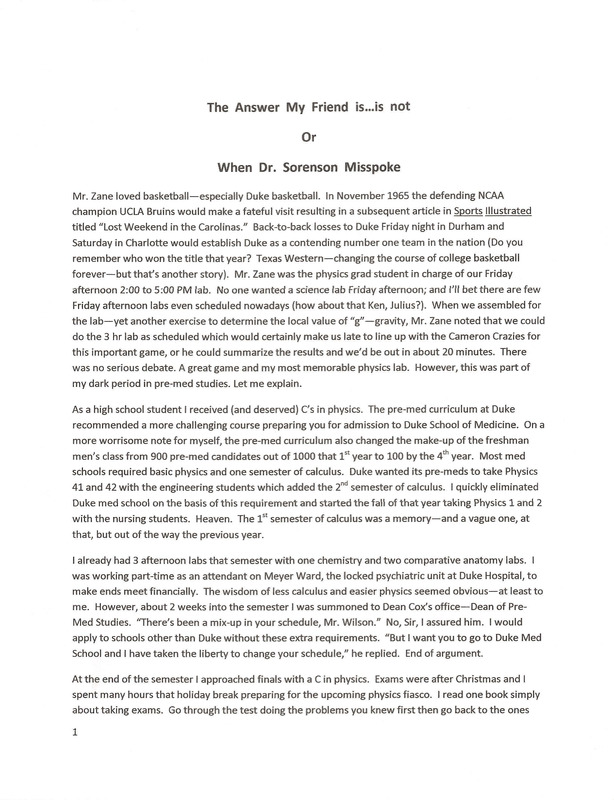
Text of a lectyure to the Sphex Club in Lynchburg. The paper discusses the evolution of a pre-med student's academic journey, focusing on challenges faced in physics and how serendipity played a role in overcoming these hurdles. It highlights memorable events, including a pivotal basketball game, struggles with coursework, and a fortunate grade mix-up. The narrative concludes with reflections on energy resources, particularly renewable energy, and their geopolitical and environmental implications.
Anne Spencer Memorial Foundation, Inc. Papers Held At Jones Memorial Library In Lynchburg, Virginia. The Papers Include Minutes, Photographs, Notes, And Articles About Harlem Renaissance Poet And Lynchburg Resident Anne Spencer.
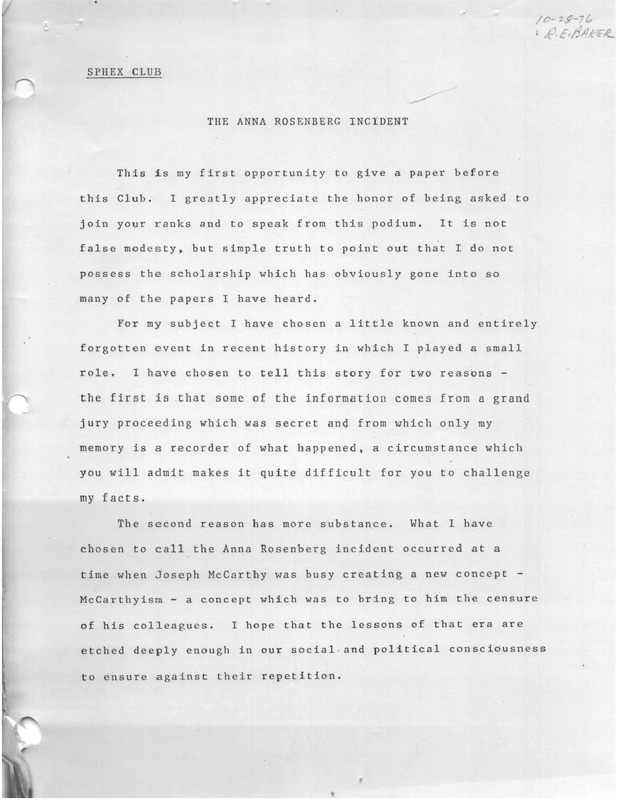
Baker's 1976 paper, the "Anna Rosenberg Incident" details the controversial Senate hearing of Anna M. Rosenberg, nominated for Assistant Secretary of Defense in 1950. Amidst McCarthyism, she faced false accusations of Communist ties, primarily from Ralph De Sola, a self-proclaimed ex-Communist. Despite De Sola's firm accusations, no evidence supported his claims, and investigations, including FBI involvement, refuted them. Rosenberg's integrity was upheld, highlighting the paranoia and injustice characterizing the McCarthy era.
The Ancient Mariner Returns, presented to the SPHEX Club, addresses the escalating problem of water pollution in Virginia's streams, drawing a parallel to the plight of the Ancient Mariner who famously lamented the lack of drinkable water. The paper discusses the historical evolution of stream pollution due to urban and industrial growth, highlights early efforts at water treatment in Virginia, and outlines the successful implementation of policies and technologies by the State Water Control Board and EPA, which significantly restored the water quality of the James River and other streams in less than 40 years. The collaborative approach of Lynchburg City and the Mead Corporation is emphasized as a model for effective pollution management, leading to an era where "The Modern Mariner can now find drinking water everywhere."
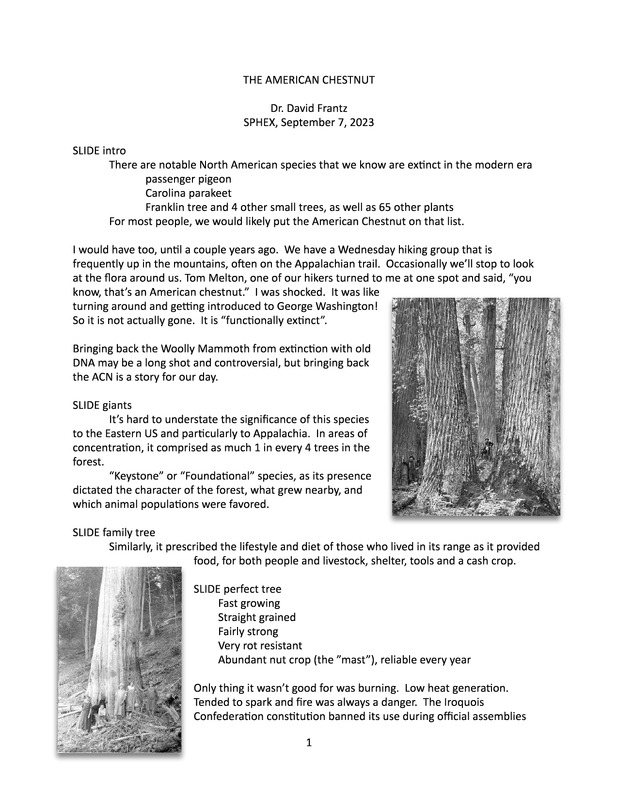
Dr. David Frantz's lecture, "The American Chestnut," discusses the history, significance, and efforts to restore the American Chestnut (ACN). The paper covers the tree's ecological and economic roles, the devastation caused by chestnut blight, and current restoration strategies, including breeding programs and genetic engineering. It highlights the challenges and controversies in reviving this foundational species, emphasizing the potential benefits and ongoing efforts despite opposition.
This paper explores the multifaceted nature of alchemy, debating its identity as a blend of philosophy, charlatanism, early chemistry, and occult knowledge. It argues that alchemy was as much a spiritual and philosophical pursuit as it was a precursor to scientific chemistry, emphasizing the alchemists' quest for enlightenment and the transmutation of base metals into gold as a metaphor for human spiritual transformation. Drawing extensively on "The Arts of the Alchemists" by Dr. C. A. Burland, the paper traces the evolution of alchemy from its mythical origins through its development in the Alexandrian school, its adaptation by Arab scholars, to its eventual decline in Europe with the rise of rational science. It highlights significant contributors to alchemical thought, such as Hermes Trismegistus, Prince Khalid, Roger Bacon, and Nicholas Flamel, and discusses the transition of alchemy into modern scientific disciplines.
The academic paper titled "The Adventures of Thomas Jefferson Snodgrass" by Jeffrey Nichols explores the architectural and personal connections between Thomas Jefferson and Mark Twain, focusing on their respective octagonal houses at Poplar Forest and Hartford, Connecticut. It discusses Jefferson's use of Poplar Forest as a retreat and its significance as potentially the first octagonal house in the U.S., alongside Twain's octagonal study where he penned his famous works. The paper highlights the contrasting personalities and philosophies of Jefferson and Twain through anecdotes and quotes, illustrating their lasting impact on American culture.