Herbert R. Moore's paper "The Deluxe Mix-Master," recounts his personal experiences and highlights the impact of the National Conference for Community and Justice (NCCJ) in promoting racial, religious, and cultural harmony. Moore shares anecdotes from his life, including hosting Reverend Jesse Jackson and addressing membership issues related to race at his church, to illustrate the importance of understanding and respect among diverse communities. He discusses NCCJ's history, from its inception in 1927 to address bias and bigotry, to its contemporary efforts like Metrotown and Unitown programs that engage youth in dialogue about prejudice and acceptance. The paper emphasizes NCCJ's role in facilitating community cohesion through education, advocacy, and action, reflecting Moore's dedication to social justice and ecumenical ministry.
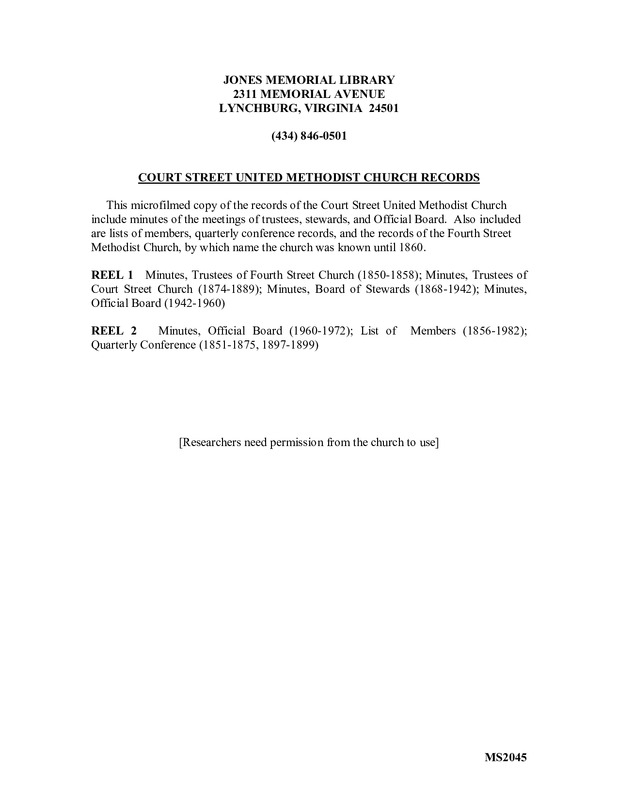
Court Street United Methodist Church Records Held On Microfilm At Jones Memorial Library In Lynchburg, Virginia. Records Include Board Meeting Minutes And Lists Of Members.
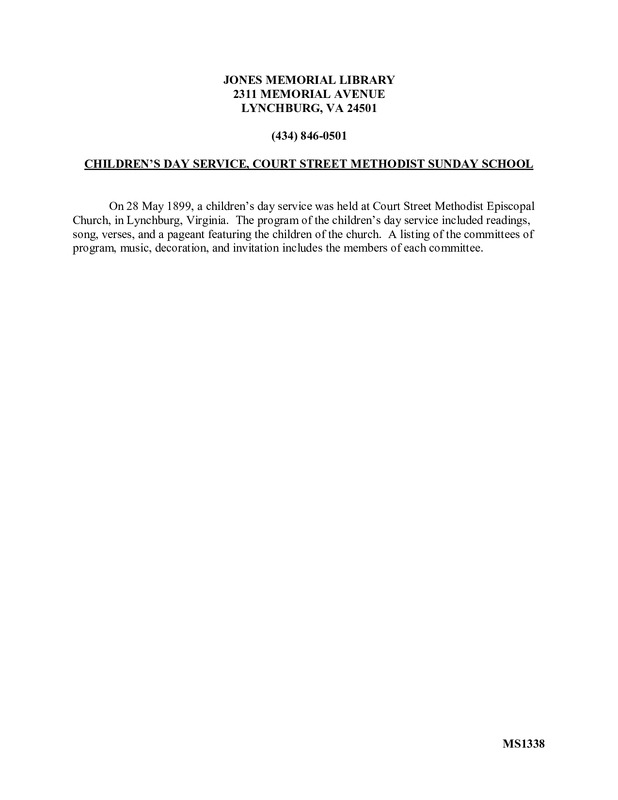
Children'S Day Service Program Held At Court Street Methodist Episcopal Church. The 1899 Program Is Held At Jones Memorial Library In Lynchburg, Virginia.
Peter Houck's lecture, "The Copper Commodity Market, Ca. 1600," presented on November 15, 1990, delves into the historical and economic significance of copper trade among the Native American tribes, particularly the Monacans, and its impact on the survival and economic strategies of early Jamestown colonists. Houck explores the advanced trade networks that existed among indigenous tribes, extending beyond the Virginia Piedmont, and how these networks included commodities like copper, valued both for practical and ceremonial uses. Houck asserts that copper played a pivotal role in the dynamics of Native American-European relations, influencing both cultural exchanges and conflicts. Houck challenges traditional narratives, emphasizing economic motives over romanticized historical interpretations, and sheds light on the Monacans' strategic use of copper as a trading asset.
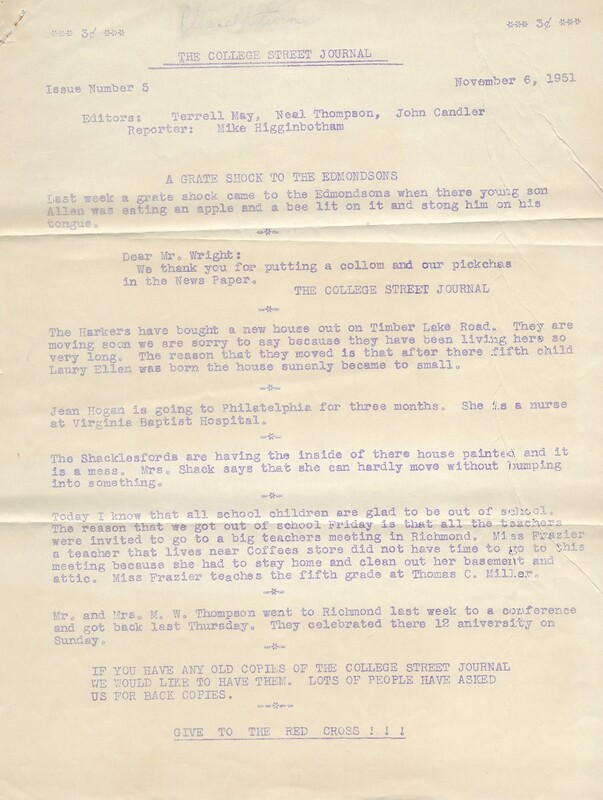
Images of three page issue of The College Street Journal. Issue number 5 for 06 November 1951. The College Street Journal was a mimeographed neighborhood newspaper issued by four Lynchburg children in the 1950s. The paper had more than 100 subscribers. This issue is part of Manuscript collection 1409 held at Jones Memorial Library in Lynchburg, Virginia.
Classmate And Card Album Held At Jones Memorial Library In Lynchburg, Virginia. The Album Contains 23 Classmate Visiting Cards From The 1930S Or 1940S.
Church Of The Holy Cross Records Held On Microfilm At Jones Memorial Library In Lynchburg, Virginia. The Records Include Registers Of Marriages And Births.
Christopher Mciver Accounts Collection Of Notes From 1838-1860 For A Tailor Or Clothing Merchant Firm Known As 'Mciver And Love' Or 'Mciver And Tinsley'
The paper, "THE CHINESE STARTED IT," presented by Cranston Williams, discusses the history of papermaking from its origins in China to its development in Virginia and the southern United States. It details the technological advancements in the industry and highlights the significant role of Dr. Charles H. Herty in developing newsprint from Southern pine, revolutionizing the paper industry in the South.
The paper "The Cerberus Was A Spy" by George T. Stewart narrates the life of Moe Berg, a Jewish baseball player who became a spy. It recounts historical events and Berg's remarkable intelligence work during WWII, highlighting his linguistic skills, contributions to atomic research espionage, and role in the defeat of the Axis powers.