This academic paper presented by Dr. Paul McKendrick explores the issue of income inequality, particularly its effects on educational outcomes and the well-being of children in poor families. McKendrick discusses the widening wealth gap, its historical context, and its impact on various societal aspects such as health, education, and social mobility. He highlights the importance of addressing income inequality through policy and community efforts to improve the lives of the impoverished, especially children, who suffer disproportionate effects. The paper emphasizes strategies that have succeeded in improving educational outcomes for at-risk students, advocating for the creation of caring, inclusive communities that support all children's academic and social development.
The paper discusses the nature of fads, their life cycles, and their impact on society. Sorenson uses various examples, including the Atkins diet and Beanie Babies, to illustrate the phases of a fad—emergence, rapid growth, and decline. He also examines social media phenomena like Facebook and Twitter, questioning whether they are enduring innovations or fleeting fads.
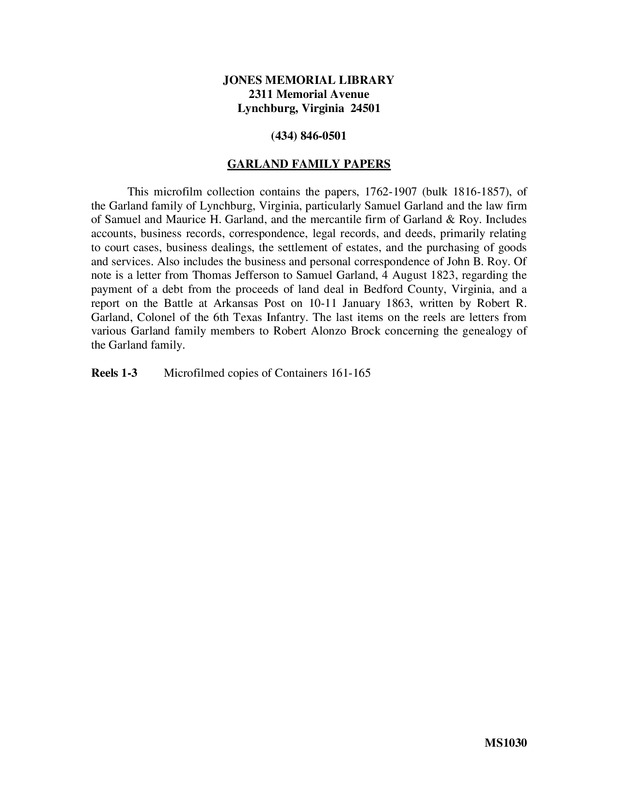
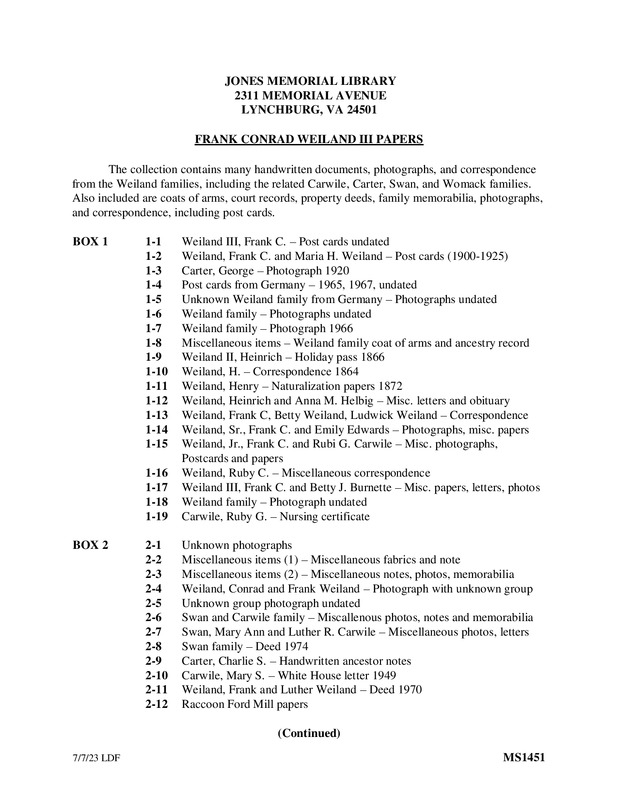
Frank Conrad Weiland Papers Held At Jones Memorial Library.
The Papers Include Photographs, Correspondence, And Documents Related To The Weiland, Swan, Carter, And Carwile Families Of Lynchburg, Virginia.
James A. Huston explains that the fourth letter in SPHEX is E for Education. He then proceeds to discuss sixteen mistakes (see Keywords) in beliefs, rules and practices that have weakened education in the United States. Huston believes these mistaken policies have put us behind many other countries and in many cases have endangered our school children. Huston suggests that we move away from the current “faddism” in education.
The paper delves into the historical significance and economic implications of the first iron furnace in America, located on Falling Creek, Virginia. It explores Virginia's pivotal role in iron production during various American conflicts and its influence on the economy, especially during reconstruction and World Wars. The paper discusses the challenges and developments in iron manufacturing, from early colonial efforts thwarted by Native American attacks to the establishment of successful ironworks, reflecting on the broader historical and economic impacts of iron and steel in America.