This academic paper provides a comprehensive overview of the Hermitage Museum in Leningrad (now Saint Petersburg), detailing its history, architectural evolution, and the vast and diverse collections it houses. James B. Noell discusses the museum's founding by Catherine II in 1764, its expansion over the centuries, and its role in cultural preservation and education. He highlights the museum's impressive array of art from various periods and regions, including works by Leonardo da Vinci, Raphael, and Rembrandt, as well as significant collections of Egyptian, Greek, Roman, and Oriental art. Noell emphasizes the Hermitage's importance as a repository of human history and creativity, showcasing its role in both Russian and global cultural heritage.
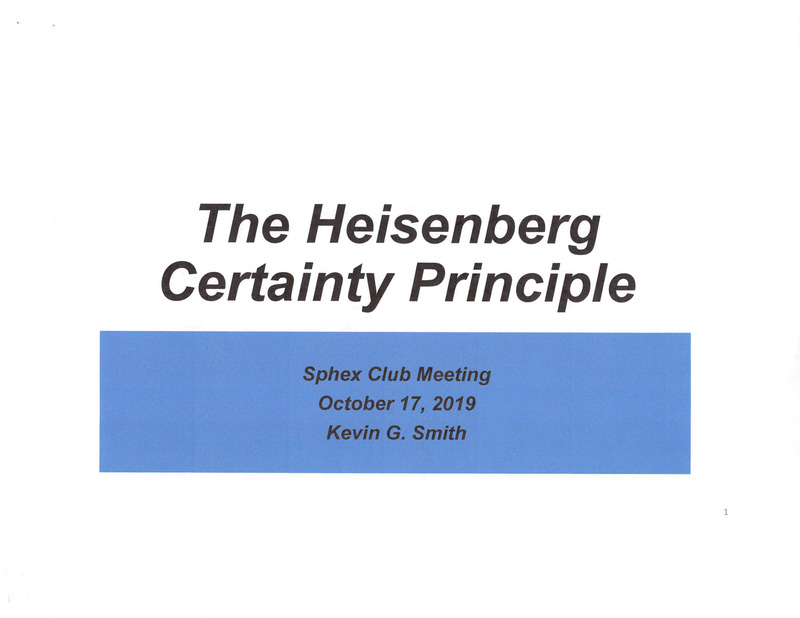
Text of a lecture delivered to the Sphex Club in Lynchburg. The Heisenberg Certainty Principle by Kevin Smith delves into the paradoxical legacy of Werner Heisenberg, juxtaposing his monumental contributions to quantum physics, notably the uncertainty principle, against his involvement in Nazi Germany's atomic bomb project. It narrates the intriguing encounter between Heisenberg and Morris Berg, an American Jewish baseball player turned spy, who assessed Heisenberg's progress on the atomic bomb for the Allies. This meeting, set against the dire backdrop of WWII, underscores the complexities of science, espionage, and moral decisions in wartime. The paper is structured around the contrasting lives of Heisenberg and Berg, their respective achievements, and the pivotal Zurich meeting that decided Heisenberg's fate.
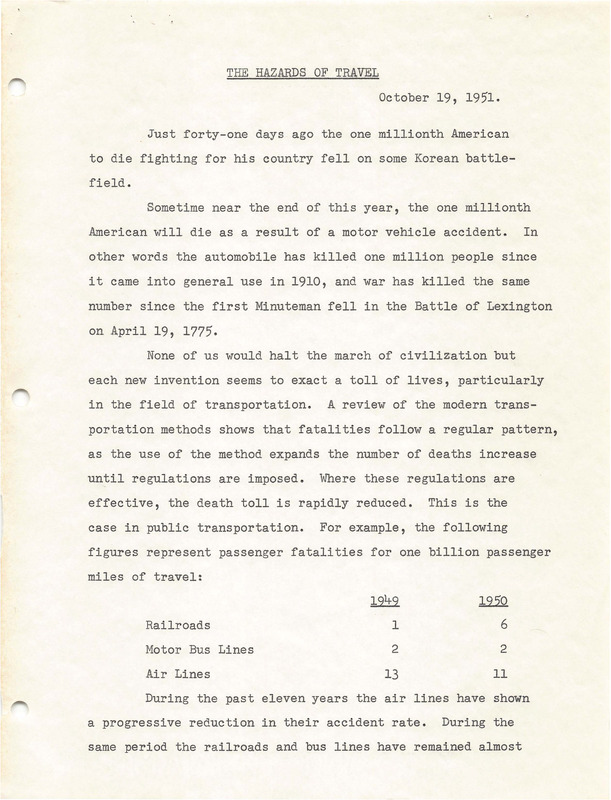
Text of a lecture to the Sphex Club in Lynchburg. The paper, "The Hazards of Travel," traces the history and evolution of transportation-related accidents and regulatory responses in the U.S., with a focus on steamboats and railways from the early 19th century to the mid-20th century. It discusses the progression of accidents as transportation methods developed and became more widely used, emphasizing the significant reduction in fatalities due to effective regulations and technological improvements. The paper also touches upon contemporary issues related to automobile safety and public perception of transportation risks.
This paper by Elisabeth Muhlenfeld explores the origins and evolution of Sweet Briar College, emphasizing its pioneering role in women's education. Beginning with the history of Elijah Fletcher and his family's values, Muhlenfeld narrates how Indiana Fletcher Williams founded the college in memory of her daughter Daisy. The paper discusses the challenges and innovations of early women's higher education, contrasting traditional methods with Sweet Briar's contemporary, integrative approach. It highlights the college's commitment to a liberal arts education, student government, and the significant role of faculty and students in shaping its culture. Muhlenfeld concludes by reflecting on the college's adaptability to societal changes over a century, maintaining its mission and single-sex status.
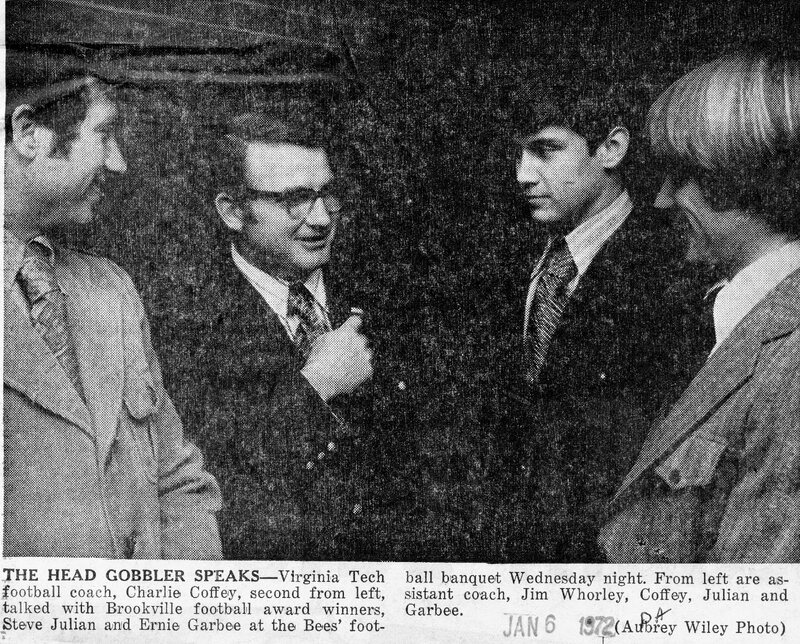
Dr. Huston recalls his young peers who before high school created an athletic club that had no adult direction or supervision and no financial support. The teams they created were competitive in many sports, even playing in national championships. The author's final message is “give the game back to the kids.” He concludes by discussing Division III, non-scholarship college sports.
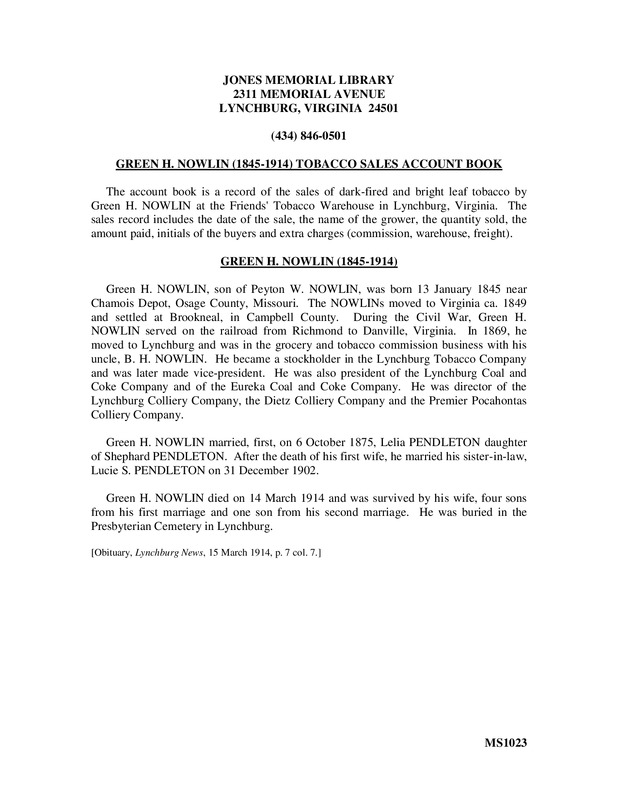
Green H. Nowling (1845-1914) Tobacco Sales Account Book. The Account Book Is A Record Of The Sales Of Dark-Fired And Bright Leaf Tobacco By Green H. Nowlin At The Friends' Tobacco Warehouse In Lynchburg, Virginia. The Sales Record Includes The Date Of The Sale, The Name Of The Grower, The Quantity Sold, The Amount Paid, Initials Of The Buyers And Extra Charges (Commission, Warehouse, Freight).
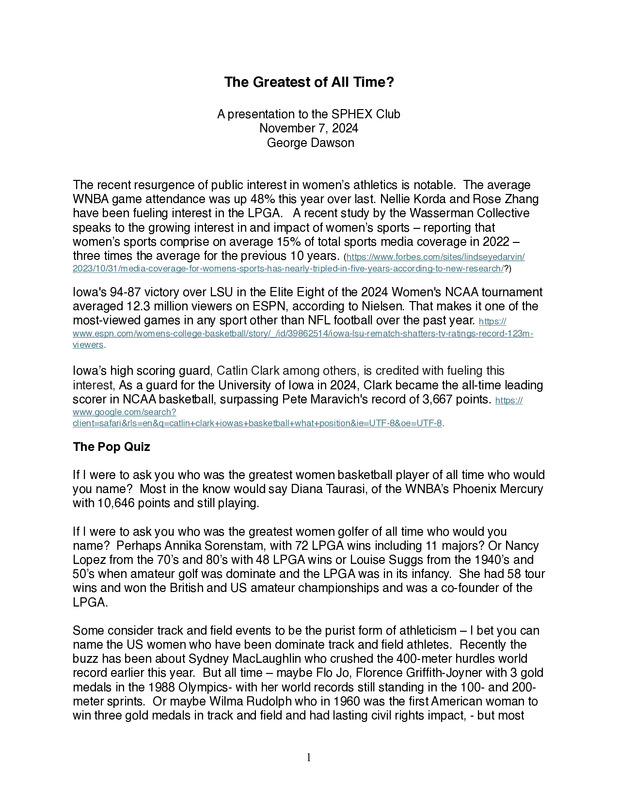
On November 7, 2024, George Dawson reflected on the history of women’s athletics through the life of Babe Didrikson Zaharias. Dawson highlighted Didrikson’s groundbreaking achievements, societal resistance to female athletes, and her controversial persona. Framed by contemporary sports milestones, the talk examined barriers faced by women in competitive sports and celebrated Didrikson’s enduring legacy as a dominant, complex, and record-breaking athlete.
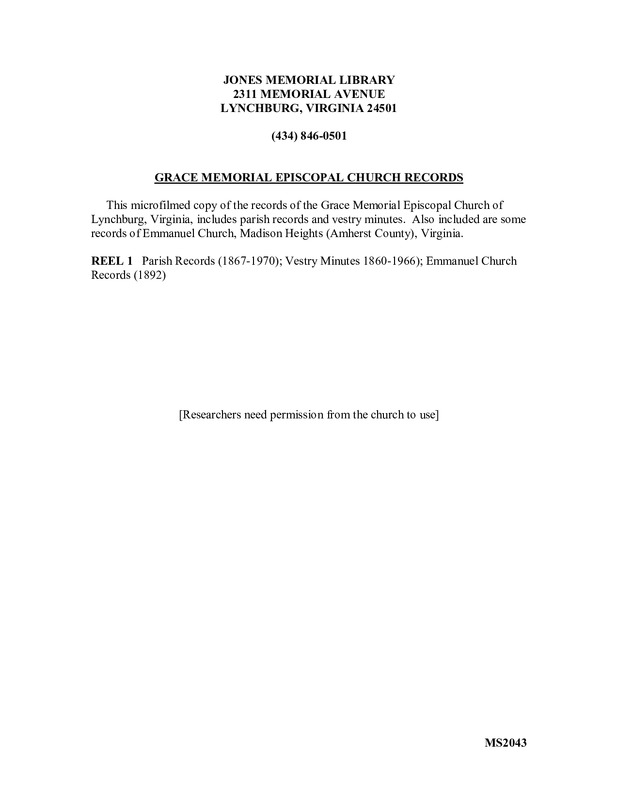
Grace Memorial Episcopal Church Records Held On Microfilm At Jones Memorial Library In Lynchburg, Virginia The Records Include Minutes And Parish Records.
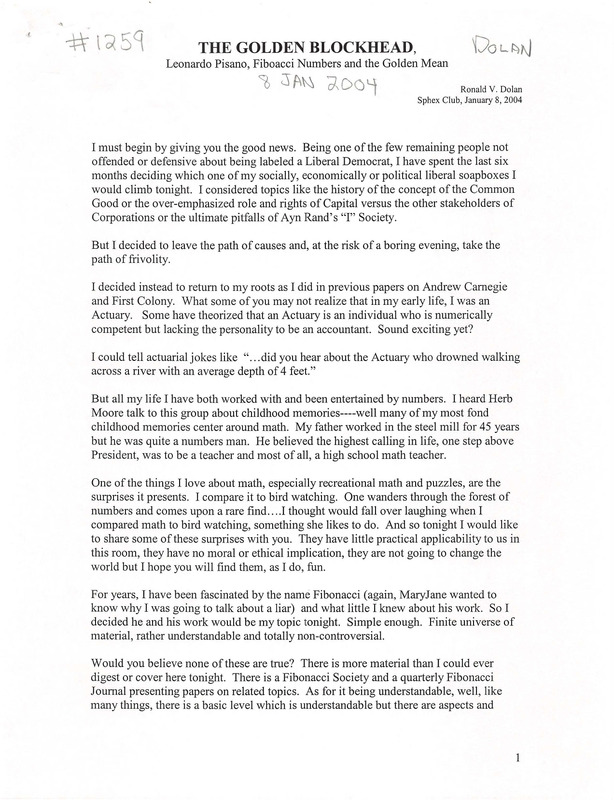
This paper, presented by Ronald V. Dolan to the Sphex Club on January 8, 2004, explores the fascinating and multifaceted concept of the Fibonacci sequence and the Golden Ratio. Dolan discusses their historical origins, mathematical properties, and diverse occurrences in nature, art, and human creativity. The paper blends mathematical rigor with anecdotes and historical context, aiming to entertain and educate about these mathematical marvels.
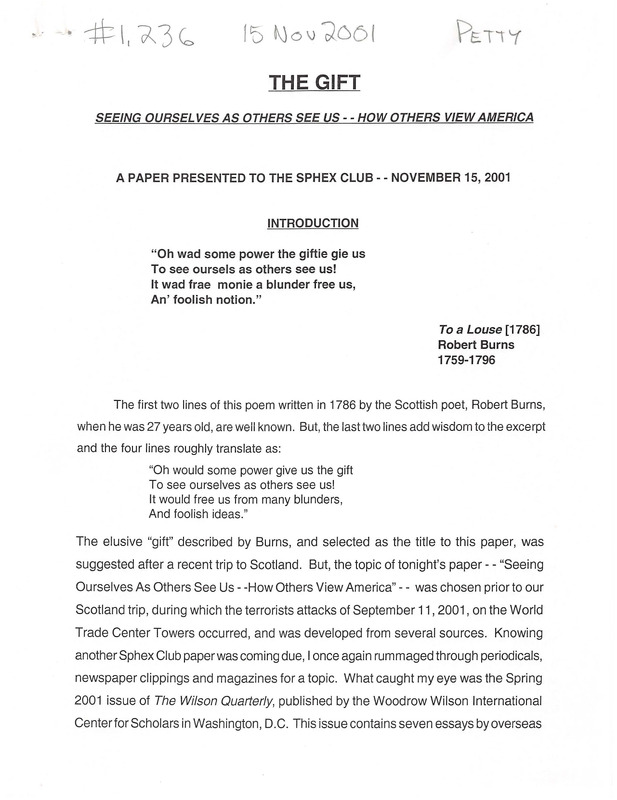
Text of a lecture delivered to the Sphex Club in Lynchburg. This academic paper by David T. Petty, Jr. delves into the complexities of how the world views America, emphasizing the paradox of global admiration and resentment towards U.S. culture and policies. Petty leverages a plethora of international perspectives, showcasing the dichotomy between the global embrace of American pop culture and the simultaneous disdain for American geopolitical actions. The paper intricately explores the multifaceted nature of international opinions on America, rooted in historical contexts and contemporary global events, particularly the aftermath of the September 11 attacks, highlighting a unified American identity against terrorism. This exploration is not only academically rich but also timely, reflecting on the evolving global landscape and America's place within it.