Text of a lecture delivered to the Sphex Club in Lynchburg. The paper by Sterling Allen Wilder, titled "The Lost Boys," discusses the educational and social challenges faced by young African American males, focusing on the Fourth Grade Failure Syndrome and its long-term effects. The paper examines the decline in academic performance, systemic biases, lack of male role models, and socio-economic factors contributing to the underachievement and high incarceration rates of African American males. It calls for educational reform, increased male role models, and community involvement to address these issues.
Text of a lecture delivered to the Sphex Club of Lynchburg. In "The Look, A Savannah Girl's View," Mrs. Langhorne reflects on her life experiences and observations, covering a range of topics from racial issues to historical events. She discusses her role in breaking the glass ceiling as Chair of the Lynchburg School Board, the controversies surrounding Ralph Northam and historical racism at Valparaiso University, and concludes with her views on the display of the Confederate flag at the Lynchburg Museum and her family's history in the Civil War.
This paper explores the life of Cassius Marcellus Clay, a prominent 19th-century abolitionist from Kentucky. It discusses his education, political career, and his fierce opposition to slavery. Notable events include his fiery abolitionist speeches, duels, and founding of the anti-slavery newspaper, The True American. The paper also covers his diplomatic service in Russia and later years marked by personal turmoil.
Text of a lecture to the Sphex Club of Lynchburg. Robert Chambliss Light, Jr.'s lecture, titled "The Lion and the Fox," delves into the dynamics of acquiring power through the lens of historical figures Huey Long and Robert Moses, contrasting their paths to influence. Light explores Long's political maneuvering in Louisiana and Moses's non-elected authority in New York, showcasing their unique strategies and impacts. Drawing from T. Harry Williams and Robert Caro's biographies, the lecture presents these figures as embodiments of Machiavellian principles, highlighting their charismatic, yet ruthless pursuit of power. Light concludes by reflecting on the multifaceted nature of power acquisition and its dependence on individual cunning and circumstance.
Robert Wimer presents a biographical Sketch of Carter Glass (1858-1946) of Lynchburg. The owner of Lynchburg’s newspapers, Glass also spent 44 years in Washington D.C. Glass was known for “ferociously assailing his opponents,” and he always put personal convictions above party loyalty. After covering a wide range of contributions (for better and worse) that Glass made, Wimer explains the times that Glass lived in and then discusses his racism and lack of willingness to compromise.
Julie P. Doyle's paper explores the world of competitive rock climbing, driven by her daughter's passion for the sport. It details the history of rock climbing, from its origins tied to mountaineering and egg poaching to its evolution as an independent sport. Key topics include the development of climbing techniques, the impact of World War II, prominent climbers like Royal Robbins and Yvon Chouinard, and the distinctions between traditional and sport climbing.
Text of a lecture delivered to the Sphex Club in Lynchburg. This paper by Marc A. Schewel explores Elvis Presley's enduring influence on American culture, politics, and music, highlighting his role in the 1992 postage stamp election, the impact of his performances and persona on societal norms and values, and his posthumous legacy as a cultural icon that transcends music, impacting political imagery and fan communities.
Robert Wimer begins by explaining how the village of Amherst “had become so poisoned that other localities were making it a laughing stock.” A central character in Amherst’s history was Judge Clarence J. Campbell who ruled with an iron fist. Lawlessness abounded and Judge Campbell was a central figure in this lawlessness. Wimer vividly describes the court trials Campbell faced in the early 1900s and the outcomes. Campbell’s opponents passed prohibition and helped Amherst become an incorporated town.
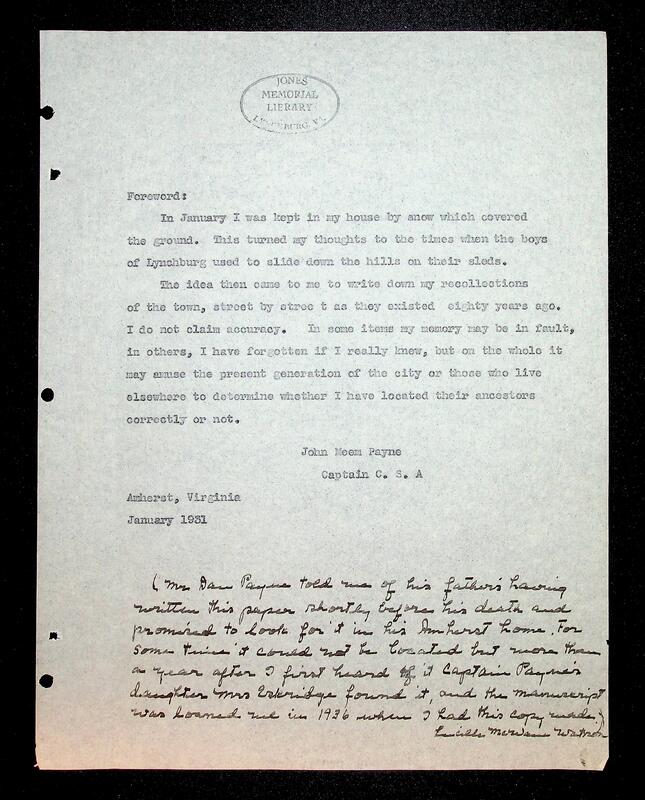
John Meem Payne Recollections Of Lynchburg Held At Jones Memorial Library In Lynchburg, Virginia. The Collection Includes Reminiscences About Lynchburg Prior To The U.S. Civil War.