The Rocky Road to Fame by Joan Jones chronicles the extraordinary life and pioneering work of William Smith, who created the world's first geological map of England and Wales in 1815. This detailed narrative explores Smith's humble beginnings, his innate curiosity about the natural world, and his monumental solo effort in producing a geological map that laid the foundations for the science of geology. Despite facing numerous challenges, including financial ruin and lack of recognition from the scientific community of his time, Smith's work eventually earned him acclaim and the prestigious Wollaston Medal. His story is a testament to the impact of individual dedication and vision in advancing scientific knowledge.
Text of a lecture to the Sphex Club in Lynchburg. A history of the building and financing of Virginia's highway system, with attention to effort to complete a north-south highway through the central portion of the state.
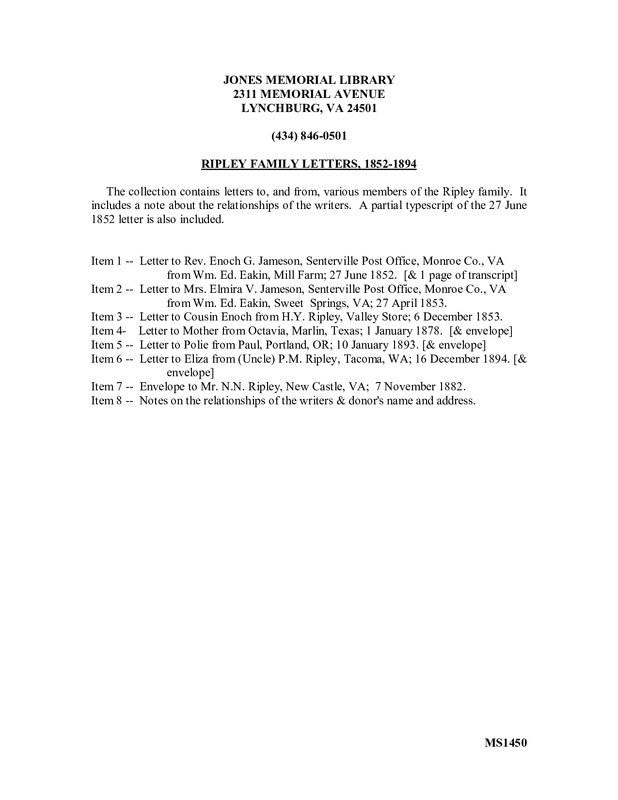
Ripley Family Letters Held At Jones Memorial Library In Lynchburg, Virginia.
The Letters Are To And From Family Members Of The Ripley Family Of Lynchburg Dating Between 1862-1894.
This follows up the 2001 Sphex presentation called “The Second California Gold Rush.” After reviewing the story of a ship filled with gold and people fatally sinking in 1857, a follow up tells the unusual if not bizarre ending of the adventure or “the rest of the story.”
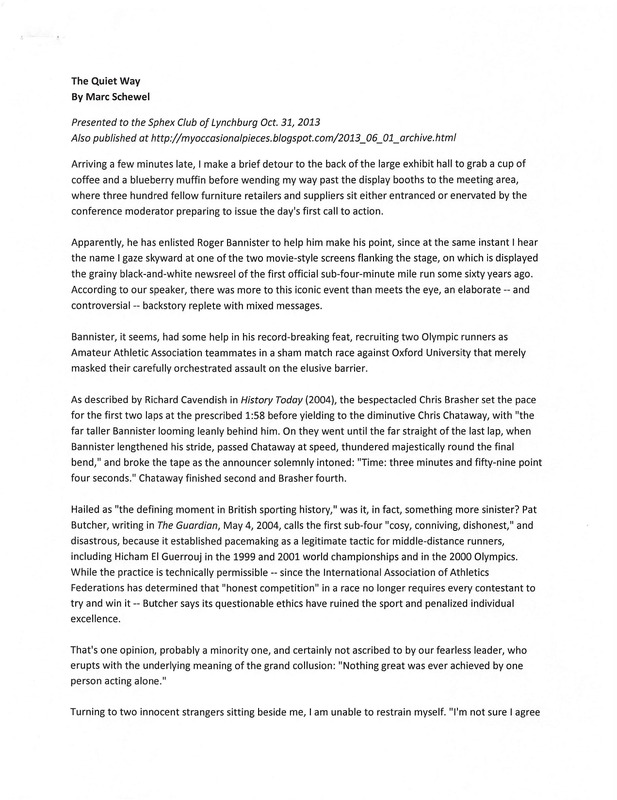
Text of a lecture delivered to the Sphex Club in Lynchburg. Marc Schewel's "The Quiet Way," critically examines the cultural bias towards extroversion in American society, juxtaposing it with the value of introversion. Schewel argues against the pervasive belief in the superiority of teamwork and extroversion for creativity and success, using historical and contemporary examples, including Roger Bannister's sub-four-minute mile and Steve Wozniak's creation of the Apple computer. The paper highlights the contributions of introverts to innovation and leadership, supported by research suggesting that solitude and deep work foster greater creativity and problem-solving than group work.
The paper delves into the ethical, legal, and personal aspects of medically assisted suicide, leveraging the philosophical and cultural backdrop of Hamlet's soliloquy to explore the complexity of choosing death over life in the face of unbearable suffering. It provides a comprehensive overview of the topic, including terminological clarifications, historical and current legal statuses, and various perspectives on euthanasia and assisted suicide. The author critically examines arguments for and against the legalization of physician-assisted suicide, reflecting on the implications for society, the medical profession, and individual autonomy. The paper concludes by contemplating the profound moral and existential questions surrounding the right to die, suggesting that these issues transcend institutional answers and resonate deeply with personal conscience and humanity's quest for dignity in death.
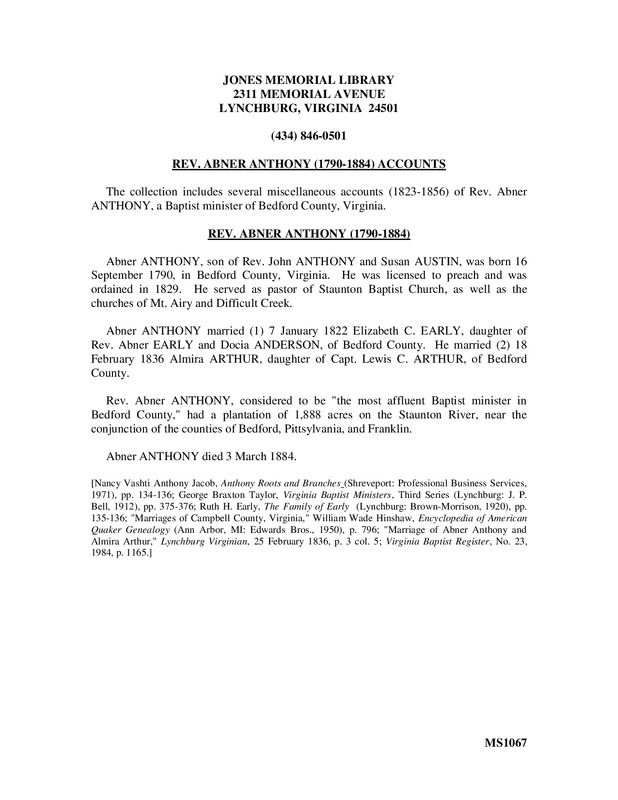
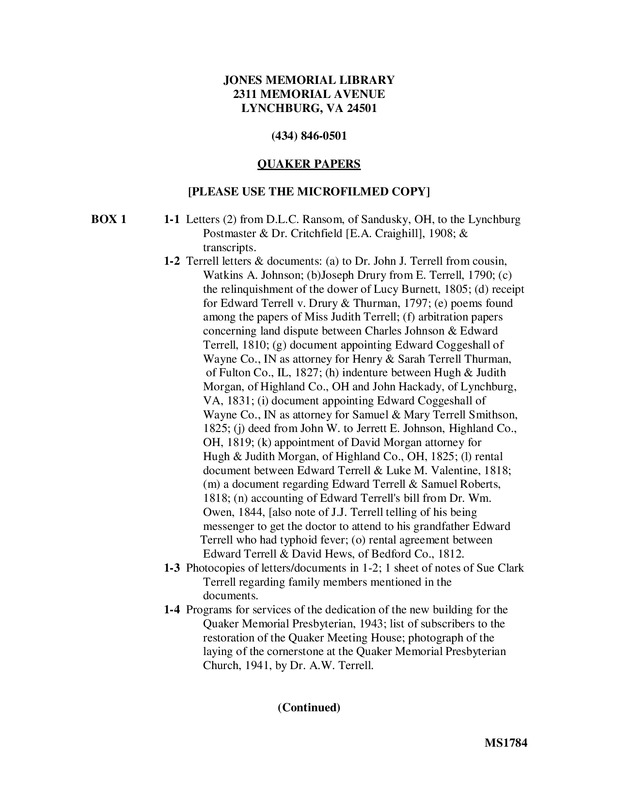
Quaker Papers Held At Jones Memorial Library In Lynchburg, Virginia. The Papers Include Correspondence And Documents Related To The Quaker Memorial Presbyterian Church, Dr. John J. Terrell, And The South River Burying Ground. Papers Are Held In Printed And Microfilmed Formats.
Julie Doyle's paper, "The Pursuit of Champagne, Faïence and a Renoir Madame," explores her family history and connections to Henriot Champagne, Quimper pottery, and Renoir's portrait of Madame Henriot. Doyle undertakes a trip to France with family members to investigate these ties, discovering historical details about her ancestors and the Henriot namesakes. Despite finding no direct familial connection, she uncovers enriching stories and deepens her appreciation for her heritage.
Text of a lecture to the Sphex Club in Lynchburg. A discussion of the relative merits of the fair value procedure and the prudent investment theory of rate regulation of public utilities.
This paper, delivered by Joe B. Linker, Jr., explores the ancient game of GO, highlighting its historical origins, strategic depth, and significance beyond mere entertainment. Linker draws parallels between GO's principles and the strategic maneuvers in the Communist Revolution in China, emphasizing how the game serves as a model for understanding military and political strategies in the Far East. The paper underscores GO's status as the greatest strategic game, its influence on military tactics, and its role in intellectual culture, particularly in China and Japan. By analyzing the Communist Revolution through the lens of GO, Linker suggests that Western misunderstandings of Eastern strategies could be mitigated by studying this game.
Joan F. Foster's paper "The Promise" discusses the transformative impact of "Promise Communities" in America over the past decade. These communities, including cities like Kalamazoo, El Dorado, Denver, Pittsburgh, and Lynchburg, have implemented place-based scholarship programs to enhance educational attainment and economic development. The paper examines the historical context, implementation, and positive outcomes of these initiatives, emphasizing improvements in graduation rates, college enrollment, and local economic growth.
Text of a lecture delivered to the Sphex Club in Lynchburg. The paper discusses the complex and often politically charged process of nominating justices to the Supreme Court, highlighting the significant influence such nominations have on the judicial and political landscape of the United States. It delves into the historical development of the Supreme Court, the evolving role of justices, and the contentious nature of recent nominations. The paper emphasizes the balance between judicial independence and the ideological leanings of nominees, reflecting on how past justices have sometimes defied the expectations of the presidents who appointed them. It also explores the concepts of judicial activism and conservatism, examining how these philosophies impact the Court's decisions and its interaction with broader societal and constitutional issues.
Proceedings Of The Trustees Of The Town Of Lynchburg Held At Jones Memorial Library In Lynchburg, Virginia. The Microfilmed Collection Includes Minutes And Proceedings Spanning From 1787 To 1836.
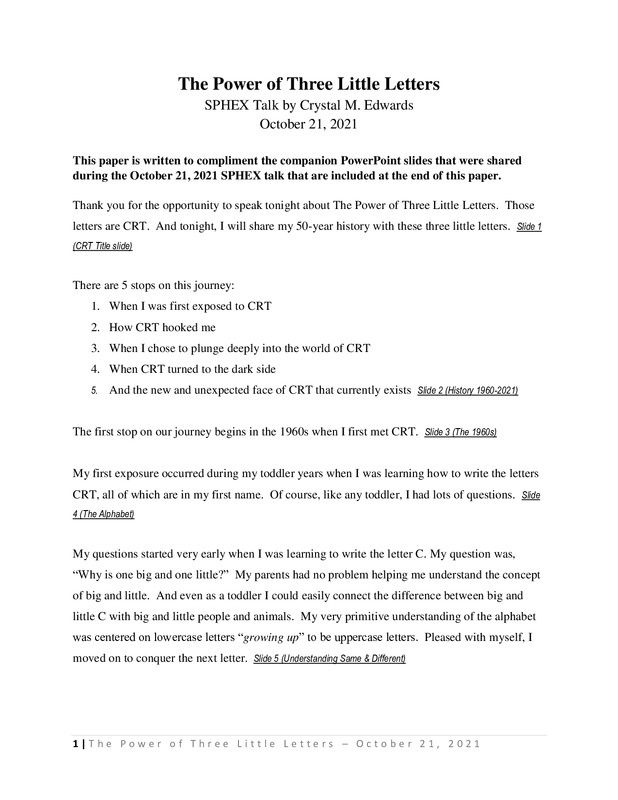
Dr. Edwards' presentation "The Power of Three Little Letters," examined her lifelong journey with the acronym CRT, from its simple beginnings in childhood letter tracing to its complex roles in education, technology, and social justice. The talk delved into the various interpretations and impacts of CRT, including its use in STEM, culturally responsive teaching, critical race theory debates, and the adaptation to COVID-19 challenges in schools.