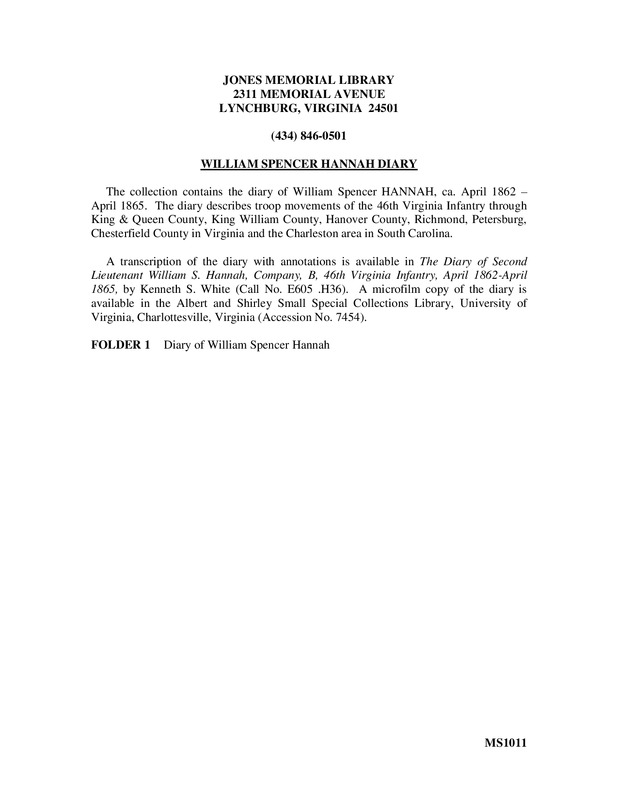
Diary Of William Spencer Hannah. Hannah's diary covers the period April 1862 to April 1865 and describes troop movements of the 46th Virginia Infantry during the U.S. Civil War.
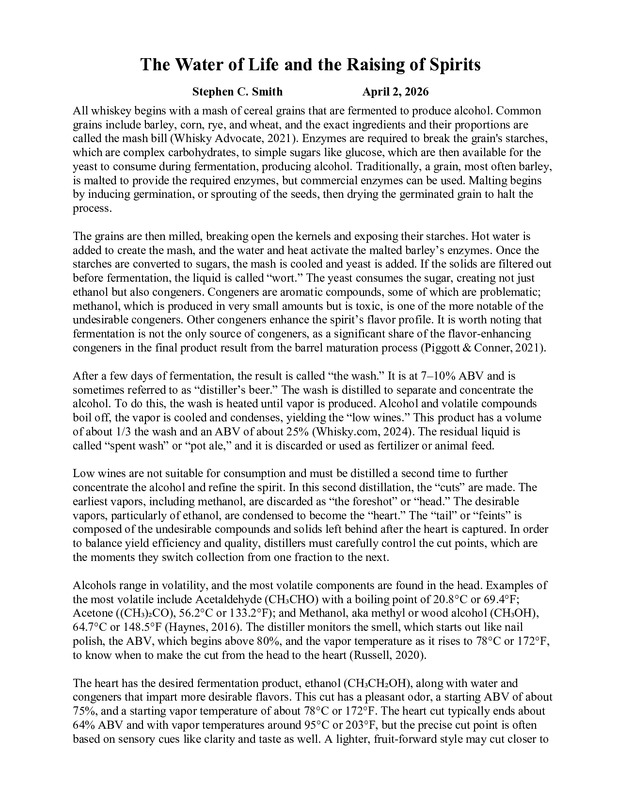
Text of a lecture delivered to the Sphex Club on April 2, 2026. Stephen C. Smith presents a comprehensive overview of whiskey production, classification, and terminology, while comparing whiskey to other distilled spirits such as vodka, gin, tequila, rum, and brandy. He explains the science of fermentation, distillation, and barrel aging, including mash bills, congeners, pot versus column stills, and the effects of oak maturation. The paper details the legal and cultural distinctions among major whiskey styles, including bourbon, Tennessee whiskey, rye whiskey, Irish whiskey, Scotch whisky, Canadian whisky, and Japanese whisky. Smith emphasizes how regulations governing ingredients, distillation proofs, aging requirements, and labeling shape each spirit’s flavor and identity. He also explores concepts such as bottled-in-bond, cask strength, single malt, and double-oaked whiskey. Ultimately, the talk demonstrates how tradition, chemistry, geography, and law combine to create the diverse “water of life.”
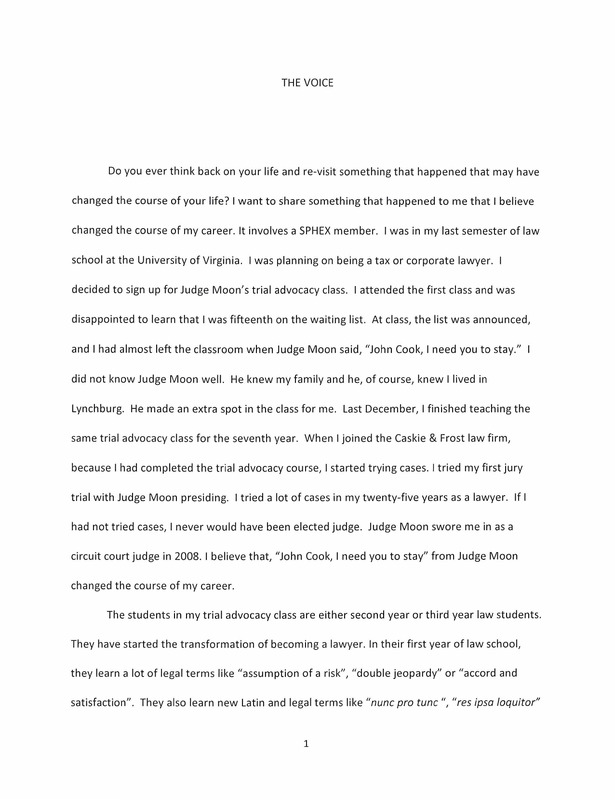
The paper reflects on a pivotal personal experience of the author involving Judge Moon and a trial advocacy class that altered the course of the author's legal career, leading him from aspiring tax or corporate lawyer to circuit court judge. The narrative expands into an in-depth exploration of teaching methodologies in the trial advocacy class at the University of Virginia, emphasizing the integration of legal, Latin terms, and rhetorical skills focused on ethos, pathos, and logos. Judge Cook then discussed at length the life and impact of Frederick Douglass, with an emphasis on the power of Frederick Douglass’s rhetoric to educate and inspire law students.
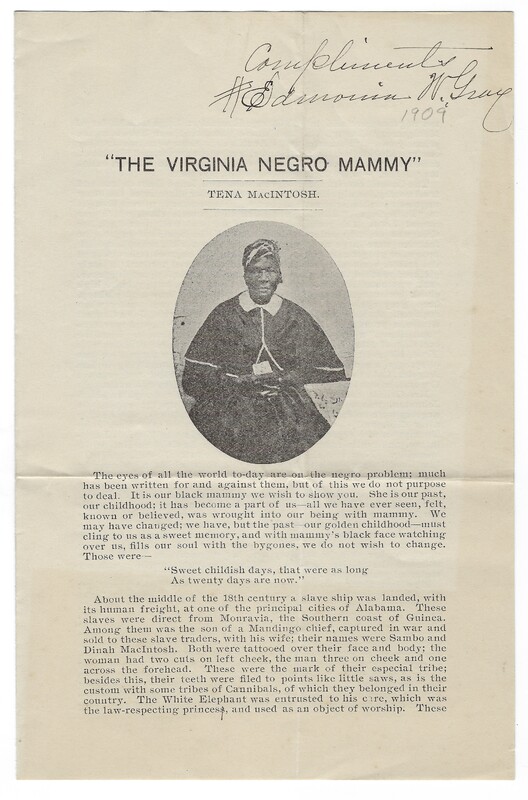
Scanned images of printed pamphlet entitled "The Virginia Negro Mammy": Tena MacIntosh by Edmonia Woltz Gray.
This four page pamphlet was printed around 1909 by Gray in Roanoke, Virginia. Accompanying the pamphlet is a letter from Gray on 14 November 1909 to W.M. Black, Librarian of the Jones Memorial Library in Lynchburg, Virginia.
The pamphlet was written as a biography of Tena MacIntosh, an enslaved woman who lived in Montgomery County, Virginia. MacIntosh was enslaved by George Hancock at Fotheringay.
Gray's publication is referenced in a biography by Dale MacAllister, "Lucy Frances Simms : from slavery to revered public service" held at the Library of Virginia. The pamphlet appears to have been acquired by the Library of Virginia in 1910 and may also be held in their collection.
The pamphlet and letter are held in original print and handwritten physical formats at the Jones Memorial Library in Lynchburg, Virginia.
This paper, presented by Richard P. Gifford, explores the impact of Vikings on history. It covers their origins, raids, and settlements across Europe and beyond. Gifford argues that Vikings were catalysts in shaping Western civilization, highlighting their roles as traders, settlers, and organizers. The paper underscores the Vikings' influence on regions like England, Iceland, and Russia, emphasizing their enduring legacy.
James R. Caskie's paper revisits James R. Caskie's review of Walker Lewis' legal analysis of the John Peter Zenger trial, which played a pivotal role in establishing freedom of the press in the American colonies. The paper, originally tailored for lawyers, is simplified for a broader audience, emphasizing Zenger's battle against the corrupt Royal Governor William Crosby in 1734-1735, who abused his power to suppress true but critical publications.
Judge William W. Sweeney's paper, "The Trial of Christ," details the historical and judicial context of Jesus Christ's trial, emphasizing its illegality and the influences of Roman and Hebrew laws. The paper explains the procedural flaws and political pressures that led to Jesus' crucifixion, highlighting key events like the cleansing of the temple, the role of the Sanhedrin, and Pilate's reluctant involvement.