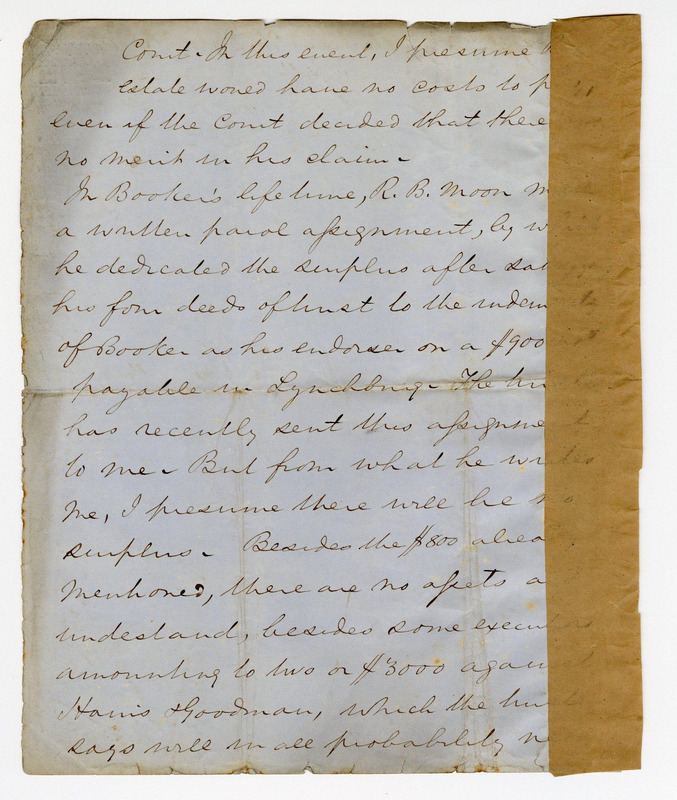
Digital scans of physical letters of Charles Blackford's business correspondence from before and after the American Civil War. Letters came from the Blackford family to Alvin Gerhardt, Jr. to the Historic Sandusky Foundation. Included in the collection are 378 letters, business correspondence of Charles Blackford.
Original order of the letters as they were organized by the Historic Sandusky Foundation has been maintained. Each letter was encapsulated and numbered, 1-378.
The original digital files were in jpeg format. Jones Memorial Library combined these image files into 44 separate pdf files, which represent the digital content of the original jpegs.
This collection was digitized by the Historic Sandusky Foundation before donation to Jones Memorial Library.. For information about obtaining digital copies please contact the Jones Memorial Library reference desk at [email protected].
Access to this collection is open, but some materials may be restricted under data protection laws. Some materials may contain sensitive or confidential information protected under federal and/or state privacy laws and regulations. JML takes steps to identify and in some cases remove this kind of information.
This collection of correspondence was gifted September 27, 2025 to Jones Memorial Library from the Historic Sandusky foundation which acquired the materials from Alvin Gerrhardt, Jr.
Historic Sandusky, in partnership with the University of Lynchburg, is dedicated to providing educational opportunities and career development for students and the public by preserving and interpreting the history of the Civil War, slavery, and 19th-century American life. Historic Sandusky is a Registered Virginia Historic Landmark and is listed on the National Register of Historic Places, Sandusky is recognized as a 501C3 non-profit entity.
This paper by James Burroughs Noell discusses the life and tenure of Melville Weston Fuller as Chief Justice of the U.S. Supreme Court, appointed by President Grover Cleveland in 1888. Spanning 22 years, Fuller's career is noted for his leadership in managing a backlog of cases through the establishment of the Circuit Court of Appeals Act in 1891. Despite not being associated with landmark decisions, Fuller's influence is highlighted through his writing of 870 opinions and his reputation for direct reasoning and common sense among his peers. The paper also touches on Theodore Roosevelt's unsuccessful attempt to replace Fuller due to a desire to appoint Taft, emphasizing Fuller's dedication to his role until his death.
This paper by J. Burroughs Noell delves into the life and contributions of Chief Justice Morrison R. Waite. From a lineage of legal professionals and a Yale graduate, Waite's career took him to Northwest Ohio, where he became a prominent figure. Despite initial setbacks and a cool reception from some Supreme Court justices, Waite's democratic principles and respect for the rule of law eventually earned him widespread admiration. His tenure of fourteen years at the Supreme Court was marked by over a thousand opinions, notably including the Grainger Cases, which addressed the public character of private property used in common, such as railroad and elevator rates. Waite's impactful career was cut short by his sudden death in 1888, just as he was set to deliver an opinion in a significant telephone dispute.
This paper presented by Dennis S. Roberts explores the historical and cultural significance of beer and wine, drawing connections between beverage preferences and climate changes over centuries. Focusing on the impact of the Little Ice Age on European drinking habits, it discusses the shift from wine to beer due to climatic cooling and technological advancements in beer production. It highlights how these shifts were influenced by economic, health, and social factors, including the Bavarian Reinheitsgebot. The paper is organized thematically, touching upon history, paleoclimatology, economics, and more, to provide a multidisciplinary perspective on how climate change has historically influenced human behavior, specifically in the context of alcoholic beverages.
Dr. William Quillian began his talk by explaining the history and unique relationship Randolph-Macon Woman’s College has had with the Methodist Church. Quillian discusses the college's origin and efforts to effect a egal ie between the ollege and the church. For decades there was a struggle to define the exact relationship between the church and the college. In 1968, Dr. Quillian concluded the College is “Church-related and independent.” (The College severed ties with the Methodist Church in June 2019.)
This academic paper by Herbert R. Moore Jr. explores the transformative impact of urban living and the influential work of James W. Rouse, a visionary real estate developer and philanthropist. Moore recounts his personal journey through various cities, ultimately focusing on Lynchburg, Virginia, as his chosen home. He highlights Rouse's innovative approach to urban development, emphasizing his creation of inclusive, vibrant communities such as Columbia, Maryland, and his efforts to revitalize city centers across the United States. Moore discusses Rouse's legacy through the Enterprise Foundation, which supports affordable housing and community development, illustrating Rouse's belief in the power of cities to foster fun, vibrant, and equitable living environments for all residents.
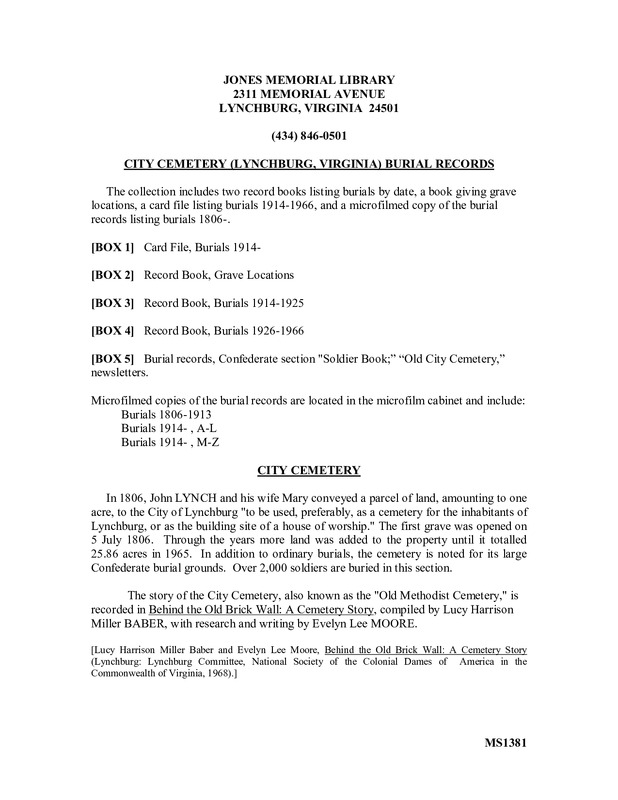
Citizens' Committee For Open Administration Collection Held At Jones Memorial Library In Lynchburg, Virginia. The Collection Includes Letters And Charts Regarding Opposition To Annexation Of The Lynchburg And Parts Of Campbell County And Bedford County.
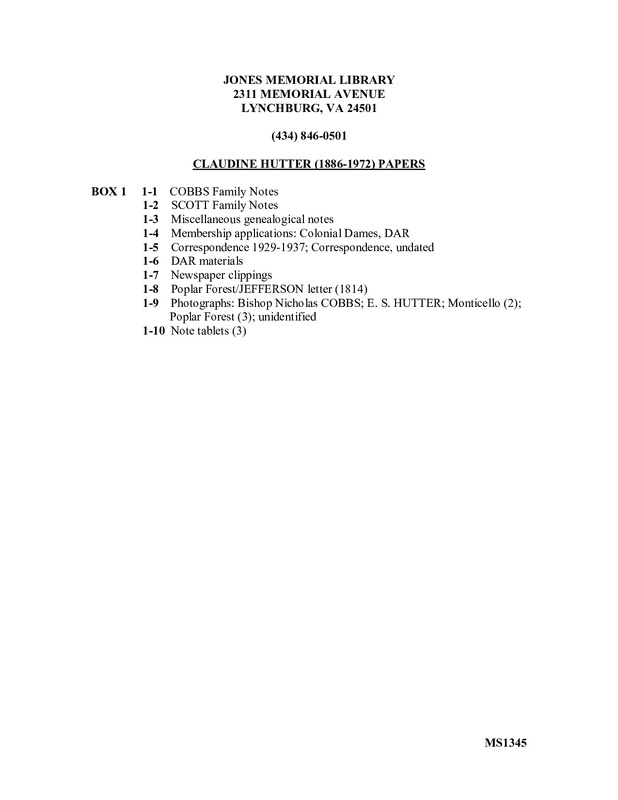
Claudine Hutter Papers Held At Jones Memorial Library In Lynchburg, Virginia. The Papers Include Notes On The Cobbs And Scott Families, Clippings, And Photographs.
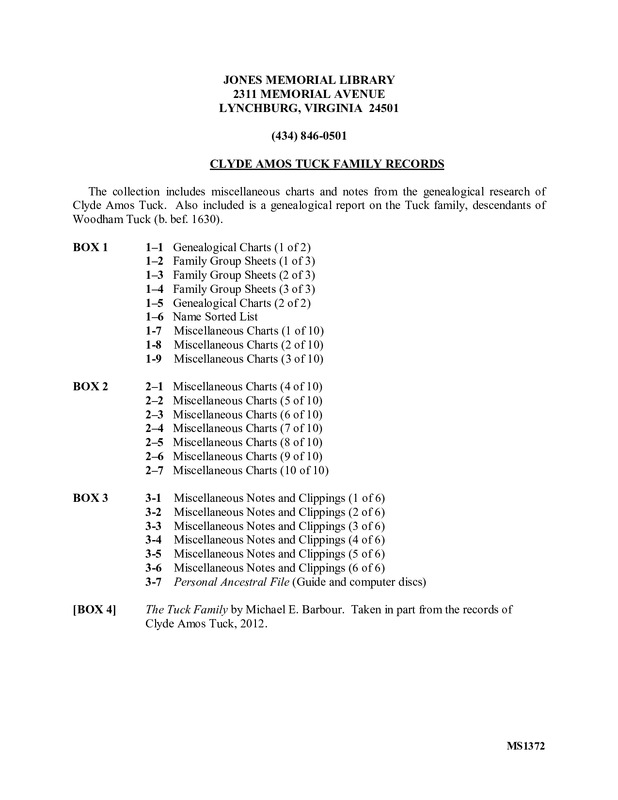
Clyde Amos Tuck Family Records Held At Jones Memorial Library In Lynchburg, Virginia. The Record Include Charts, Notes, And Clippings About The Descendants Of Woodham Tuck.
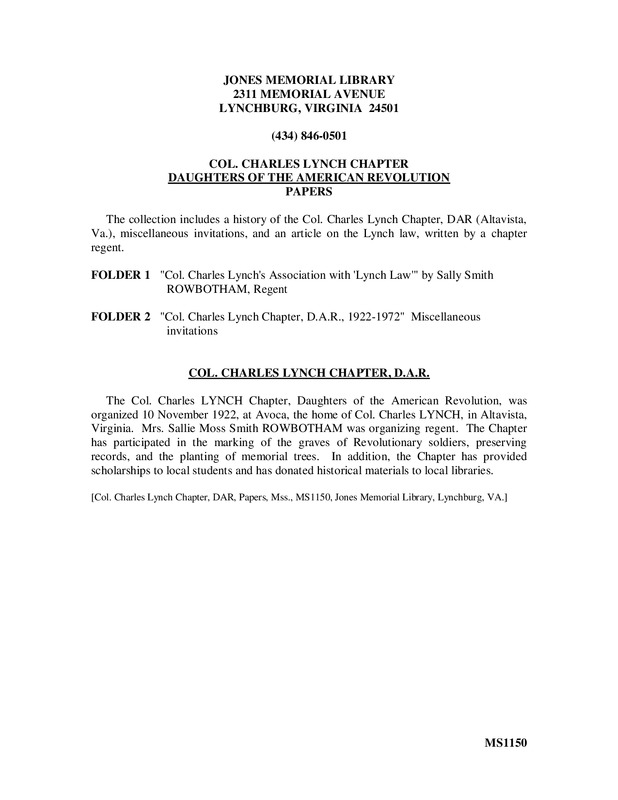
Col. Charles Lynch Chapter Daughters of The American Revolution Papers Held At Jones Memorial Library In Lynchburg, Virginia. Papers Include A Chapter History, Invitations, And Articles.
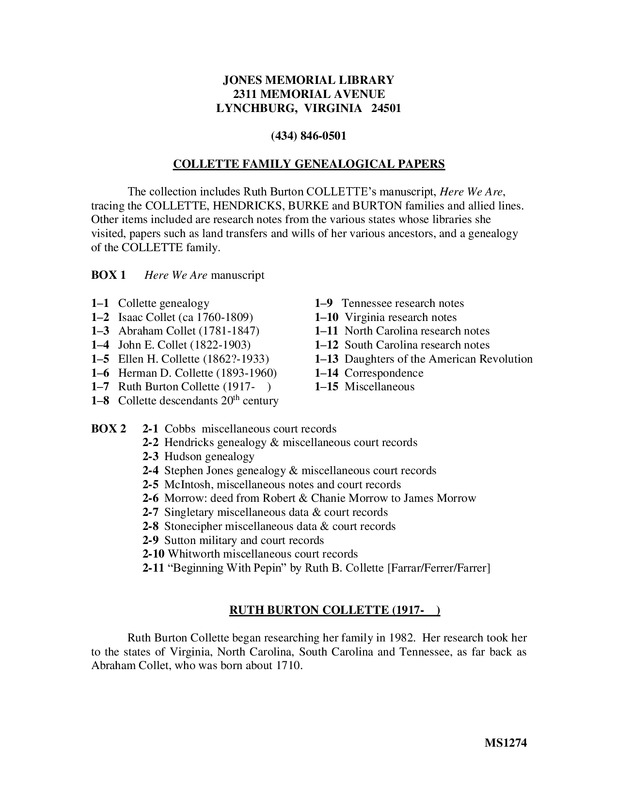
Collette Family Genealogical Papers Held At Jones Memorial Library In Lynchburg, Virginia. Papers Include Research Notes For The Manuscript "Here We Are" By Ruth Burton Collette.
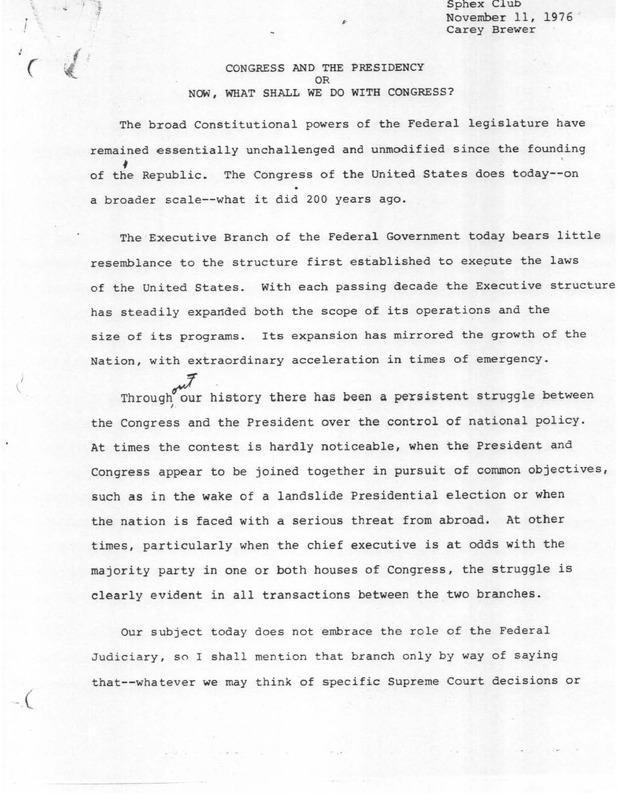
The paper discusses the enduring power struggle between the U.S. Congress and the Presidency, emphasizing the constitutional checks and balances designed to maintain democratic control. It explores the evolution of executive and legislative roles, highlighting instances where one branch overstepped its bounds and the ongoing necessity for both branches to cooperate for effective governance. Key topics include the expansion of presidential powers, Congress's responses to executive actions, and the impact of these dynamics on national policy and government functionality.
John Turner explores the major ideas of four different thinkers in the God is Dead movement: William Hamilton, Gerhard Ritter; J. J. Altizer and Gabriel Vahanian. Turner does not discount all of their viewpoints. For example, Turner agrees that some concepts of God are obviously false and that some misunderstanding of the Bible comes when readers don’t distinguish between the Bible’s literal and figurative language.
Dr. Bill Quillian began his presentation: “The aim of this paper is to provide a fairly simple outline of some of the major philosophical positions current today.” Quillian describes five positions in his paper (“Five Easy Lessons”). The first three he discusses fall under the general category of non-rationalistic philosophies: Pragmatism, Positivism, and Existentialism. The next two Quillian examines are rationalistic systems: Idealism and Naturalism.