Text of a lecture delivered to the Sphex Club in Lynchburg. This academic paper by Julius A. Sigler, titled "But How Do You Know?" explores the fundamental issue of scientific literacy and understanding in American education. Sigler critiques the way science is taught, emphasizing the lack of focus on "how we know" over "what we know," leading to a disconnect between scientific knowledge and its practical application. The paper delves into the author's personal journey in science education, the problems with current teaching methodologies from elementary through college levels, and the societal implications of these educational shortcomings. Sigler advocates for a reevaluation of science curricula, improved teacher preparation, and a greater integration of technology and its societal impacts into education. His insights aim to spark a conversation on enhancing the appreciation and understanding of science among students and the general public.
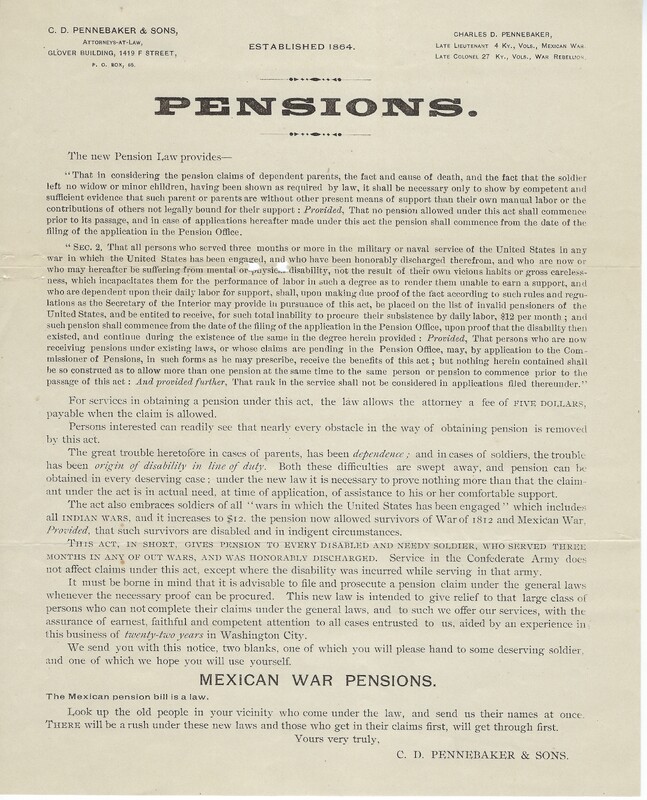
Advertisement from the C.D. Pennebaker & Sons law firm in Washington, D.C. advertising services to aid in filing pension documents.
The advertisement is from the late 1800s and follows a change to military pension laws enacted by the 49th U.S. Congress on 29 January 1887 that allowed for a pension increase.
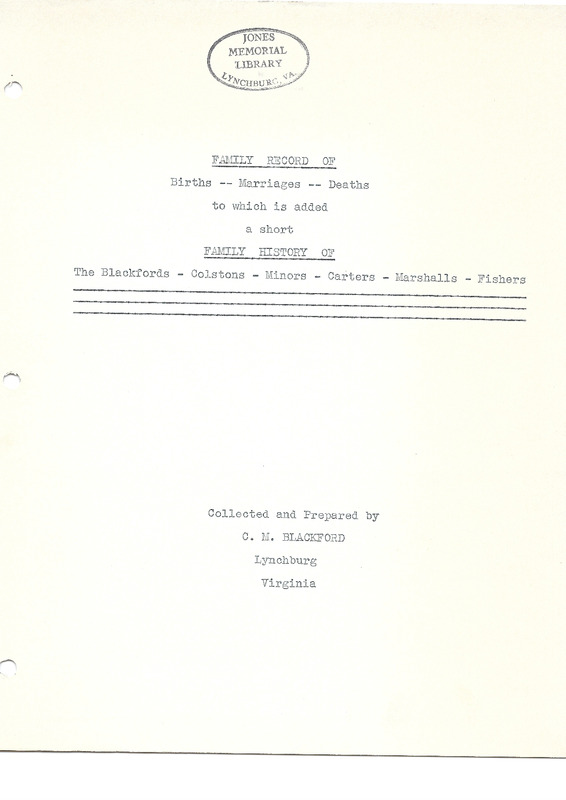
Digital scan of "Family Record of Births - Marriages - Deaths with which is added a short Family History of The Blackfords-Colstons-Minors-Carters-Marshalls-Fishers collected and prepared by C.M. Blackford, Lynchburg, Virginia"
This family history is part of Jones Memorial Library manuscript collection 1793, the Blackford Family Collection. The document is held in typed format in Folder 1-1.
The scanned replica has been divided into three parts.
Thomas Ledford began by observing that despite his love for American history “the medical aspects influencing our major wars were entirely new to me.” Ledford described the heroic behavior of two nursing “icons” Florence Nightingale and Clara Barton. He then discussed the nurses who served in WWII who were trained at Lynchburg General, and Central Virginia’s highly skilled doctors who made the “ultimate sacrifice.” Ledford highlights the major advancements in medicine and in the "chain of evacuation" used in WWII.
Digital images Jones Memorial Library Manuscript 2074, the Calista Rosser Cralle Long Journal. Includes a hand drawn map.
The journal is a typescript entitled Journal of a Journey from Virginia to Kentucky, which is transcribed and prepared by Anne Lilliott Long from an original journal kept by Calista Rosser Cralle Long. The journal details a migration from Campbell County, Virginia to Union County, Kentucky in December 1836 and January 1837.
The typescript is held in printed format at Jones Memorial Library in Lynchburg, Virginia.
James A. Huston traces the progress made in a little over 100 years in caring for wounded soldiers and other patients. People were suffering from dysentery, typhoid fever, typhus, small pox, autumnal remittance, and other serious conditions. George Washington was concerned. Huston traces the challenges, failures and successes in improving medical treatment. His presentation concludes by highlighting ten people “to whom we owe a special debt of gratitude for our health."
This academic paper explores the author's personal journey and fascination with ley lines—a concept suggesting that straight lines connect various historical and spiritual sites across the globe. Monk narrates her initial encounter with ley lines, her subsequent experiences that reinforced her interest, and delves into broader research on the topic. She discusses ley lines' historical significance, their impact on culture and architecture, and their potential spiritual and geomantic implications. The paper integrates personal anecdotes with scholarly research, offering insights into how ancient civilizations might have utilized these alignments for spiritual, political, or practical purposes.
Charles F. Church's presentation uses a canoe trip as a metaphor to discuss the challenges organizations face adapting from the industrial age to the information age. He describes the transition as navigating through white water rapids, emphasizing the need for flexibility and innovation. The talk outlines strategies for local governments to adjust to these changes by fostering community relationships, enhancing service delivery, restructuring organizational systems, and prioritizing employee relations.
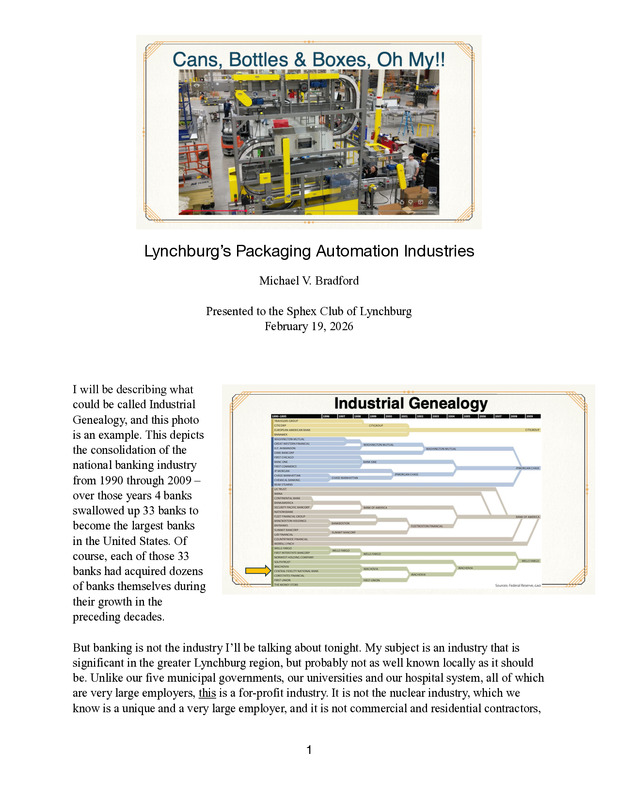
Text of a lecture delivered to the Sphex Club on February 19, 2026. Michael V. Bradford traces the “industrial genealogy” of Lynchburg’s packaging automation industry, emphasizing the entrepreneurs who built a nationally significant manufacturing cluster beginning in the 1960s. The story starts with Dacam, created by Old Dominion Box, and especially with Bob Englander, whom Bradford portrays as the industry’s central figure. Englander and engineer George McVeigh founded Simplimatic Engineering in 1963, pioneering customized conveyor and packaging systems for major beverage companies. Simplimatic’s rapid growth later produced multiple spin-off firms, including Alliance Machine Systems, Sentry, and Automated Conveyor Systems, led by former executives such as Bill Graff, Adam Vinoskey, and Michael Shenigo. Bradford also highlights Belgian immigrant Al Stroobants, whose Belgium Tool & Die became another major automation enterprise. Together these innovators created a durable regional ecosystem of advanced manufacturing, patents, skilled labor, and global industrial influence.
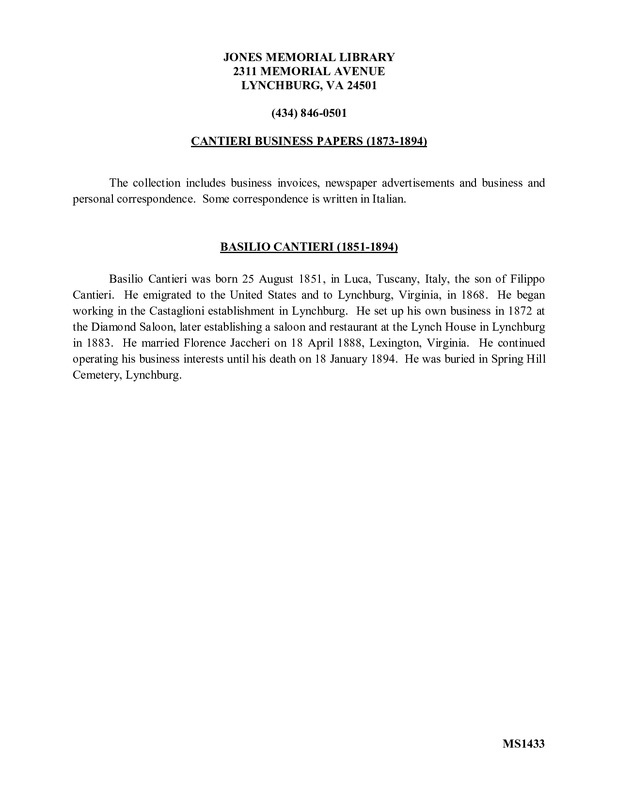
Basilio Cantieri Business Papers Held At Jones Memorial Library In Lynchburg, Virginia. The Papers Include Invoices, Advertisements, And Correspondence.
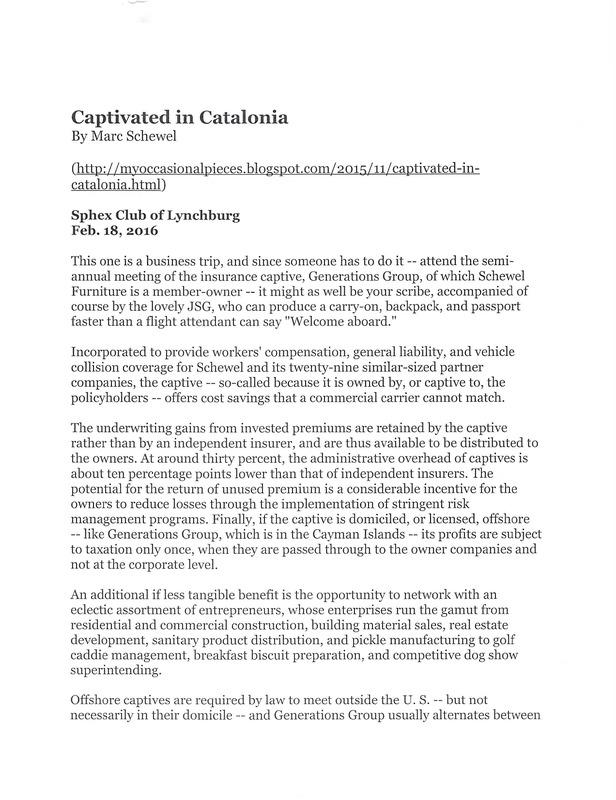
Text of a lecture delivered to the Sphex Club in Lynchburg. This academic paper, titled "Captivated in Catalonia" by Marc Schewel, provides a detailed account of Schewel's business trip to Catalonia, focusing on a meeting of the insurance captive, Generations Group, and its benefits such as cost savings and networking opportunities. It delves into the personal and professional development sessions attended, particularly highlighting the inspiring lecture by Chad Hymas on overcoming adversity and leadership. The paper also explores the impact of various lifestyle choices on health, as discussed by Todd Whitthorne, and addresses the dire consequences of drug abuse as presented by Bob Stutzman and Judge Jodi Switalski. Moreover, it offers a comprehensive exploration of Antoni Gaudí's architectural marvels in Barcelona, emphasizing their unique design, symbolism, and Gaudí's innovative techniques. The document concludes with a reflection on Salvador Dalí's Theatre-Museum in Figueres, showcasing Dalí's surrealist artwork and his contributions to various art forms.
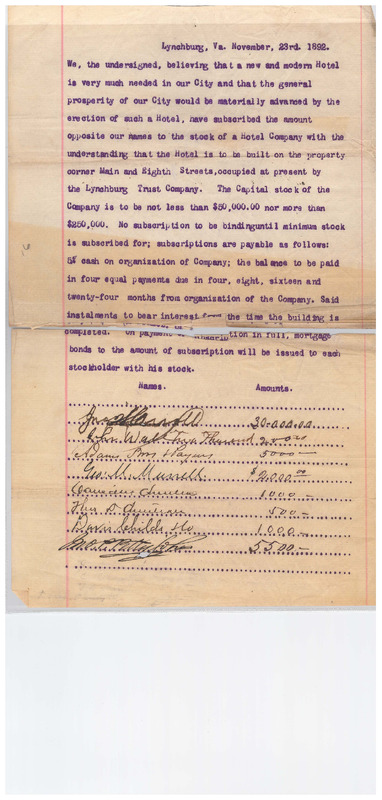
Manuscript 1332 is a collection of records related to the Carroll Hotel in Lynchburg, Virginia. The hotel was built on the corner of Main and Eighth streets and opened in 1893. The hotel was demolished in 1959. Included in the collection is a subscription list for capital stock of a hotel company and invoices received by the hotel following construction and opening. The collection is available in physical format at Jones Memorial Library in Lynchburg, Virginia.
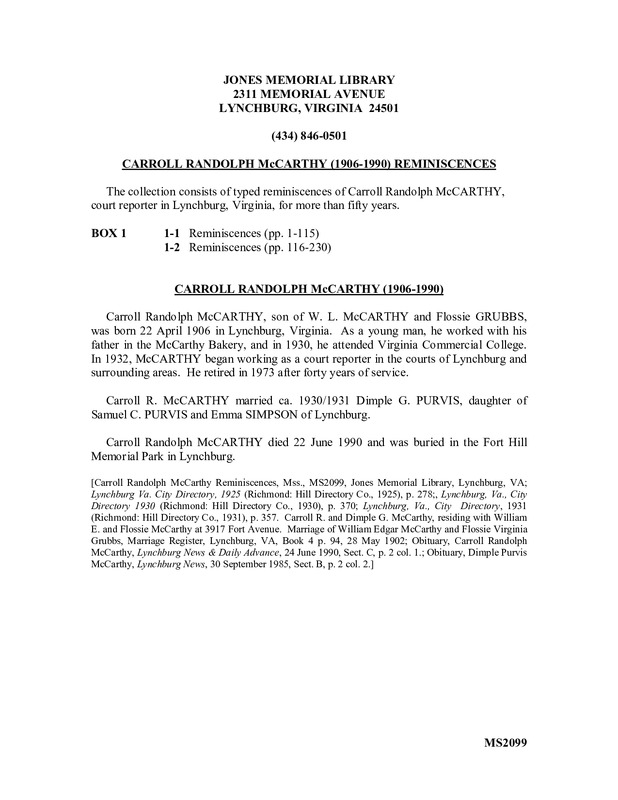
Carroll Randolph Mccarthy Reminscences Held At Jones Memorial Library In Lynchburg, Virginia. The Collection Includes Typed Notes By Mccarthy, A Lynchburg Court Reporter.
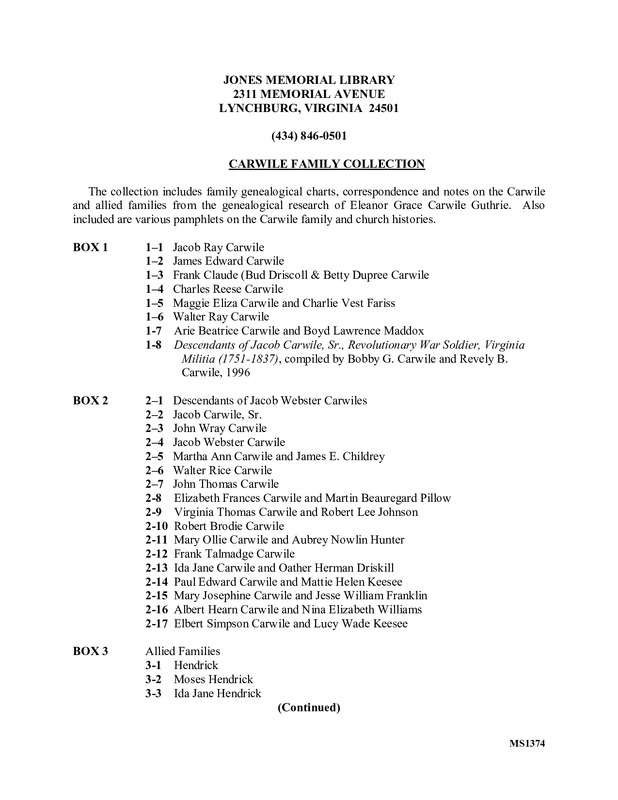
Carwile Family Collection Held At Jones Memorial Library In Lynchburg, Virginia. The Collection Includes Charts, Notes, And Research On The Carwile And Allied Families.
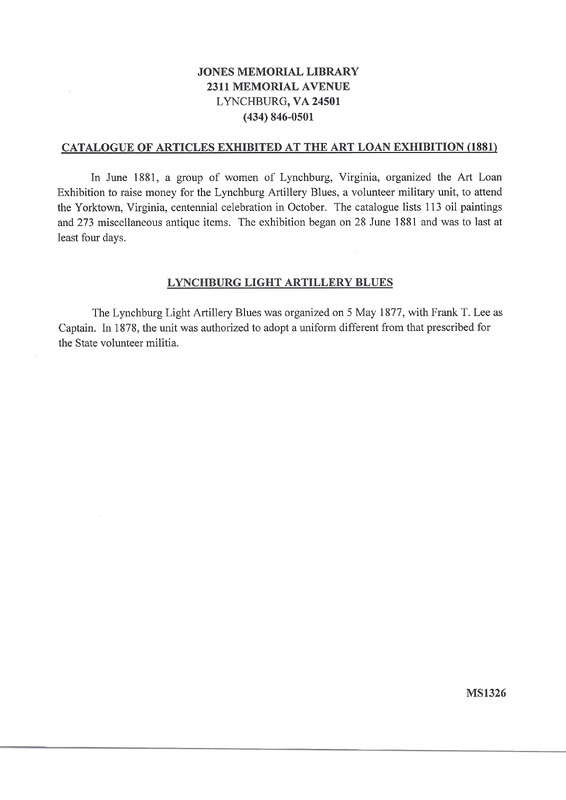
Catalogue Of Articles Exhibited At The Art Loan Exhibition Held At Jones Memorial Library In Lynchburg, Virginia. The Catalog Includes Description Of Paintings And Antiques For A Fundraiser In 1881.
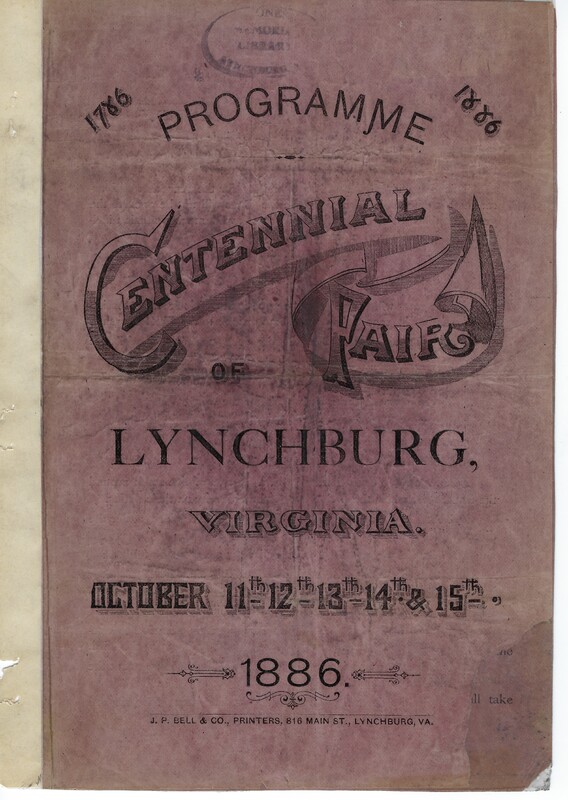
Digital images of a four page program listing events for the Centennial Fair of Lynchburg, Virginia held October 11 through October 15, 1886.
The original program, which is held in the Jones Memorial Library collection as Manuscript 1323, has been laminated and is 6.5 inches wide by 10 inches long.
Centennial Premium List Of The Lynchburg Agricultural And Mechanical Society For The 17Th Annual Fair In 1886. The List Is Held At Jones Memorial Library In Lynchburg, Virginia.
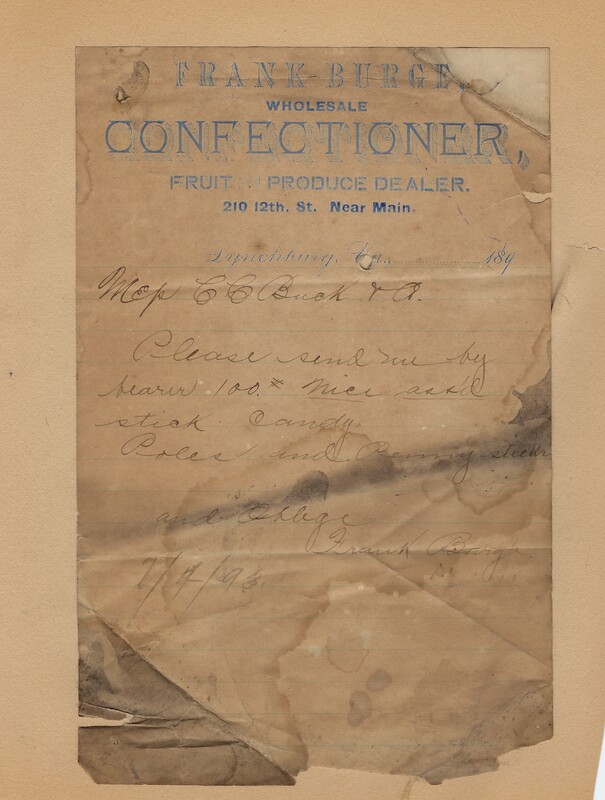
Three digital images of customer requests to the Charles C. Buck and Company candy distributor in Lynchburg, Virginia.
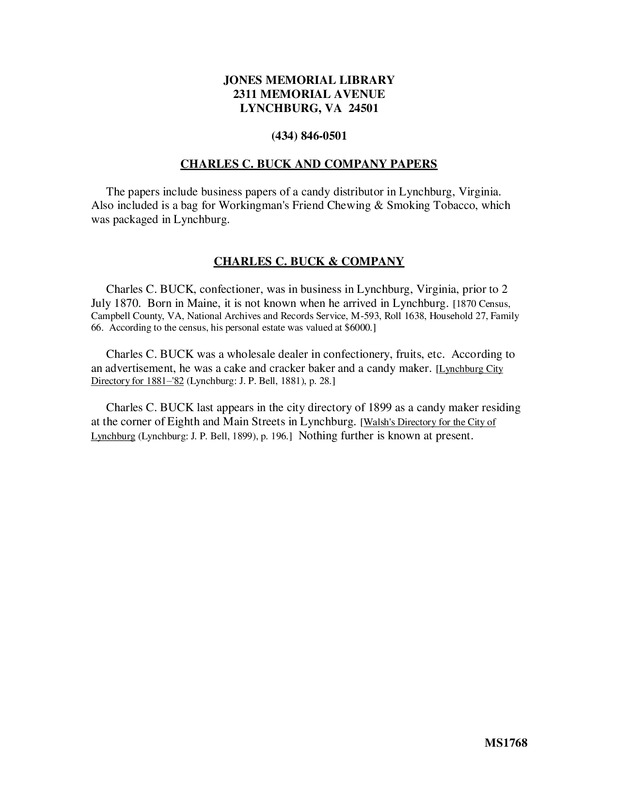
Manuscript Collection 1768 is the Charles C. Buck and Company Papers. The company was owned by Charles Buck, a confectioner who conducted business in Lynchburg prior to July 1870. Buck operated as a wholesale dealer in confectionary and fruits. He was also a cake and cracker baker and candy maker. His residence was at the corner of Eighth and Main streets.
Manuscript Collection 1768 includes more than 50 requests and receipts for delivery. In these three sample requests an Ernest Williams requests 50 pounds more candy delivered to Centenary Church in December 1892, Henry C. Wysor of the New York Life Insurance Company also makes a December 1892 request for lemon sticks, mint sticks, mixed drops, and other candy to "ship at once", and Frank Burge requests 100 pounds of nice assorted stick candy in July 1893.
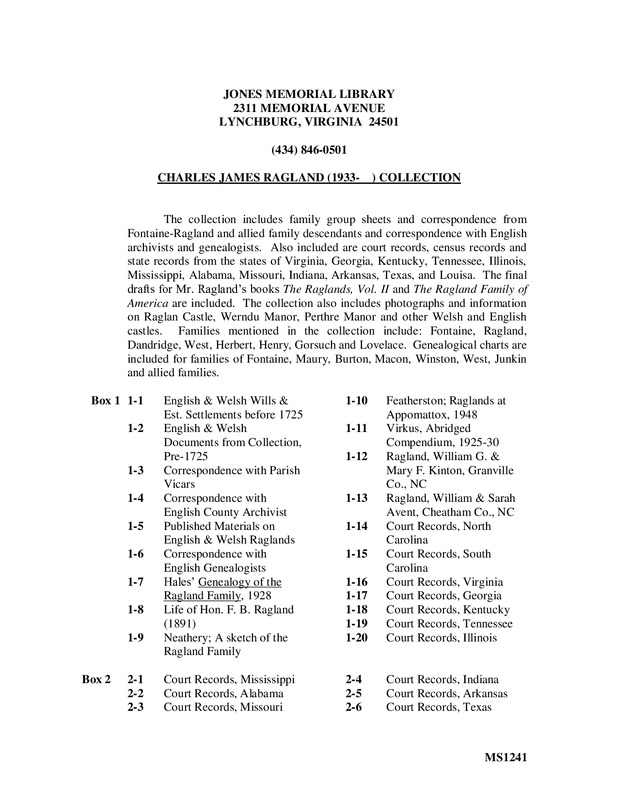
Charles J. Ragland Collection Held At Jones Memorial Library In Lynchburg, Virginia. The Collection Includes Family Group Sheets, Correspondence, Court Records, Census And State Records, Final Manuscript Drafts, Photographs, And Charts.