Virginia Courts Of Appeal Docket Books From 1835-1862 For Appomattox, Amherst, Bedford, And Campbell Counties And The City Of Lynchburg. Books Are Held At Jones Memorial Library In Lynchburg, Virginia.
Poems and notes written to Miss CHRISTIAN by her friends at the Female College Institute (probably the Female Collegiate Institute in Buckingham County, VA); includes
a list of members of her graduating class and the titles of their essays; also includes many extracts from famous poems and plays
Virginia Nurses Association District III Papers Held At Jones Memorial Library In Lynchburg, Virginia. Papers Include Minutes, Membership Lists, Correspondence, Constitution, Bylaws, Publications, Reports, Publications, Scrapbooks, And Financial Records.
Virginia Public School Register & Scrapbook Held At Jones Memorial Library In Lynchburg, Virginia. The Register Is For Biggers Primary School For 1889-90.
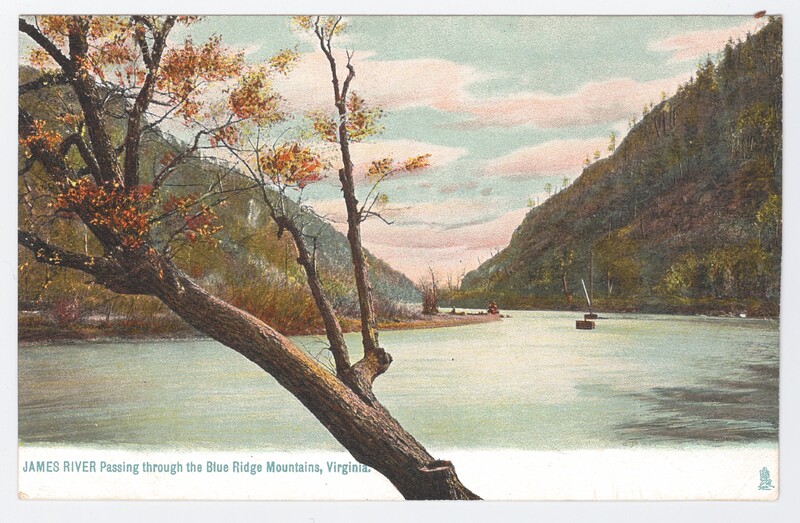
Virginia Williamson Magruder Gilliam Papers Held At Jones Memorial Library In Lynchburg, Virginia. The Papers Include Postcards, Newspaper Clippings, Photographs, And Letters.
The paper discusses George Wythe, a lesser-known but influential American founding father, focusing on his contributions as a legal mentor, politician, and delegate at the Continental Congress. Wythe's teachings and relationships, particularly with Thomas Jefferson, his advocacy for independence, and his role in the Virginia Ratification Convention are highlighted. The paper also covers his personal life, including his early years, education, and the tragic circumstances of his death.
The paper "Virginia's Early Money of Account" by Raymond H. Williamson explores the historical development of Virginia's financial system from the early 1600s to the 19th century. It details the use of various forms of money, including tobacco and Spanish dollars, the impact of British mercantile policies, and the eventual transition to a decimal-based monetary system. The paper is organized chronologically and examines the economic strategies and challenges faced by Virginia's colonists.
Text of a lecture to the Sphex Club in Lynchburg. The paper titled "Virginia’s Lost Industry" by John D. Capron, delivered on June 10, 1942, examines the history and decline of the iron industry in Virginia from 1619 to the 20th century. It traces the establishment, boom, and eventual stagnation of iron furnaces, highlighting the technological, economic, and wartime factors that influenced the industry. Key points include the initial rise of iron production, its pivotal role in various American wars, and the industry's decline due to depleted resources, outdated technology, and economic shifts.
Text of a lecture to the Sphex Club in Lynchburg. Eric J. Sorenson discusses the transformative leadership of Mustafa Kemal Atatürk in the aftermath of World War I. It details Turkey's dramatic political and societal changes, Atatürk's efforts to modernize and Westernize Turkey, his secular reforms, and his emphasis on education and women's rights. The narrative also highlights Atatürk's military successes and the long-lasting impact of his vision on modern Turkey.
Text of a lecture delivered to the Sphex Club in Lynchburg. The impending fiscal crisis caused by Social Security and Medicare costs and the impact on younger generations. A tongue in cheek suggestion that Baby Boomers commiting suicide could be part of the solution and an examination of suicide and euthanasia in contemporaty society.
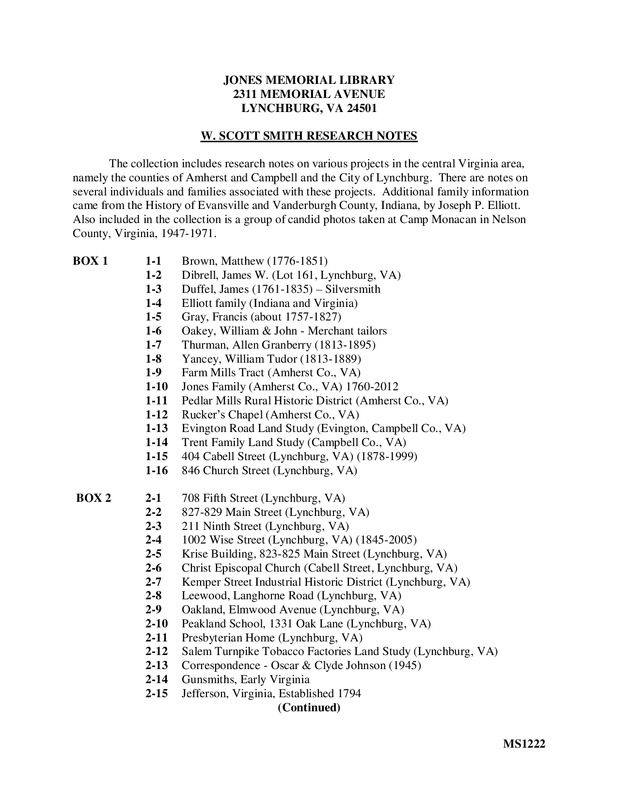
W. Scott Smith Research Notes Held At Jones Memorial Library In Lynchburg, Virginia. The Collection Includes Notes On Projects In Amherst And Campbell Counties And The City Of Lynchburg.
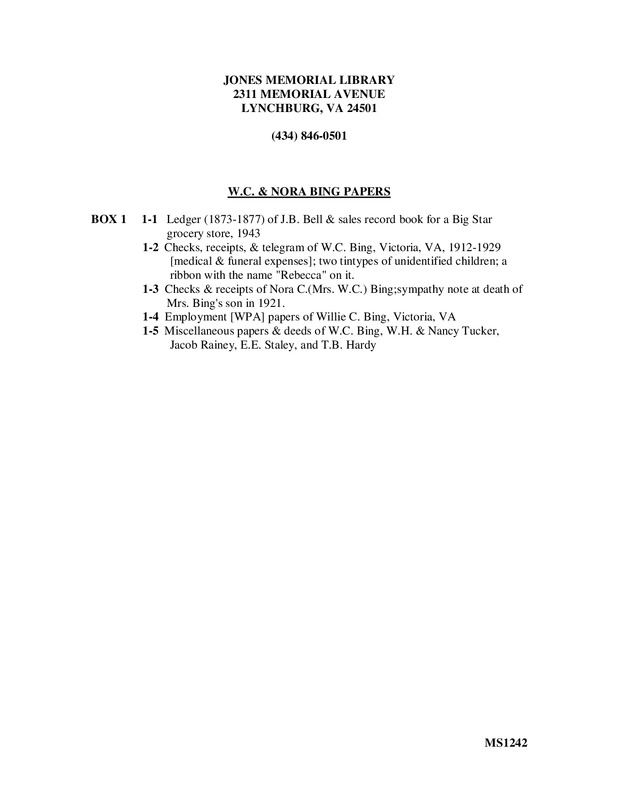
W.C. And Nora Bing Papers Held At Jones Memorial Library In Lynchburg, Virginia. Included Are Ledgers, Receipts, Telegrams, Notes, Papers, Deeds, And Records.
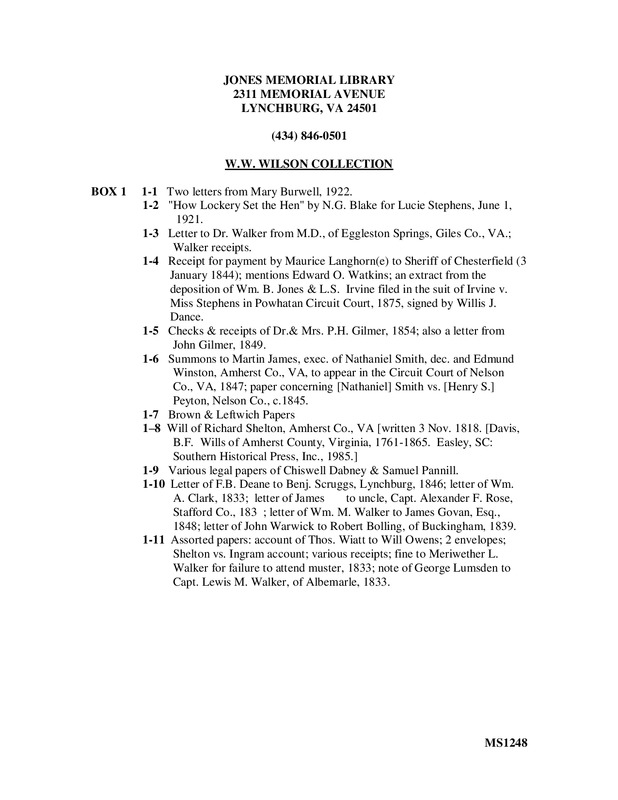
W.W. Wilson Collection Held At Jones Memorial Library In Lynchburg, Virginia. The Collection Includes Wills, Papers, Receipts, Extracts, Checks, Legal Papers, And Letters.
Dr. Reid Wodicka's presentation "Wait, what happened?" delved into the challenges and inefficiencies of the juvenile justice system in Virginia, emphasizing the high recidivism rates among youth. It highlighted the need for a trauma-informed approach and the implementation of evidence-based practices to improve rehabilitation outcomes in juvenile detention centers.
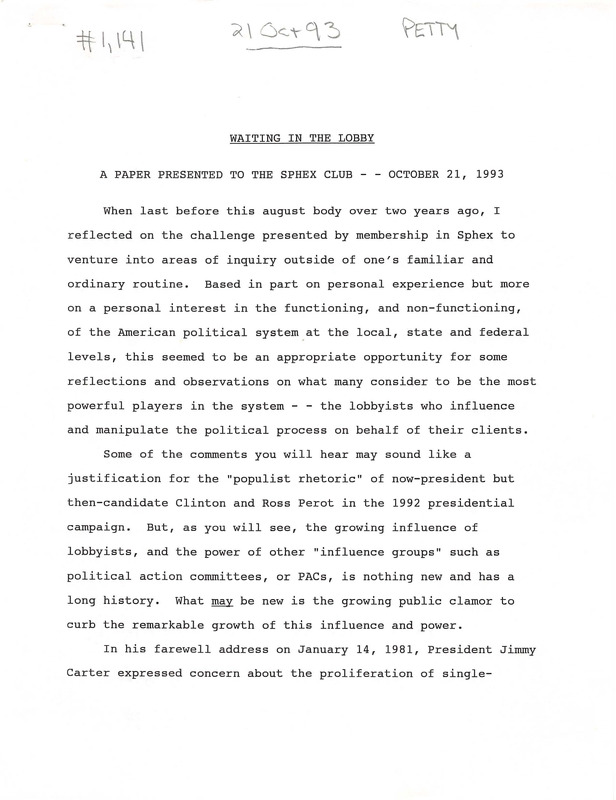
Text of a lecture delivered to the Sphex Club in Lynchburg. This academic paper by David T. Petty, Jr. delves into the complex world of lobbying in the United States, tracing its evolution from early practices to its contemporary state. Petty critiques the massive growth of the lobbying industry, its impact on legislation, and the challenges in regulating this sphere due to its roots in constitutional rights. He shares personal experiences with lobbying efforts, highlighting the nuanced roles lobbyists play in shaping legislation. The paper discusses various attempts at reform, including the Federal Regulation of Lobbying Act and recent legislative efforts, while emphasizing the importance of transparency and public scrutiny in mitigating undue influence on the political process.
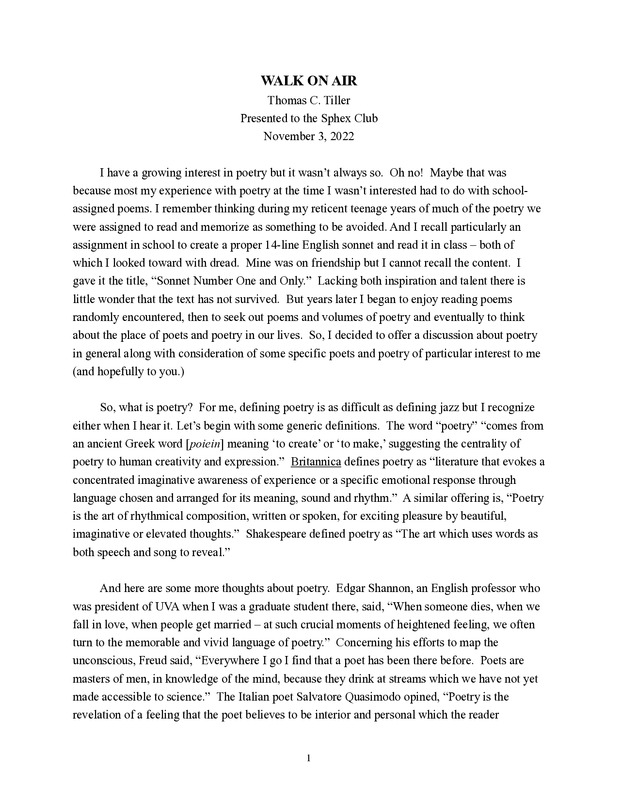
Text of a lecture delivered to the Sphex Club in Lynchburg. Thomas C. Tiller explores the evolution of his appreciation for poetry, from initial disinterest to a deep engagement with poets and their works. He discusses the essence of poetry as both a creative and evocative form of expression, touching on its power to convey complex emotions and experiences. Tiller emphasizes poetry's role in significant life events and its capacity for social commentary, highlighting examples like Bob Dylan's Nobel Prize and the impact of Ukrainian poet Taras Shevchenko. The paper underscores poetry's diverse forms and the personal connection readers can find within its lines.
Text of a lecture to the Sphex Club in Lynchburg. Watchman, What of the Night? by A. F. Thomas, examines the parallels between biblical and contemporary global turmoil, advocating for moral integrity, democratic cooperation, and international governance. Thomas critiques the failures of post-WWI settlements, emphasizes the importance of moral law in political and economic realms, and suggests that the U.S. model of divided sovereignty could inspire a global democratic framework.
Thomas Ledford begins by discussing the 1927 Mississippi River Flood that is considered by many to be America's greatest natural disaster. Ledford analyzes the causes of major floods and then discusses past and future plans to control flooding. Unfortunately Captain Andrew Humphrey’s jealousy over the sound ideas of two excellent scientists threw flood control progress off track for seventy-five years. Despite new ideas about flood control, Ledford questions whether great river floods can ever be eliminated.