Moore-Wise Family Papers Held At Jones Memorial Library In Lynchburg, Virginia. The Papers Include Correspondence, Photographs Scrapbooks, Diaries, And Notes For The Israel S. Moore Family And Related Families. Included Are Civil War Diaries.
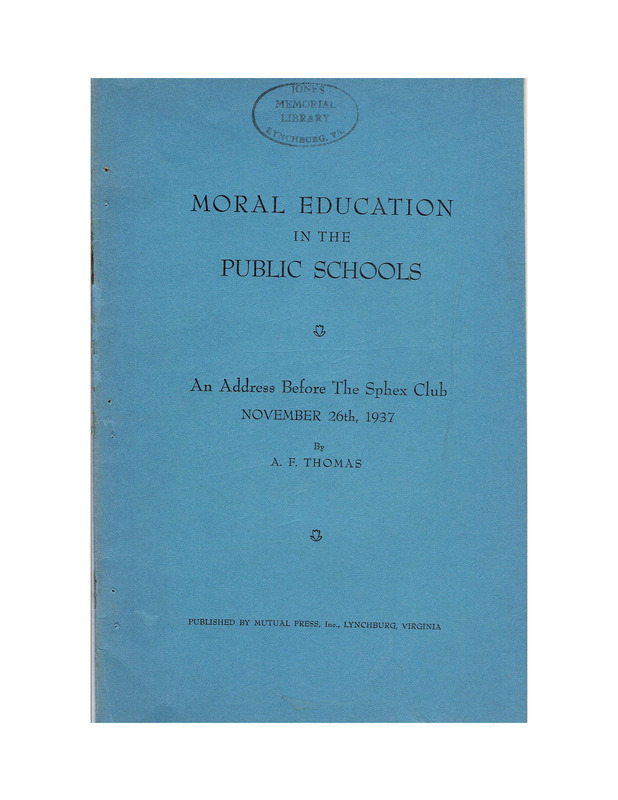
Text of a lecture to the Sphex Club in Lynchburg. This address, delivered by A.F. Thomas, argues for the incorporation of moral education in public schools to develop well-rounded citizens. Thomas emphasizes the need for balanced intellectual, physical, and moral training to prevent societal issues like crime. The paper differentiates between ethics and religion, advocating for state-led ethical instruction while leaving religious education to individuals and religious institutions.
Professor Peter Marcy gives a brief history of modern British historiography, beginning with Sir Walter Raleigh, William Camden and Sir Francis Bacon. He cites a shift away from uncritical acceptance of received knowledge to an emphasis on documentary evidence and scholarly interpretation that sought to establish causation. In the following century, David Hume, William Robertson and Edward Gibbon were influenced by the Enlightenment, particularly Voltaire, and emphasized social history. The theories of Hume, Voltaire and Gibbon are discussed. The later influence of Sir Walter Scott and subsequently Thomas Carlyle and others showed that history could be interesting and involves an imaginative as well as intellectual understanding of the past. The author discusses the contributions of Leopold von Ranke and Thomas Babbington Macauley, and concludes that modern British historiography includes sophisticated analysis of evidence and addresses anthropological, economic, psychological and intellectual dimensions.
Thomas Ledford begins: “I am going to tell a positive story of water and how the need for an abundant supply of clean, healthy water has been acquired through a series of sound public policy decisions made over the course of the last 200 years in Lynchburg.” Ledford describes decisions that Lynchburg made despite opposition. He concludes: “Lynchburg's leaders over the last two centuries have provided our community with safe, clean water today and far into the future.”
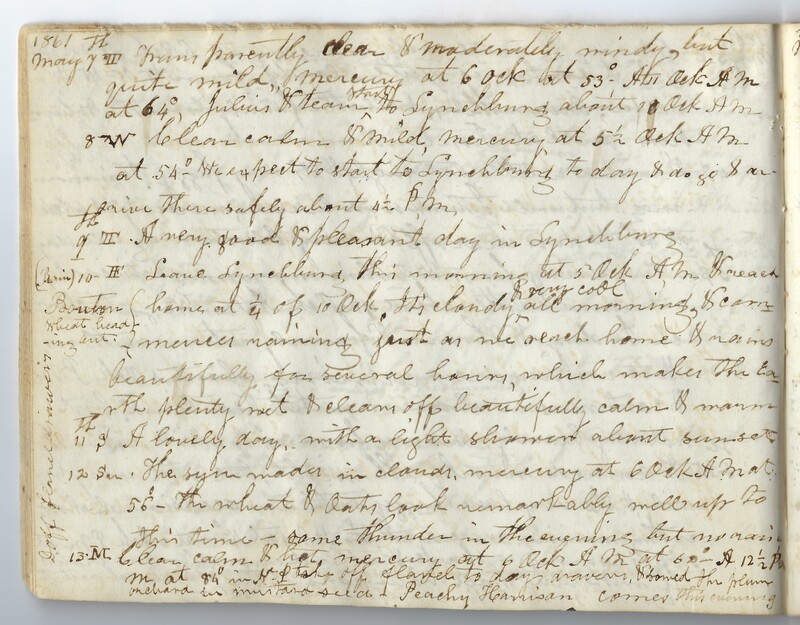
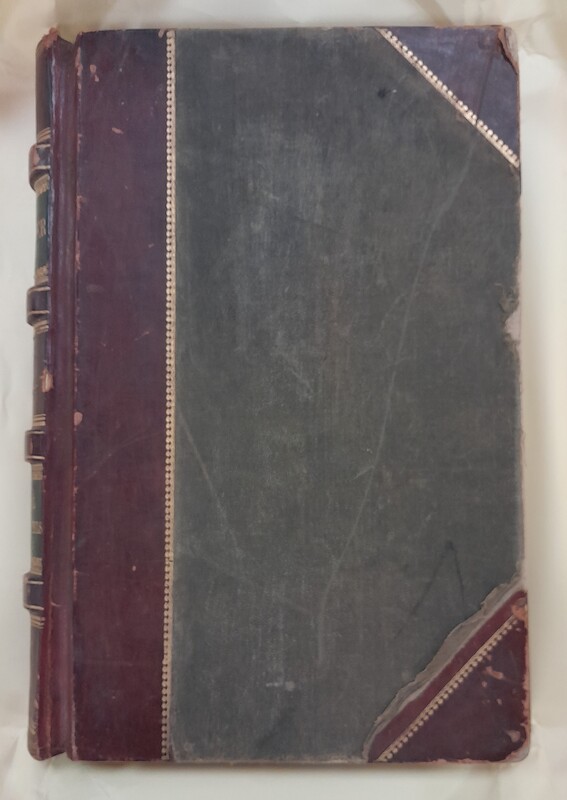
Weather Memorandum Book Detailing Daily Observations Of The Weather At The Massie Plantations, Pharsalia And Level Green, Located In Nelson County, Virginia For The Period 1860-1862. The Book Is Held At Jones Memorial Library In Lynchburg, Virginia.
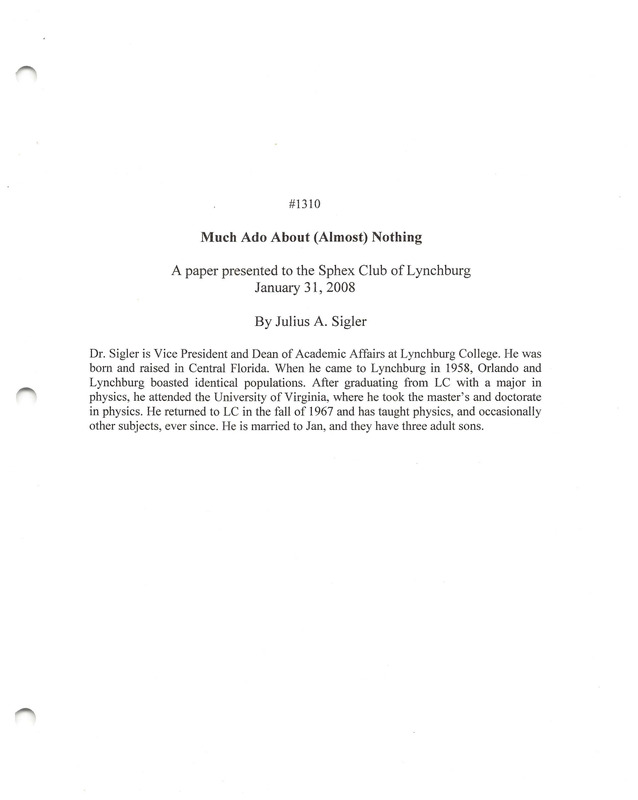
Text of a lecture delivered to the Sphex Club in Lynchburg. This academic paper, titled "Much Ado About (Almost) Nothing: A Sphex Club Paper" by Julius Sigler explores the feasibility and scientific foundation of constructing a space elevator as initially perceived to be an impossible project. Sigler shares his journey from skepticism to discovery, highlighting significant advancements in materials science, particularly in the realm of nanotechnology. The paper delves into the principles of atom behavior, the importance of surface area to volume ratios, quantum physics, and the potential applications of nanoscience in various fields including medicine, electronics, and environmental technology. It concludes with a revisitation of the space elevator concept, now seen as feasible with the advent of carbon nanotube technologies.
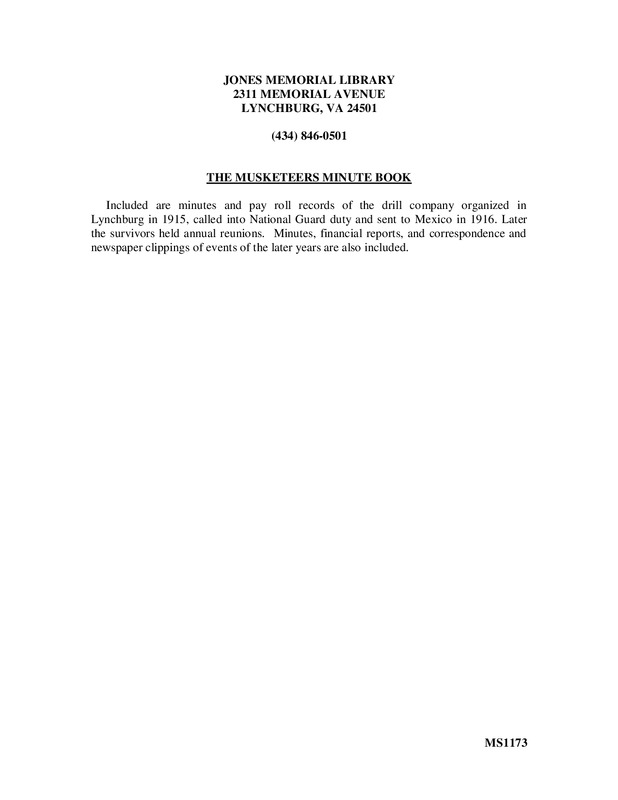
Musketeers Minute Book Held At Jones Memorial Library In Lynchburg, Virginia For The Minutes And Pay Roll Records Of A Drill Company Called For National Guard Duty In Mexico In 1916.
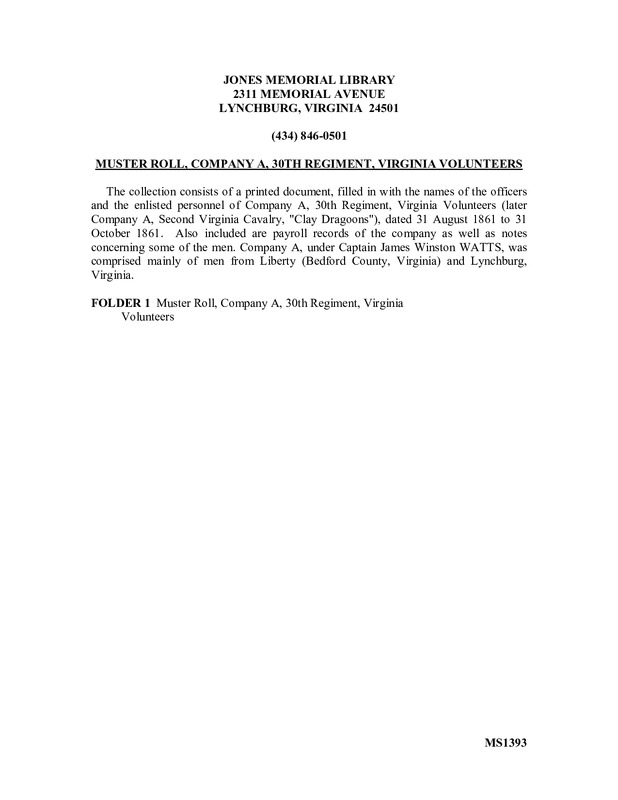
Muster Roll, Company A, 30Th Regiment Virginia Volunteers Document Held At Jones Memorial Library In Lynchburg, Virginia. The Company Was Known As The Clay Dragoons. The Document Lists Officers And Enlisted Personnel For 31 August To 31 October 1961.
J. Everette Fauber’s Sphex Club lecture explores his deep connections with historically significant buildings he worked on as an architect. He personifies these inanimate structures, describing them as intimate friends. Fauber highlights several notable restorations, including the Captain Horton Plantation Home, the John Carlyle House, and the Octagon House, emphasizing their historical and architectural significance.
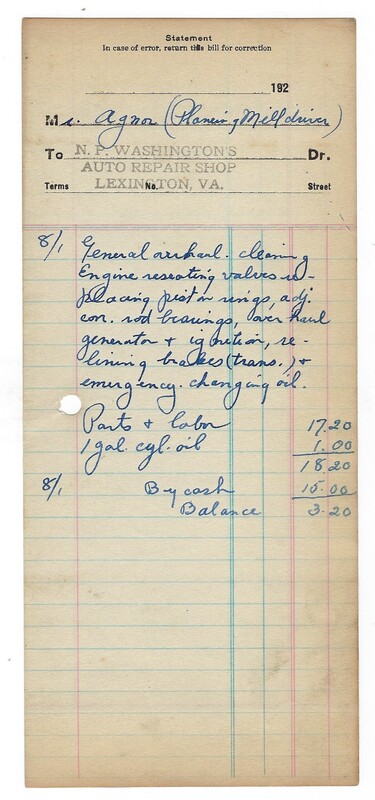
N.P. Washington Auto Repair Shop Accounts Held At Jones Memorial Library In Lynchburg, Virginia.
The Collection Includes Accounts By Customer Name With Notes On Repair Work Done In The Early-Mid 1900S In Lexington, Virginia.
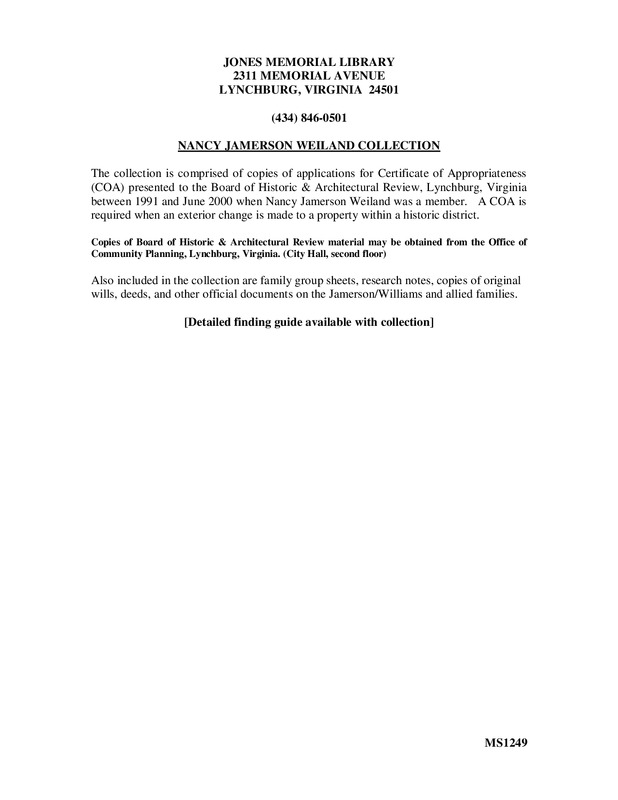
Nancy Jamerson Weiland Collection Held At Jones Memorial Library In Lynchburg, Virginia. Included Are Copies Of Applications For Certificate Of Appropriateness To The Board Of Historic & Architectural Review In Lynchburg. Also Included Are Family Group Sheets, Notes, And Genealogical Research Materials.
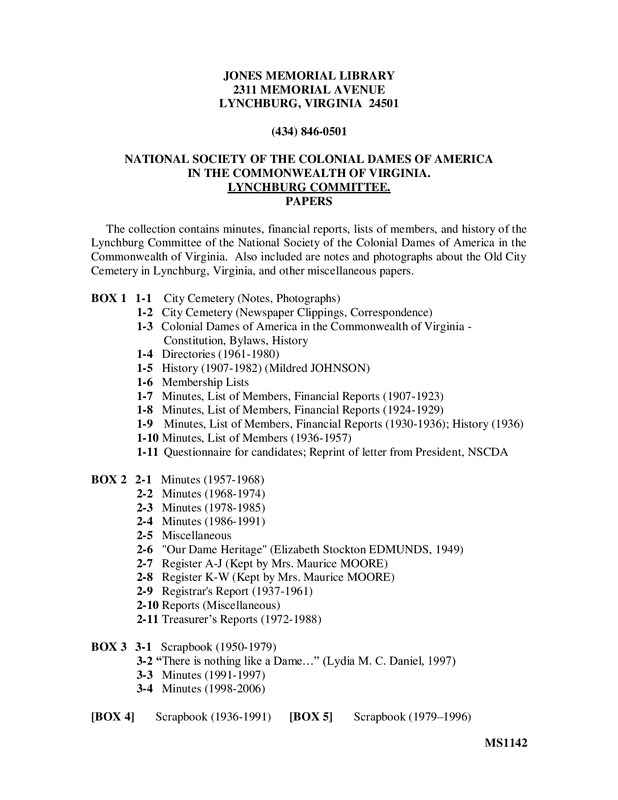
National Society Of The Colonial Dames Of America In The Commonwealth Of Virginia Lynchburg Committee Papers Held At Jones Memorial Library In Lynchburg, Virginia. Papers Include Notes And Photographs About The Old City Cemetery In Lynchburg.
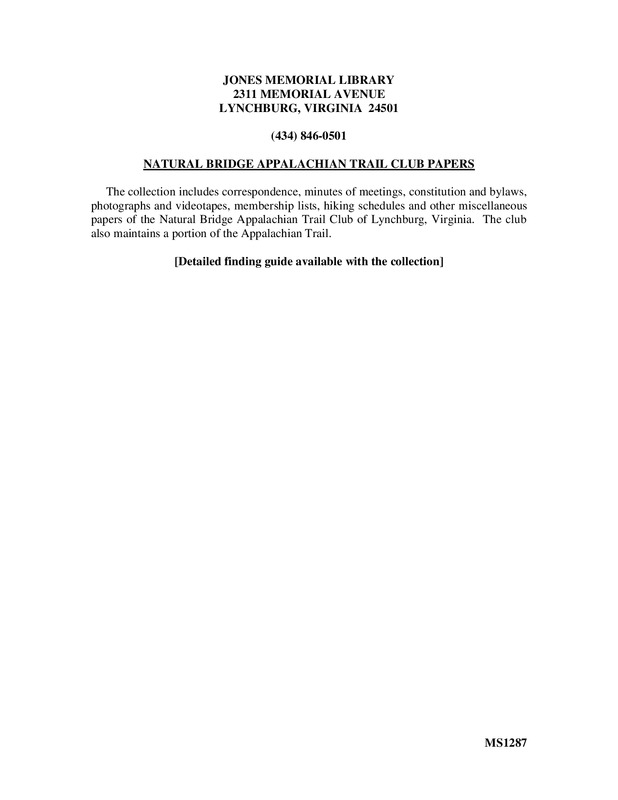
Natural Bridge Appalachian Trail Club Papers Held At Jones Memorial Library In Lynchburg, Virginia. The Club Maintains A Portion Of The Appalachian Trail.
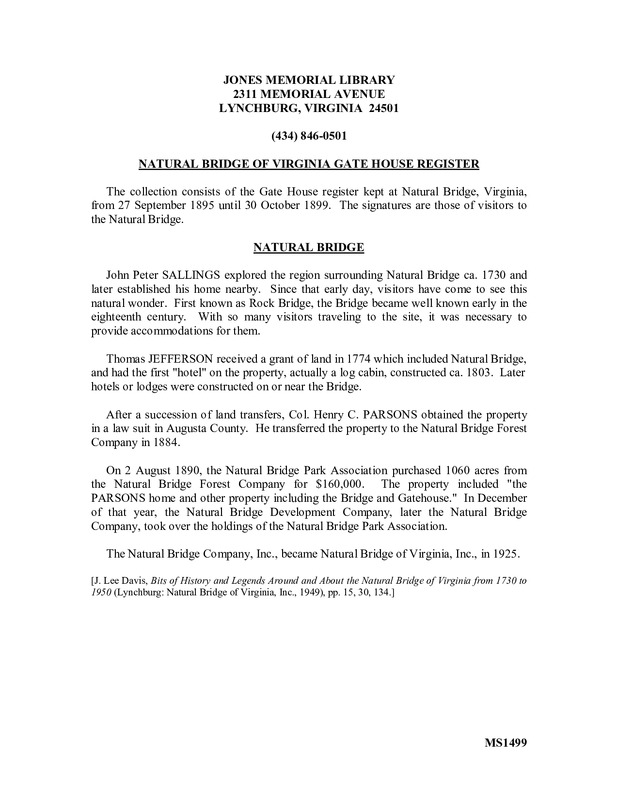
Natural Bridge Of Virginia Gate House Register Held At Jones Memorial Library In Lynchburg, Virginia. The Register Records Visitors To Natural Bridge Between 27 September 1895 And 30 October 1899.
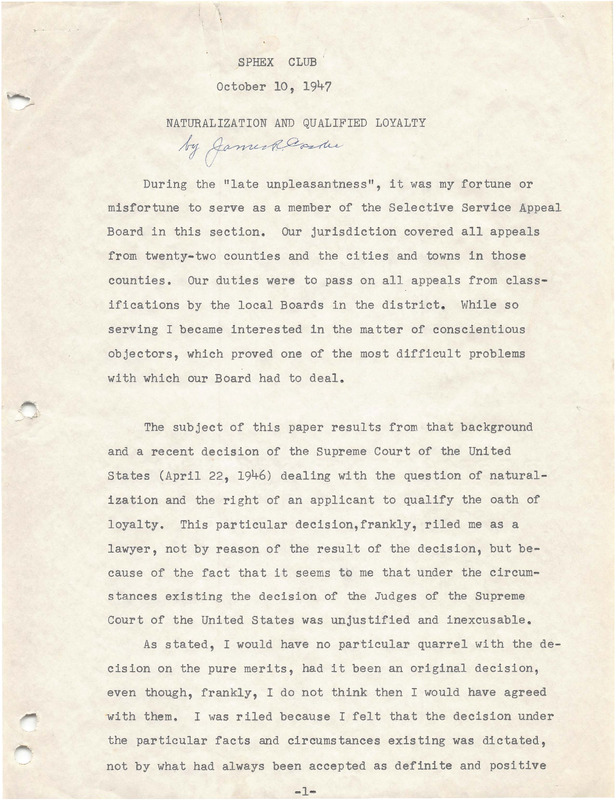
Text of a paper delivered to the Sphex Club in Lynchburg. This paper, delivered to the SPHEX Club on October 10, 1947, explores the complex issue of naturalization, loyalty oaths, and conscientious objectors in the United States, particularly in light of a Supreme Court decision on April 22, 1946. The author, having served on the Selective Service Appeal Board, critiques the Court's decision, which he sees as unjustified and indicative of judicial activism influenced by the New Deal philosophy. The paper meticulously reviews historical cases, legislative responses, and philosophical debates surrounding the oath of allegiance and the implications for both native and naturalized citizens.
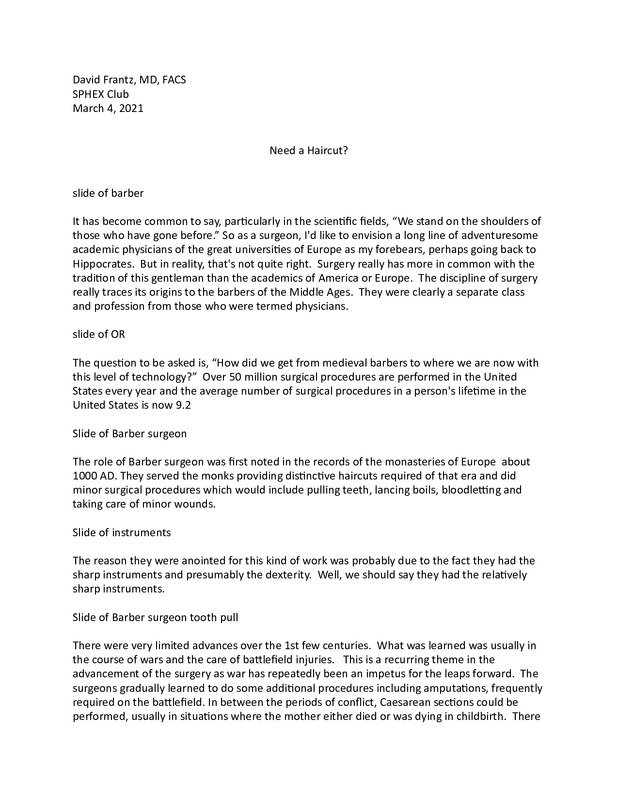
David Frantz's presentation, "Need a Haircut?," delves into the historical evolution of surgery, tracing its roots back to barber-surgeons in the Middle Ages. He discusses the significant advancements in surgical practices, particularly during wartime, and the transition from apprenticeships to academic training. The talk highlights key milestones, including the introduction of anesthesia, antisepsis, and asepsis techniques, as well as advancements in blood transfusion, which collectively overcame major barriers in surgery, transforming it into a crucial aspect of modern medical practice.