Text of a lecture delivered to the Sphex Club in Lynchburg. Using eyewitness accounts and commentaties of historians, supplemented by historic and contemporaty photographs, the paper explores the impact and the aftermath of the Battle of Gettysburg on the village and surrounding Adams County. A subsidiary theme is the experience of Private James Maurice Moore, a member of the Lynchburg Home Guard who was wounded and captured in the battle.
An exploration of the relationship between quantum mechanics and free will. The arguments examined explore aspects of being that transcend time. The author posits the existence of an immortal soul.
Walter R. Wineman’s paper, "Just Tolerable" - Witchcraft or Medicine?, explores the historical attitudes toward health and medicine in early America, highlighting the contrasts between past and present medical practices. The paper discusses the impact of diseases, the primitive understanding of health, and the transition from superstitious treatments to more scientific approaches. Wineman also touches on the societal implications of medical practices and the roles of various figures in the medical field during the 17th and 18th centuries.
Jo Ellen Parker's essay explores the concept of "moral panic" related to new technologies, using historical and contemporary examples to illustrate how innovations such as electric lighting, the telegraph, and internet have triggered societal fears, particularly regarding their impacts on time, space, and human relationships. Parker discusses anthropologist Genevieve Bell's hypothesis on technology-induced moral panic and extends the discussion to artificial intelligence, using the Turing test and cultural representations of AI to ponder the evolving relationship between humans and technology, and how these advancements challenge our understanding of humanity.
The academic paper, titled "King James of Lynchburg: An Analysis of the Flood of November 5, 1985" by E. Allen Culverhouse, delves into the severe flooding that devastated Lynchburg due to the James River overflowing. The paper provides a detailed account of the flood's impact, exceeding $50 million in damages, and emphasizes the heroism of municipal employees and local organizations. It covers historical flood data, the emergency responses, and the community's resilience, ultimately advocating for improved flood warning systems.
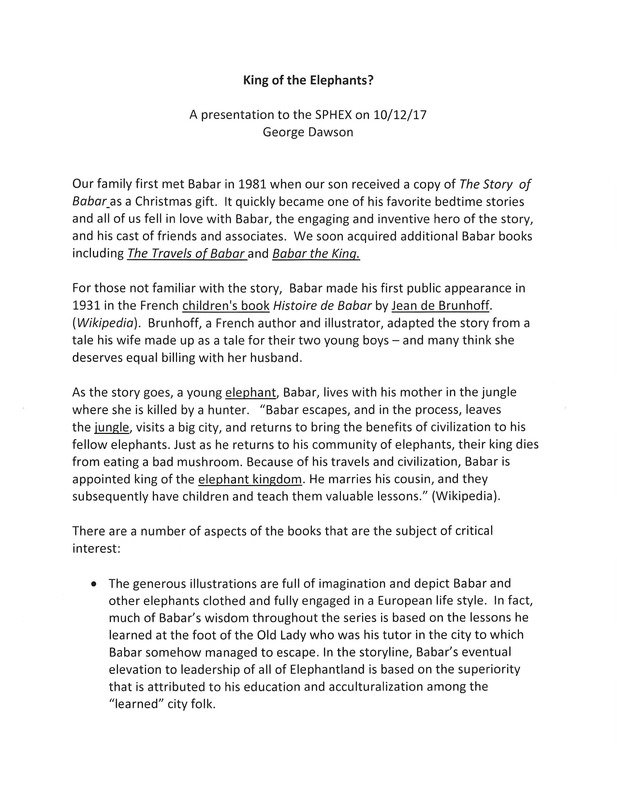
George W. Dawson's lecture, "King of the Elephants?" presented to the SPHEX Club on 10/12/17, explores the Babar children's book series, anthropomorphism, and the real-life implications and controversies surrounding Babar's depiction. Dawson delves into the history of Babar, the character's journey from jungle to civilization, and the broader issues of colonialism and racism hinted at in the stories. The presentation also includes personal anecdotes, analysis of elephant biology and social structures, and the pressing issue of ivory poaching and its historical context.
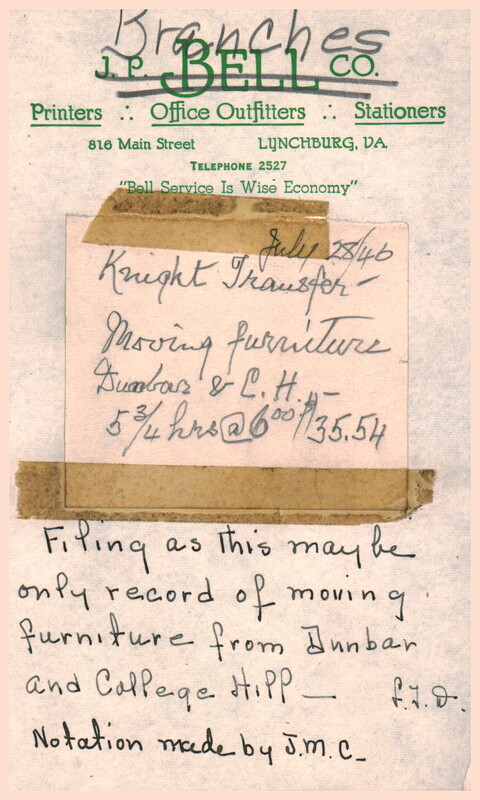
Scanned image of a handwritten note referencing the cost of moving furniture from the Dunbar Branch and College Hill Branch of the Jones Memorial Library on 28 July 1946. The note is part of Jones Memorial Library Manuscript Collection 1396, the Dunbar High School Library Papers. The note indicates that Knight Transfer charged $35.54 for 5.75 hours of service to move furniture from the Dunbar and College Hill Branches. At this period of time, the Dunbar Branch had transferred from operating under the Jones Memorial Library to operating under the Lynchburg City Schools; the College Hill branch had closed. The note includes a reference that "Notation made by JMC", which likely refers to Jane Maud Campbell, the head librarian at the time.
L. Hunter Early Collection Held At Jones Memorial Library In Lynchburg, Virginia.
The Collection Includes Three Typescript Articles By Lewis Hunter Early Regarding The Methodist Episcopal Church In Lynchburg.
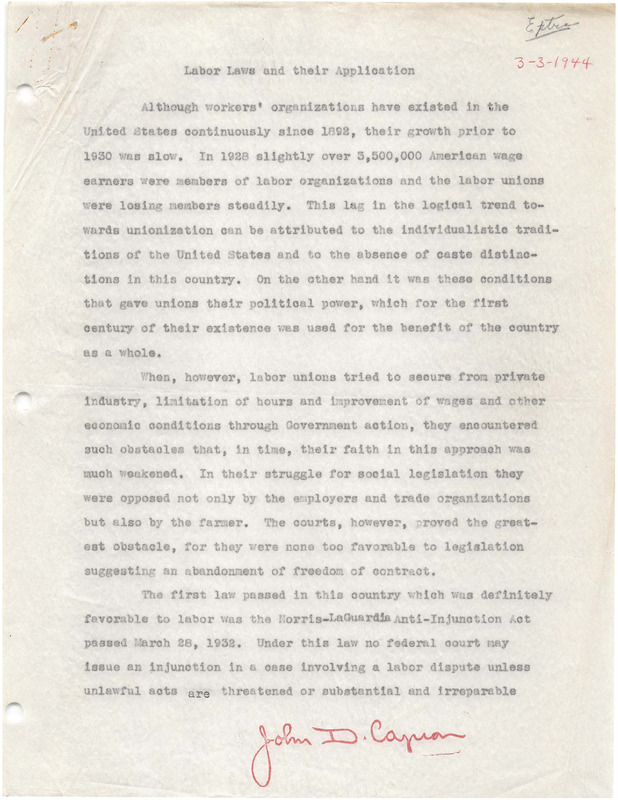
Text of a lecture delivered to the Sphex Club in Lynchburg. The paper outlines the development and impact of labor laws in the U.S., focusing on their evolution from the Norris-LaGuardia Act to the Fair Labor Standards Act, and their effects on labor conditions, employer practices, and industrial relations. It discusses specific legislation, court challenges, and the experiences of Glamorgan Pipe and Foundry Company with labor laws and union activities. The narrative highlights the complexities and consequences of labor legislation, both intended and unintended, on businesses and workers.
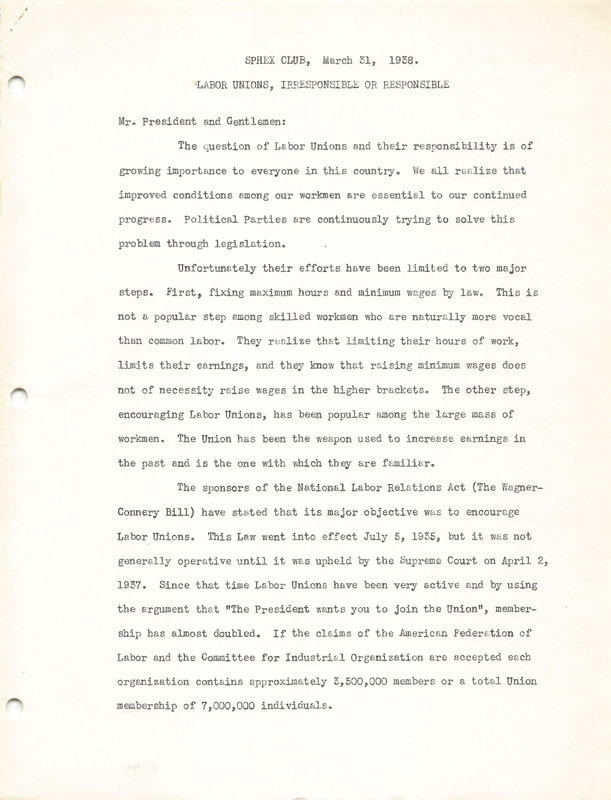
Text of a lecture to the Sphex Club in Lynchburg. John Capron's 1938 paper critically examines the role and responsibility of labor unions in America. It delves into the challenges and consequences of the National Labor Relations Act, discussing the increase in strikes and the debate over the regulation and power of unions in the industrial landscape.
Land Transfer, Grayson County, Virginia 1796 Virginia Land Office Treasury Warrants 11289 And 13265 Held At Jones Memorial Library In Lynchburg, Virginia
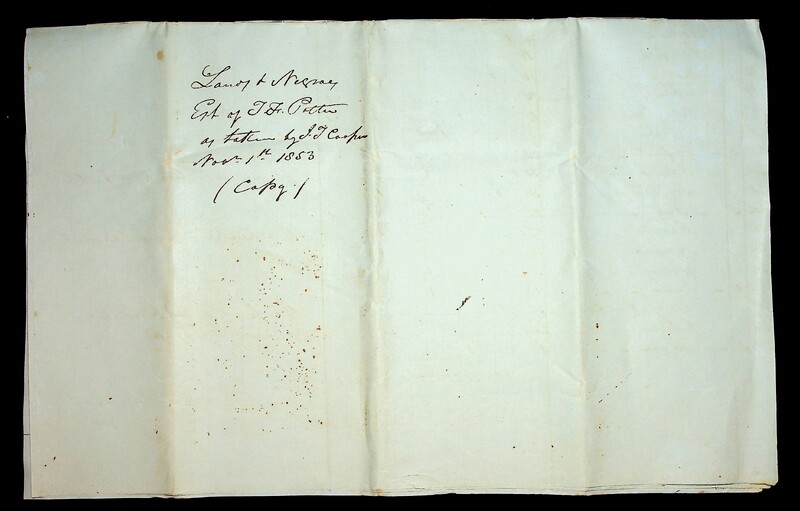
Scanned images of a document entitled Lands and Negroes Est. of T.F. Potter dated 01 November 1853, Copy 1. This document is part of Jones Memorial Library Manuscript Collection 1141, the Potter Estate Papers, Box 1-4.
Thomas Potter owned the Colerain Plantation in Savannah, Georgia. This document enumerates and lists named persons enslaved by Potter.
This paper by Rear Admiral Malcolm W. Cagle, delivered at a SPHEX Club lecture, discusses the implications of U.S. military and diplomatic decisions during the Korean War. The author elaborates on three main themes: the U.S.'s lack of clear intentions prior to the conflict, manpower issues in the military, and significant military decisions by Stonewall Jackson to highlight broader strategic lessons. Cagle emphasizes the necessity of clear national intentions, preparation for conflict, and maintaining strong civilian control over the military. He concludes with a cautionary stance against altering the all-volunteer military system.
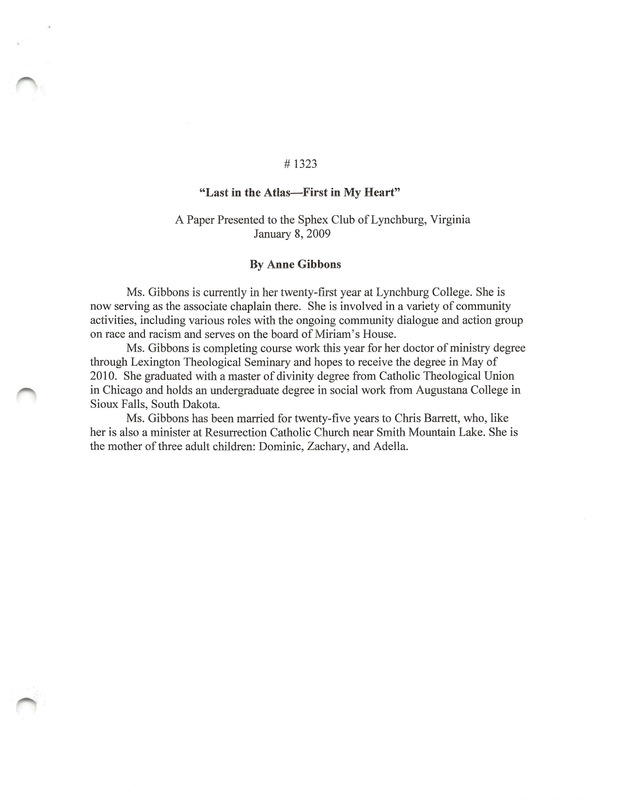
The paper "Last in the Atlas-First in My Heart," presented by Anne Gibbons to the SPHEX Club of Lynchburg, Virginia, on January 8, 2009, explores the history, geography, and culture of Wyoming, focusing on its sparse population, rich heritage, and environmental issues. Gibbons blends historical chronology, cultural insights, and personal anecdotes to illustrate the unique charm and ongoing conflicts of her home state.