Text of a lecture to the Sphex Club in Lynchburg. Dr. Ken West’s presentation focuses on the "couple strengths" that lead to positive marriages and the "couple weaknesses" that frequently create unhappy marriages. West explains why quick marriages based on romantic feelings create a high risk. Robert Sternberg’s triangle theory is explored. People lacking one or more “sides” experience predictable problems. John Gottman’s theory of the mismatches that create perpetual problems in a marriage is examined. Also, the characteristics of “Consummate Love” that can last a lifetime are presented.
James M. Elson's paper, "If You Would Not Be Forgotten," presented to the Sphex Club on October 13, 2005, encourages individuals to consider how they will be remembered by posterity. Elson highlights the importance of writing autobiographies and preserving documents to ensure one's legacy. He discusses historical figures like Benjamin Franklin, Thomas Jefferson, and George Washington, emphasizing the value of written records in preserving their legacies. Elson also provides practical advice on documenting personal and family histories for future generations.
In Memoriam by Joan S. Jones is a deeply reflective paper dedicated to Helen Calvert, exploring the profound impact of the Scramble for Africa from approximately 1876 to 1912. Through meticulous analysis of Thomas Pakenham's extensive research, Jones encapsulates the frenzied annexation of Africa by European powers, driven by imperialistic ambitions and a disregard for indigenous sovereignties. The narrative weaves through various historical milestones, including the roles of explorers like Stanley and de Brazza, the strategic military and diplomatic maneuvers of European nations, and the eventual partitioning of the continent. Jones highlights the complex interplay of exploration, exploitation, and the eventual push towards independence, illustrating the enduring consequences of colonialism.
James A. Huston’s paper, presented to the SPHEX Club of Lynchburg on October 22, 2009, explores the phenomenon of how myths and misinformation can spread and become accepted as truth. The paper is structured into eight sections, each discussing various anecdotes and examples, including humorous misattributions, psychological warfare, frivolous lawsuits, and pressures on witnesses. The central theme highlights the unintended consequences of information manipulation and the creation of urban legends.
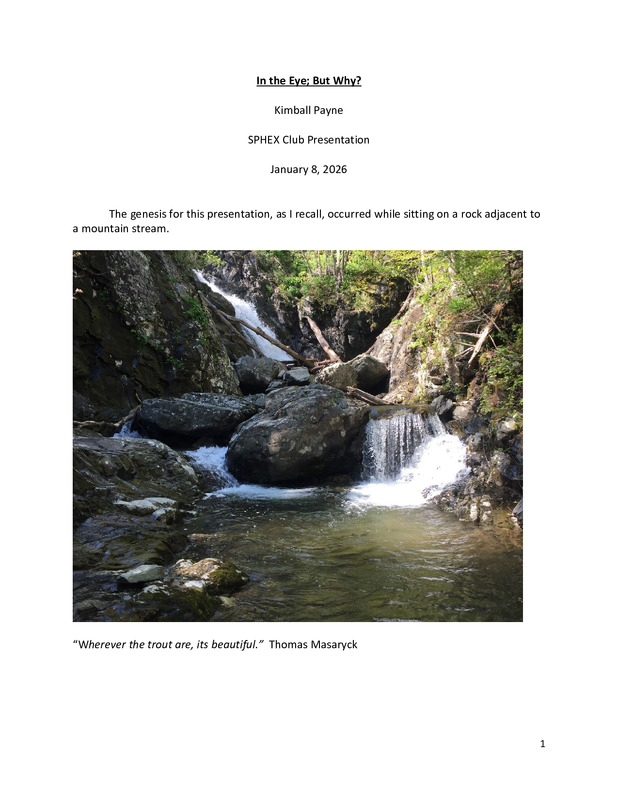
Text of a lecture delivered to the Sphex Club on January 8, 2026. In this reflective SPHEX presentation, Kimball Payne explores the nature of beauty, especially in natural landscapes, asking whether beauty is objective, subjective, or both. Inspired by moments spent outdoors, he surveys philosophical, psychological, scientific, and artistic theories of beauty, drawing on thinkers from Plato and Kant to modern neuroscientists and landscape researchers. Payne examines attempts to measure scenic beauty through surveys, eye-tracking, neuroscience, fractals, the Golden Ratio, and artificial intelligence, while questioning whether scientific methods can fully explain aesthetic experience. He argues that beauty involves emotional, spiritual, and sensory dimensions that transcend pure measurement. Ultimately, he concludes that beauty exists inherently in creation but is perceived through individual experience, culture, and circumstance, and that people discover beauty by slowing down and paying attention.
Text of a paper delivered to the Sphex Club in Lynchburg. The paper "Industry and Civilization" by S. Wells Utley discusses the historical importance and societal contributions of industry. Utley criticizes contemporary attitudes that belittle industrial achievements and emphasizes that industry has been fundamental in the progress of civilizations by creating surplus wealth, driving cultural advancements, and opposing war. The paper underscores the necessity of preserving industrial freedom and warns against increasing government intervention.
Raymond H. Williamson's paper "Inflation Revisited," explores historical inflationary periods to derive lessons for the present. The paper covers early instances of inflation, such as coin devaluation by ancient Romans and Henry VIII, and examines major hyper-inflations, including post-WWI Germany and 1946 Hungary. Williamson assesses the U.S. inflation situation, highlighting the role of the Federal Reserve and Congressional spending, and warns of the potential for hyper-inflation in the U.S., stressing the importance of redeemable currency standards.
This paper by Dennis S. Roberts explores the dynamic history of marriage, highlighting its fluid nature and continuous evolution over centuries. It dissects the varied forms of marriage, from monogamous to same-sex, and how economic, social, and political changes have shaped the institution. The discourse on marriage equality and the legal, theological, and social battles it has engendered are central, illustrating the deeply personal and societal implications. Key themes include the non-traditional nature of marriage, its role in power and wealth preservation, the shift towards love-based unions, and the impact of gender equality and gay rights movements on the institution. The paper concludes optimistically, noting marriage's resilience and the hopeful expansion of marriage rights.
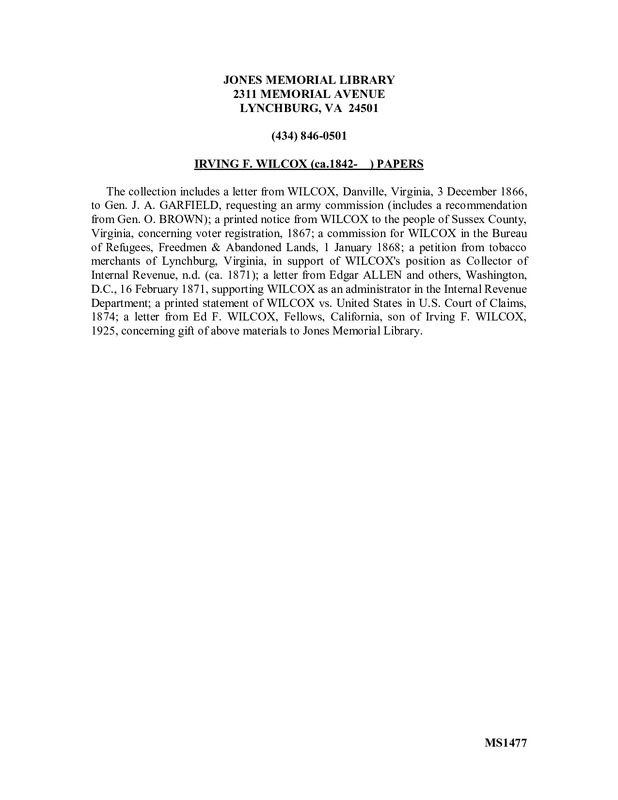
Irving F. Wilcox Papers Held At Jones Memorial Library In Lynchburg, Virginia. The Papers Include Letters, Notices, Petitions, And Statements Regarding Wilcox In The 1860S And 1870S.
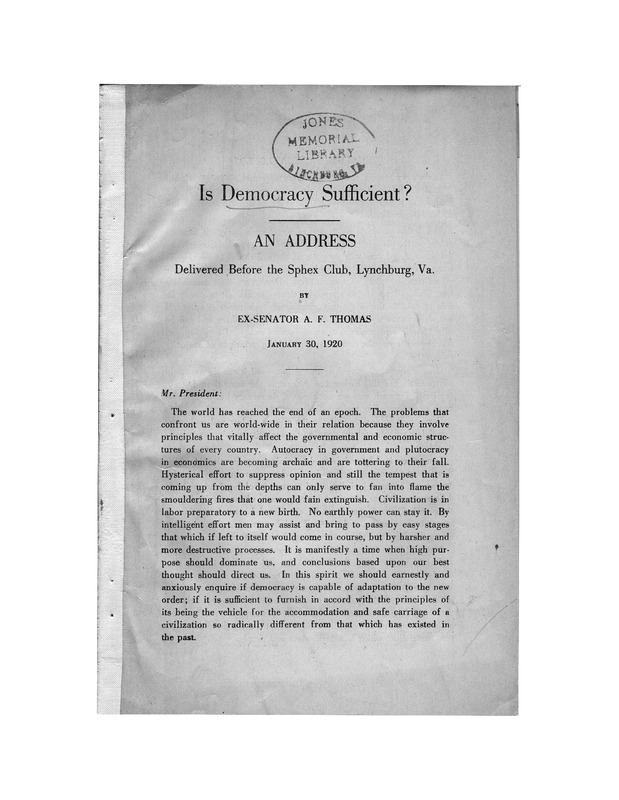
Text of a paper delivered to the Sphex Club in Lynchburg. The paper "Is Democracy Sufficient?" by Ex-Senator A.F. Thomas addresses the evolving challenges and opportunities of democracy in a changing world. It emphasizes the need for democracy to adapt to new societal structures and underscores the importance of equality, individual rights, and moral law. Thomas critiques both extreme individualism and class-based governance, advocating for a balanced approach that integrates democratic principles with economic and social reforms.
Text of a lecture delivered to the Sphex Club of Lynchburg. Robert Chambliss Light's presentation delves into the history, operation, and controversies surrounding the U.S. Presidential Electoral College. Light articulates the Electoral College's origins from the 1787 Constitutional Convention, emphasizing its design to prevent mob rule and ensure a balanced representation of states in presidential elections. He defends the system as a crucial element of the U.S.'s democratic republic framework, highlighting its benefits in decentralizing elections and containing electoral disputes. Light critiques proposals for its abolition, particularly the National Popular Vote Interstate Compact, for potentially undermining state sovereignty and increasing risks of electoral fraud.
In "It Pays to Increase Your Word Power," William T. Johnson explores the life and work of Isaac Willis Russell, a key figure in the study of neologisms and the evolution of the English language. Johnson highlights Russell's academic background, his role at the University of Alabama, and his contributions to understanding how language adapts to societal and technological changes. Interesting entries from Dr. Russell's publication, "Among New Words" from the mid-1940s to the mid-1980s are featured. The paper also reflects on Johnson's personal connection to Russell, who was Johnson's grandfather, showcasing the profound influence Russell had on his understanding and appreciation of language, especially Shakespearean literature.
Katie Webb Cyphert's presentation "It's A Little Stuffy In Here" discusses American consumerism's impact, emphasizing the excessive accumulation of possessions. The paper explores the growth of minimalism and decluttering trends as counter-movements, featuring methods like Marie Kondo's and various online support groups. It also details the severity of hoarding disorder, now recognized in the DSM-5, and stresses the necessity for community-based support systems, using local data and national statistics to underline its prevalence and social impact.
Text of a lecture delivered to the Sphex Club in Lynchburg. Julius Sigler's presentation explores the concept of "the American Way" through personal anecdotes and historical analysis. Growing up in rural Florida, Sigler's early life was marked by modest beginnings and a keen awareness of societal values and injustices, deeply influenced by his family, education, and significant national events. His talk reflects on America's identity, questioning national exceptionalism and morality against the backdrop of historical actions and current realities. Sigler examines the foundational beliefs of freedom, equality, and justice in America, juxtaposing them with the nation's sometimes contradictory actions and policies. His narrative spans early personal experiences, through critical reflections on national ideals, to an examination of America's role in global affairs, ultimately inviting a broader conversation on what constitutes the American essence.
Herbert R. Moore Jr.'s paper, "It's Better to Be Wrong Than Asleep," explores the life and legacy of Beverly Roy Cosby, a Lynchburg, Virginia, minister known for his humble and transformative community work. Moore highlights Cosby's foundational role in the Church of the Covenant and Lynchburg Covenant Fellowship, emphasizing his commitment to inclusivity, justice, and serving the underprivileged. Drawing on personal anecdotes and contributions from those close to Cosby, the paper paints a portrait of a visionary leader whose impact on Lynchburg's social and religious landscape was profound, despite preferring to remain out of the spotlight. Cosby's philosophy—that making an effort is preferable to inaction—even if it leads to mistakes, underpins his lifelong dedication to service and community betterment.