This academic paper explores the life and legacy of Anne Spencer, a notable figure in the Harlem Renaissance. McKendrick delves into Spencer's multifaceted identity as a poet, her experiences with racial dynamics, and her significant contributions to African American literature. Despite the challenge of encapsulating Spencer's 93-year life within a concise presentation, the paper highlights her defiance of societal norms, her nuanced approach to race and identity, and her unique voice in poetry that transcends protest to embody beauty, control, and a profound connection with nature. Spencer's work and life story are contextualized within the broader narrative of the Harlem Renaissance, emphasizing her influence and the challenges she faced in gaining recognition.
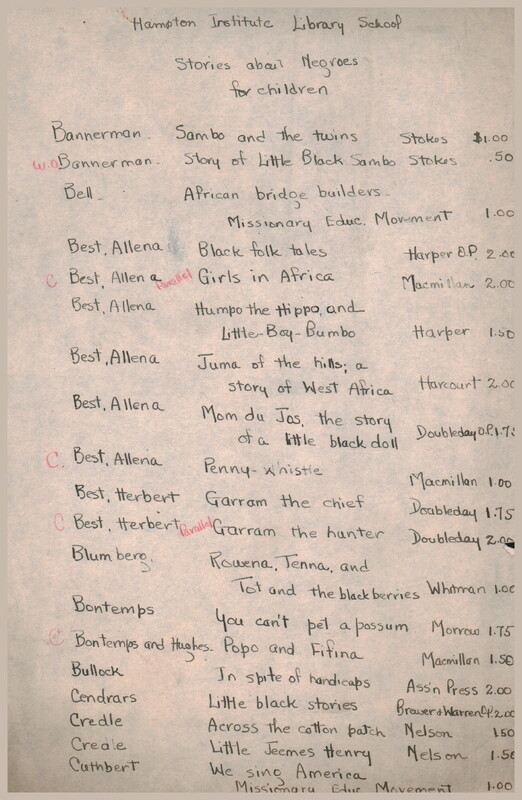
Scanned images of a handwritten list entitled "Hampton Institute Library School Stories About Negroes for Children list". This item is part of Jones Memorial Library Manuscript Collection 1396, the Dunbar High School Library Papers.
The list is sorted alphabetically by author last name and includes recommended titles to include in a library serving African Americans in the early 1900s.
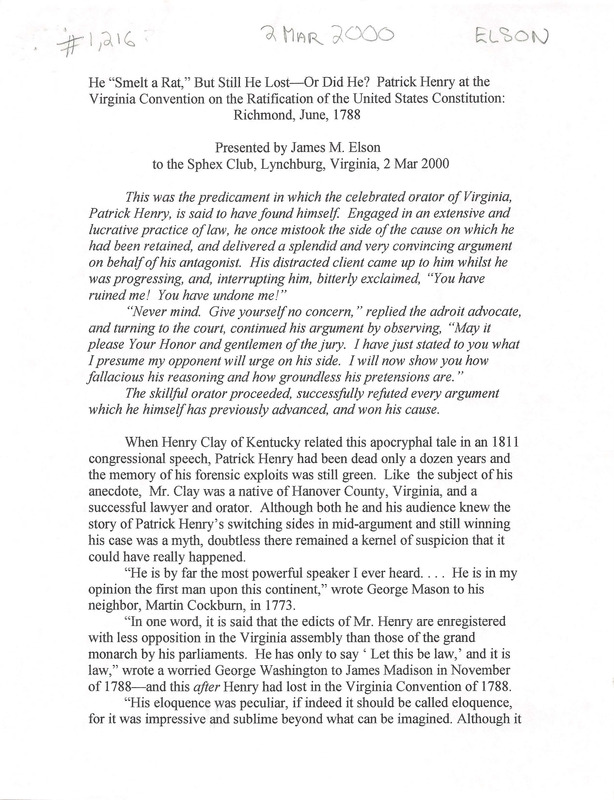
The paper by James M. Elson, presented to the Sphex Club in 2000, explores Patrick Henry's role in the Virginia Convention of 1788, focusing on his opposition to the ratification of the U.S. Constitution. Elson details Henry's political philosophy, his eloquent speeches, and his influence on the inclusion of a Bill of Rights. Despite Henry's fears of a centralized government, the Constitution was ultimately ratified.
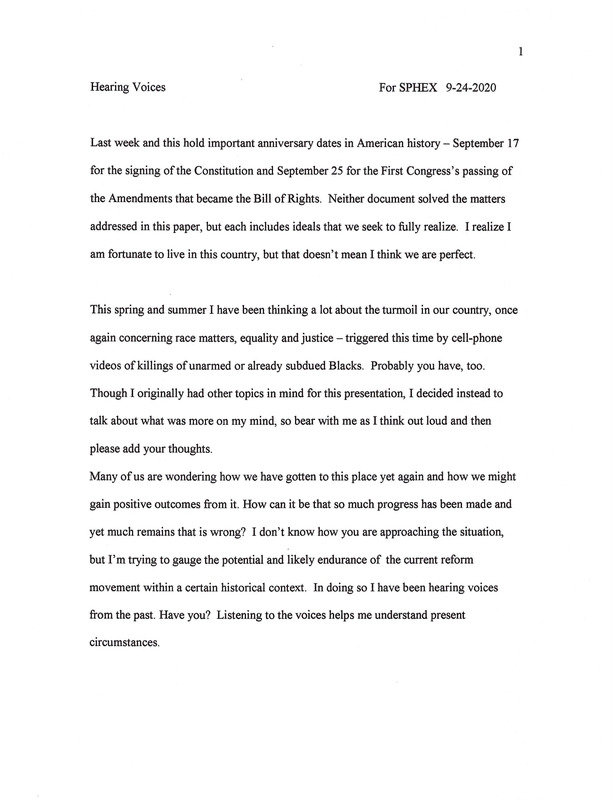
Text of a lecture delivered to the Sphex Club in Lynchburg. Dr. Thomas Tiller's presentation, "Hearing Voices," examines the evolution and impact of race relations and equality movements in the United States, contextualized within the framework of America's three historical reconstructions. The paper discusses the recent resurgence in racial justice activism, its historical precedents, and the potential future implications for societal change and reforms in areas like policing and reparations. The title refers to the many messages about our civil rights deficits we have received and not attended to, and the author highlights the step-forward, step-backward nature of civil rights efforts in the US.
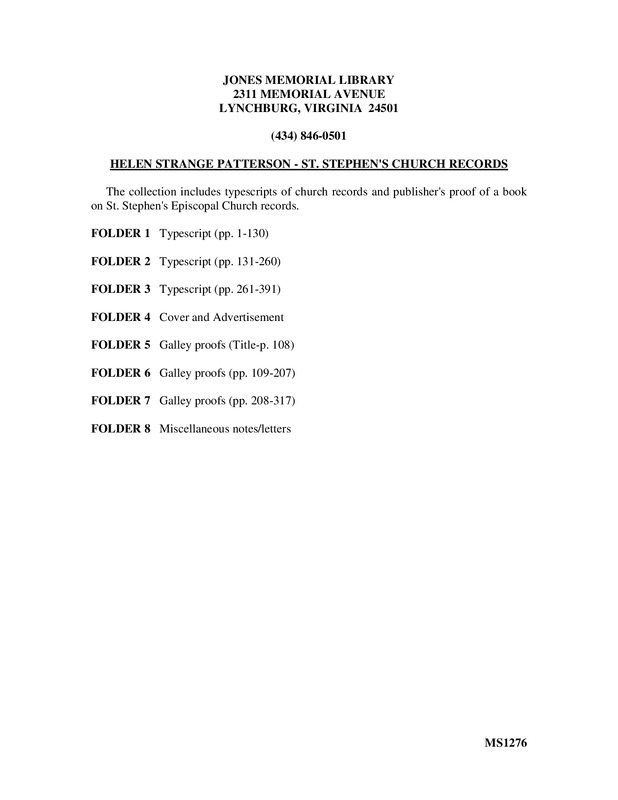
Helen Strange Patterson - St. Stephen's Church Records Held At Jones Memorial Library In Lynchburg, Virginia.
The records from the 1800s include lists of marriages, births, and deaths. Included are "colored" and African-American (black) worshippers at the church who are listed by name and with details on free or enslaved status.
Text of a lecture delivered to the Sphex Club in Lynchburg. Thomas C. Tiller's lecture outlines the complex history and contemporary challenges of nuclear weapons under eleven U.S. presidents. It covers the inception of nuclear arms during FDR's term, emphasizing the scientific breakthroughs and the ethical dilemmas faced by leaders, particularly Truman's decision to use atomic bombs on Japan. The narrative progresses through subsequent administrations, highlighting shifts towards deterrence, arms control efforts like SALT and START treaties, and the end of the Cold War. Tiller also discusses the modern nuclear threats from countries like North Korea and Iran, the proliferation risks, and the renewed global dialogue on nuclear disarmament, referencing significant contributions like the Wall Street Journal op-ed by Shultz, Perry, Kissinger, and Nunn advocating for a world free of nuclear weapons. The paper concludes by questioning the financial and moral costs of nuclear armament and echoing Eisenhower's call for a reevaluation of priorities towards peace and prosperity.
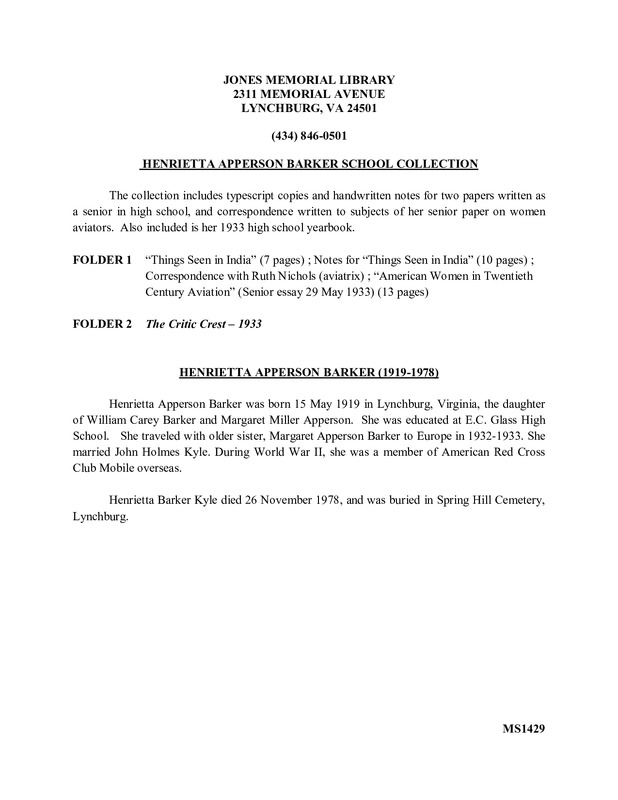
Henrietta Apperson Barker School Collection Held At Jones Memorial Library In Lynchburg, Virginia. The Collection Includes Notes And Letters Related To A School Paper On Women Aviators.
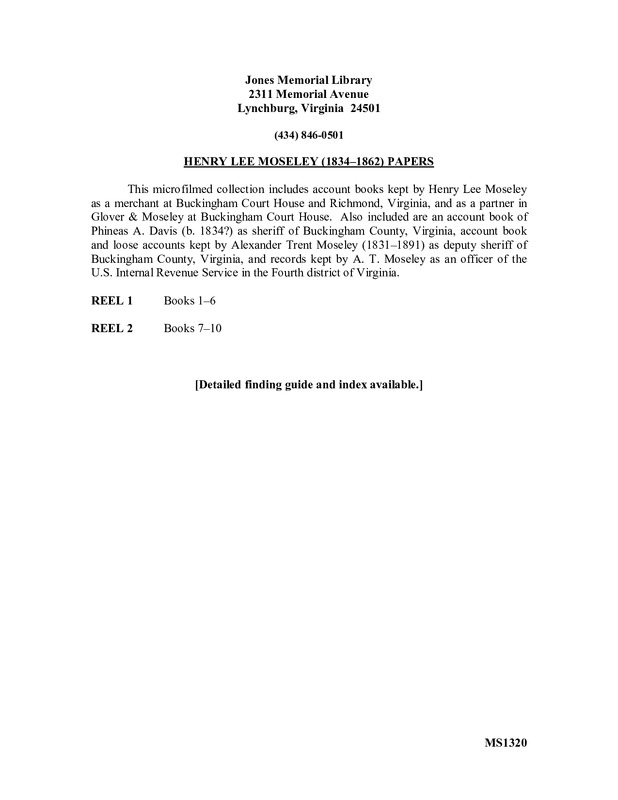
Henry Lee Moseley Papers Held At Jones Memorial Library In Lynchburg, Virginia. The Collection Is Held On Microfilm And Includes Account Books Related To The Buckingham County Court House.
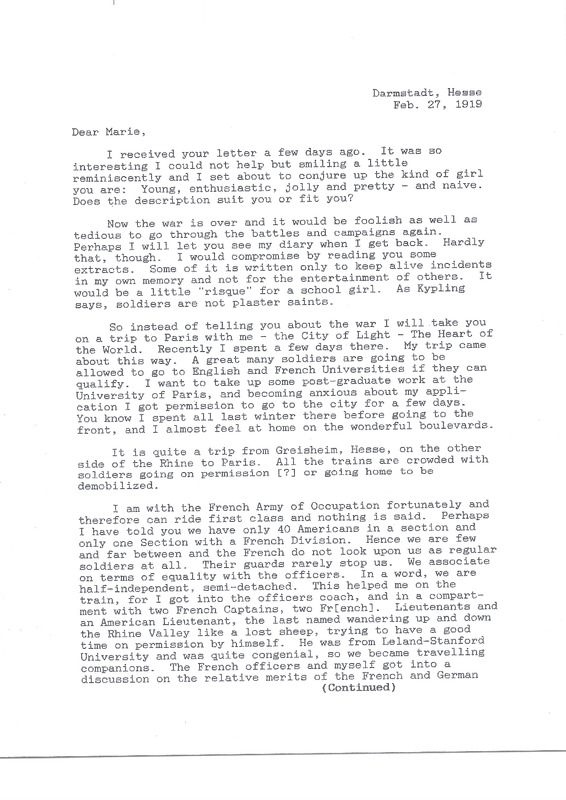
Henry Louis Amonette Letter To Marie Held At Jones Memorial Library In Lynchburg, Virginia. The Letter Was Written In 1919 From Germany And Includes Reminiscences Of World War I.
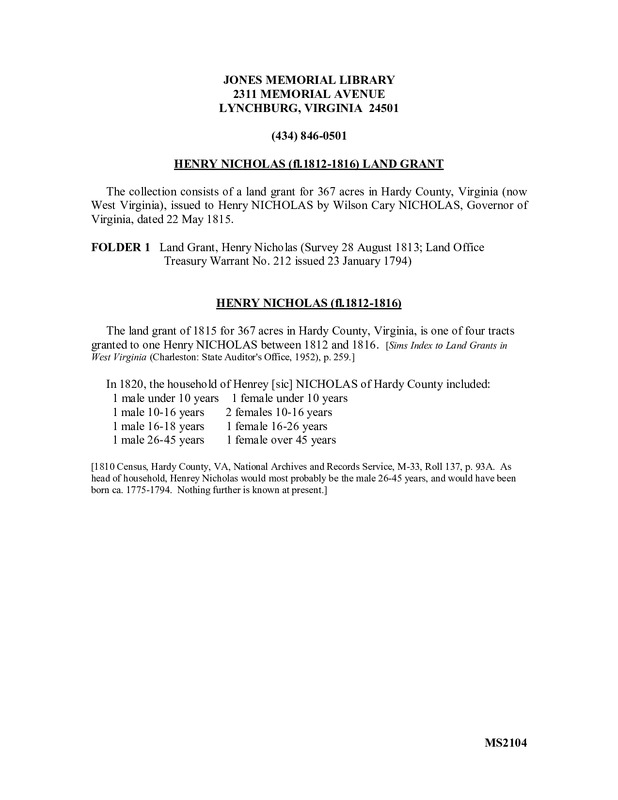
Henry Nicholas Land Grant Held At Jones Memorial Library In Lynchburg, Virginia. The Collection Includes A Grant For 367 Acres In Hardy County, Virginia For Henry Nicholas.
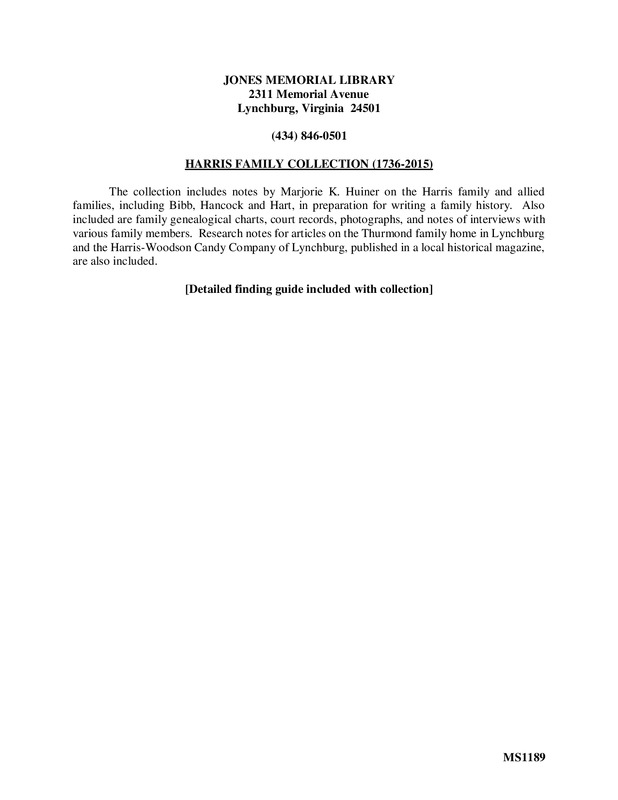
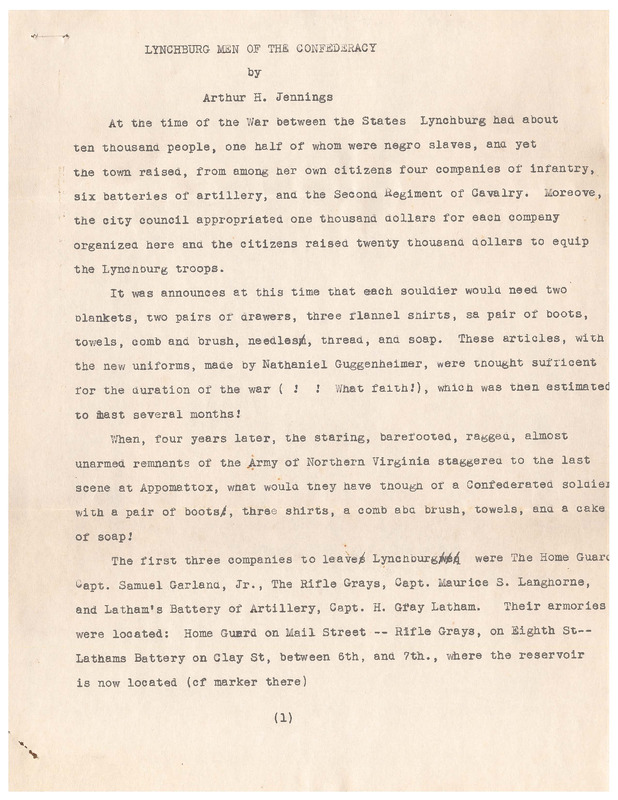
Herbert Bouldin Hawes Papers Held At Jones Memorial Library In Lynchburg, Virginia. The Papers Include Research Notes On The History Of Lynchburg For A Proposed Garrett And Massie Publication On The History Of The City.
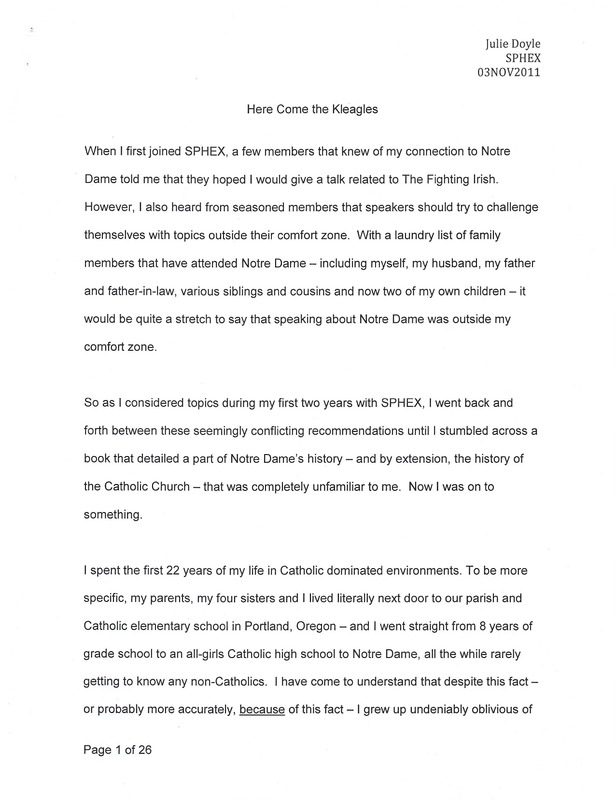
Julie Doyle's lecture at SPHEX on November 3, 2011, titled "Here Come the Kleagles," ventures into an unexplored segment of Notre Dame's history, revealing its unexpected intersection with the Ku Klux Klan's activities in the 1920s. Doyle unveils how Notre Dame, a symbol of Catholic education and values, became a battleground against the KKK's resurgence, highlighting a lesser-known chapter of the university's legacy. Through detailed recounting, she illuminates the courageous stand taken by Notre Dame students against the Klan's attempt to parade through South Bend, Indiana, thereby challenging and overcoming the Klan's message of hate and bigotry.
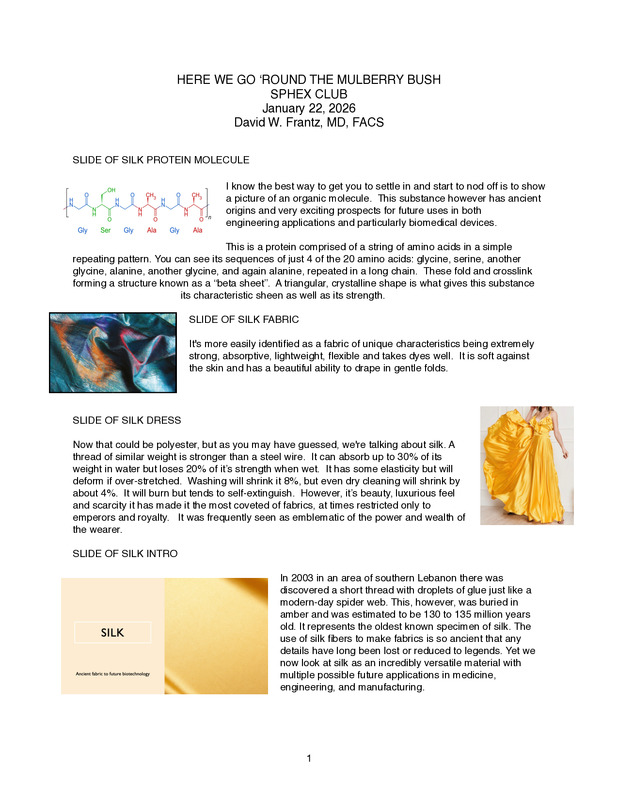
Text of a lecture delivered to the Sphex Club on January 22, 2026. This SPHEX presentation examines the history, biology, production, and future potential of silk. Beginning with silk’s small role in global textiles compared with synthetic fibers, the speaker explains how silkworms, especially Bombyx mori, became uniquely domesticated for silk production. The talk describes the silkworm life cycle, cocoon harvesting, sericulture’s origins in ancient China, and the spread of silk technology along the Silk Road into Europe and the Americas. It also details the labor-intensive process of reeling and weaving silk and the modern automation led by China. The presentation then shifts to cutting-edge research involving silk protein fibroin, highlighting its biocompatibility, biodegradability, and applications in medicine, manufacturing, food preservation, sensors, adhesives, and vaccine delivery, including genetic engineering and synthetic biological production of silk proteins.
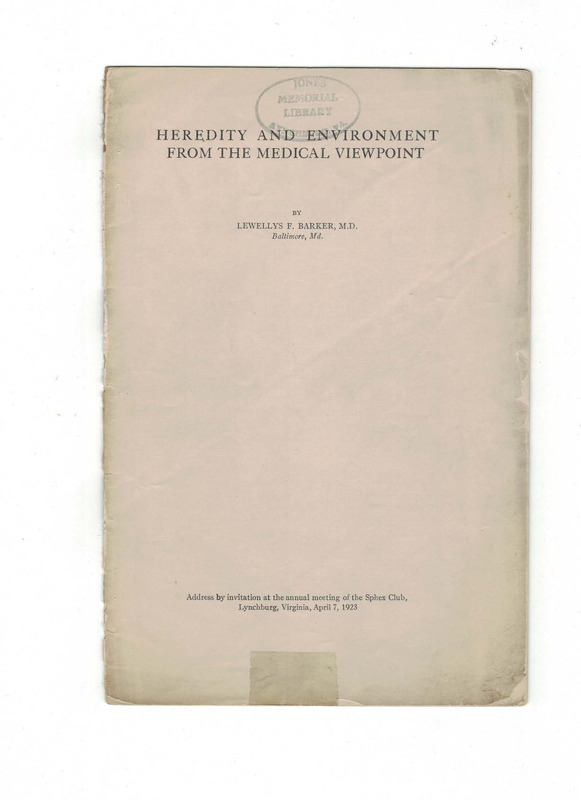
Text of a lecture delivered to the Sphex Club in Lynchburg. Lewellys F. Barker's paper, Heredity and Environment from the Medical Viewpoint, presented on 4/7/1923, delves into the impact of heredity and environment on medical conditions, exploring the balance between genetic predispositions and external factors in disease development. Barker emphasizes the role of internal secretions in physical and mental development, and discusses the implications for medical treatment and societal health.
Hills City Lodge Assembly Hall Music Programs Held At Jones Memorial Library In Lynchburg, Virginia. The Collection Includes Four Programs For Music Concerts Held At Hill City Masonic Lodge In The Early 1900S.