The collection of the Sphex Club, of Lynchburg, Virginia, includes minutes of meetings, the constitution and bylaws of the Club, a roster of its members, and a listing of Sphex papers presented by members and guests of the Club. In addition to this guide, the collection is outlined in more detail in “Sphex in the Jones Memorial Library,” Chapter VI of the Club history, The Sphex Club of Lynchburg, Virginia: The First One Hundred Years, 1910-2010, by James M. Elson.
Access Rights
Lectures delivered by members appear as papers in the Item Set. Papers are available in print at the library. Select papers have been digitized (including all papers delivered to the Club prior to 1952).
Authors retain copyright to their work. Papers may not be reproduced or reprinted without permission of the author and the library.
The academic paper, titled "King James of Lynchburg: An Analysis of the Flood of November 5, 1985" by E. Allen Culverhouse, delves into the severe flooding that devastated Lynchburg due to the James River overflowing. The paper provides a detailed account of the flood's impact, exceeding $50 million in damages, and emphasizes the heroism of municipal employees and local organizations. It covers historical flood data, the emergency responses, and the community's resilience, ultimately advocating for improved flood warning systems.
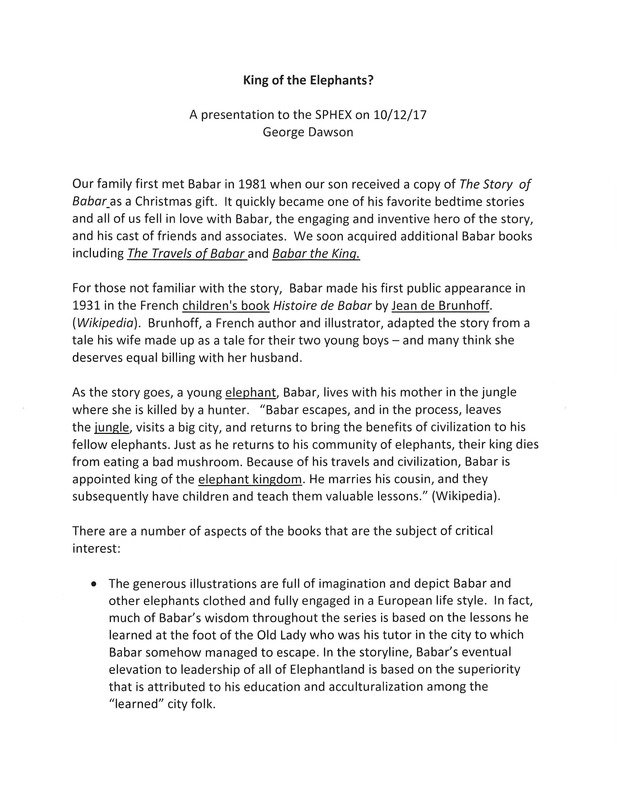
George W. Dawson's lecture, "King of the Elephants?" presented to the SPHEX Club on 10/12/17, explores the Babar children's book series, anthropomorphism, and the real-life implications and controversies surrounding Babar's depiction. Dawson delves into the history of Babar, the character's journey from jungle to civilization, and the broader issues of colonialism and racism hinted at in the stories. The presentation also includes personal anecdotes, analysis of elephant biology and social structures, and the pressing issue of ivory poaching and its historical context.
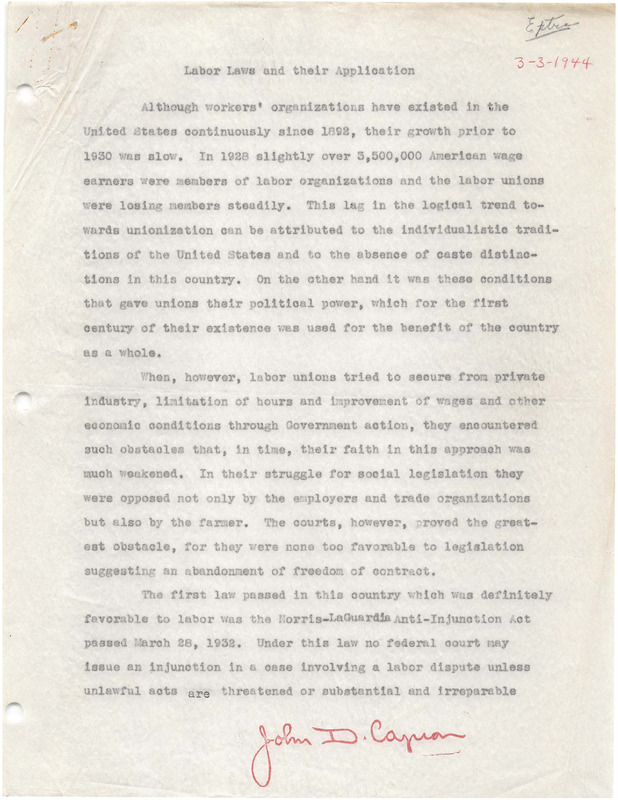
Text of a lecture delivered to the Sphex Club in Lynchburg. The paper outlines the development and impact of labor laws in the U.S., focusing on their evolution from the Norris-LaGuardia Act to the Fair Labor Standards Act, and their effects on labor conditions, employer practices, and industrial relations. It discusses specific legislation, court challenges, and the experiences of Glamorgan Pipe and Foundry Company with labor laws and union activities. The narrative highlights the complexities and consequences of labor legislation, both intended and unintended, on businesses and workers.
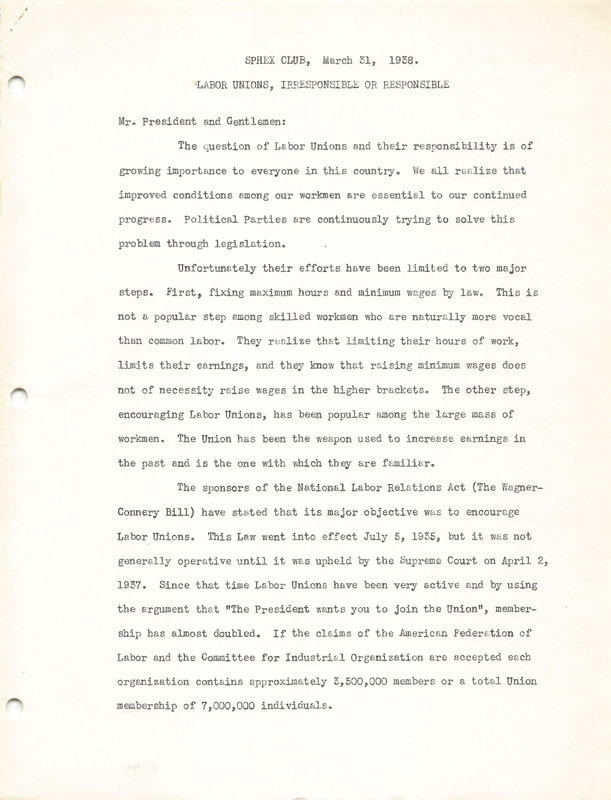
Text of a lecture to the Sphex Club in Lynchburg. John Capron's 1938 paper critically examines the role and responsibility of labor unions in America. It delves into the challenges and consequences of the National Labor Relations Act, discussing the increase in strikes and the debate over the regulation and power of unions in the industrial landscape.
This paper by Rear Admiral Malcolm W. Cagle, delivered at a SPHEX Club lecture, discusses the implications of U.S. military and diplomatic decisions during the Korean War. The author elaborates on three main themes: the U.S.'s lack of clear intentions prior to the conflict, manpower issues in the military, and significant military decisions by Stonewall Jackson to highlight broader strategic lessons. Cagle emphasizes the necessity of clear national intentions, preparation for conflict, and maintaining strong civilian control over the military. He concludes with a cautionary stance against altering the all-volunteer military system.
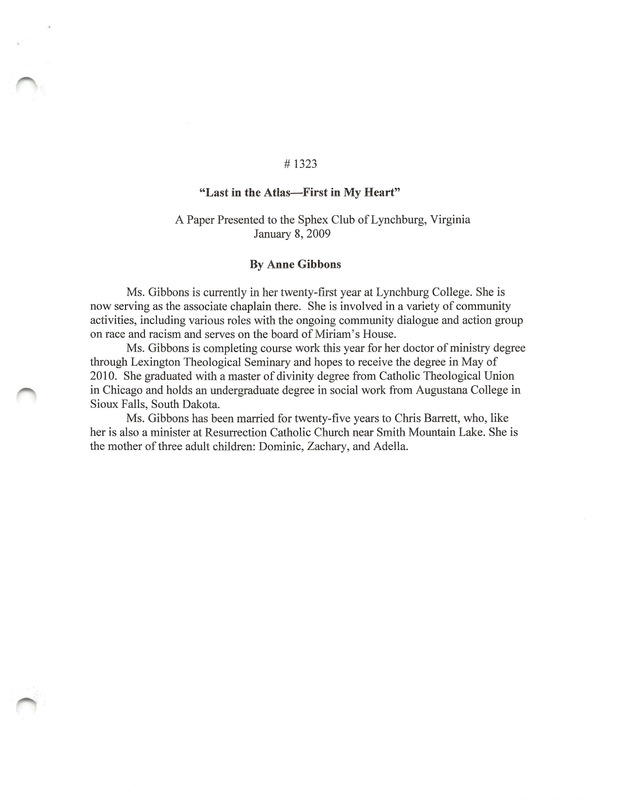
The paper "Last in the Atlas-First in My Heart," presented by Anne Gibbons to the SPHEX Club of Lynchburg, Virginia, on January 8, 2009, explores the history, geography, and culture of Wyoming, focusing on its sparse population, rich heritage, and environmental issues. Gibbons blends historical chronology, cultural insights, and personal anecdotes to illustrate the unique charm and ongoing conflicts of her home state.
The paper by Kenneth R. Garren discusses leadership, exploring various definitions and perspectives on what makes an effective leader. It contrasts leaders, managers, and dictators, emphasizing moral and ethical decision-making. Key traits of successful leaders include drive, motivation, honesty, self-confidence, cognitive ability, and business knowledge. The paper also examines gender differences in leadership styles and concludes with practical advice for leaders.
This paper by Boyd C. Rist delves into the conservation ethos and efforts in late 19th and early 20th century America, focusing on key figures like Theodore Roosevelt and John Muir, and the broader socio-political movements of the era. It highlights the emergence of a conservation ethic amidst rapid industrialization and the pivotal role of influential individuals and organizations in advocating for the preservation of natural wilderness. The narrative explores Roosevelt's personal transformation into a conservationist and the legislative and executive measures he championed as President to safeguard vast expanses of American wilderness for future generations, emphasizing the foundational belief in the democratic right to natural beauty and resources.
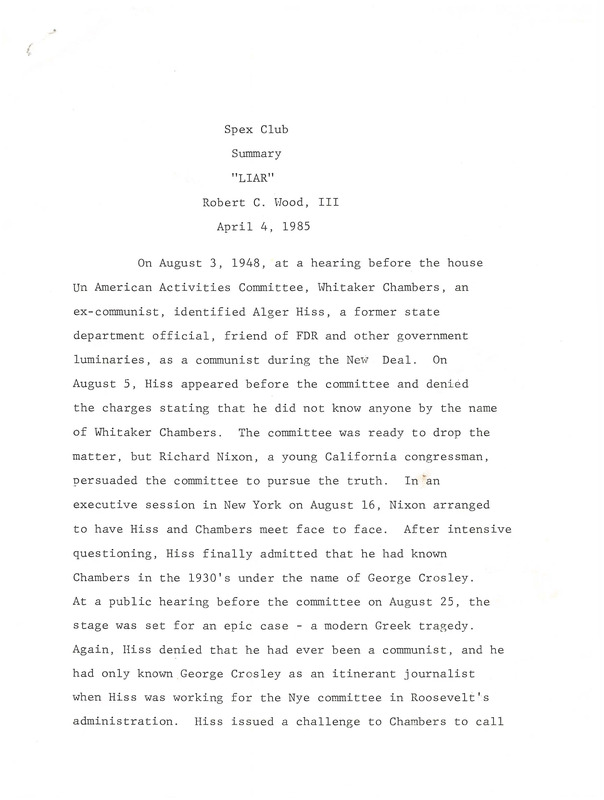
Text of a lecture to the Sphex Club in Lynchburg. This academic paper examines the historical case of Alger Hiss, accused by Whitaker Chambers of being a communist and a spy. The narrative traces the investigation led by Richard Nixon, the subsequent legal battles, and the grand jury indictments. It delves into the conflicting testimonies, the emergence of physical evidence (the "pumpkin papers"), and the eventual perjury conviction of Hiss. The paper invites the reader to reassess the case, considering the Watergate scandal's impact on public trust in government.
The paper explores the LIFE program, a lifelong learning initiative designed to enrich the lives of seniors through educational opportunities. It traces the development of the program from its inception at the University of Central Florida to its expansion to other universities. The paper emphasizes the cognitive, emotional, and social benefits of lifelong learning. It also delves into the cultural and social significance of quilting, particularly focusing on the historical and contemporary roles of quilting groups.
Lights Over the Bar by George M. Snead Jr. discusses the author's experiences as a cadet at the Virginia Military Institute (VMI) and explores the history and impact of Confederate blockade runners during the Civil War. The paper provides detailed accounts of both the challenging cadet life at VMI and the strategic importance of blockade running in maintaining the Confederacy's supply lines. The author draws parallels between historical military strategies and modern conflicts, emphasizing the need for unwavering commitment in wartime.
This paper, presented by William A. McIntosh, explores the Theatrum Mundi metaphor's historical and contemporary significance, engaging with themes of truth, fiction, and the role of art in society. McIntosh uses various anecdotes, including a controversy involving Oprah Winfrey and James Frey's memoir, to discuss the blurred lines between truth and fiction in literature and life. He reflects on the implications of storytelling, the authenticity of memoirs, and the theatrical nature of public life and politics, suggesting that the intersection of truth and fiction is a complex and nuanced space.
Retired Judge William W. Sweeney presided over one of the most historic cases in Lynchburg history – the double murder trial of Jens Soering. Judge Sweeney describes the events surrounding the cases against Elizabeth Haysom and Jens Soering for the murder of Elizabeth’s’ parents. Sweeney’s report to Sphex after his retirement was a rare first-hand account of the horrors that occurred in 1985.
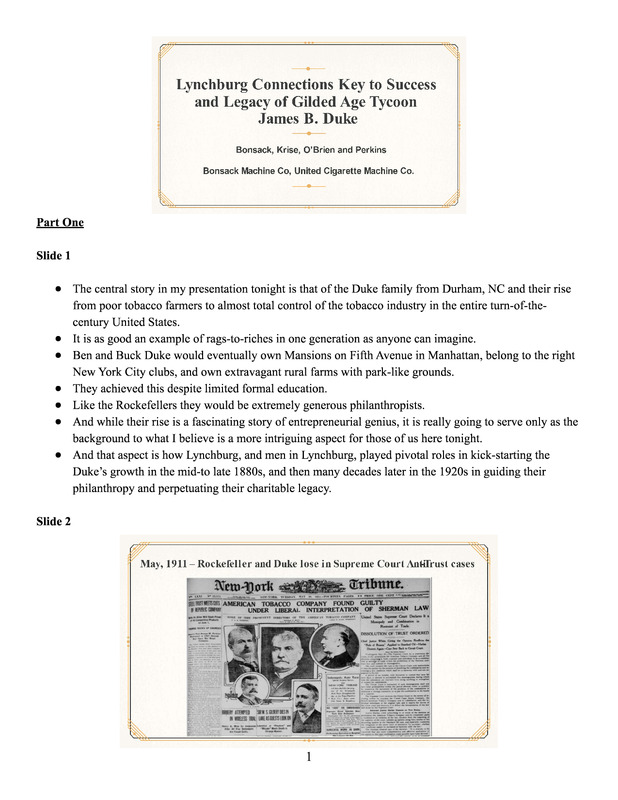
The paper explores the Duke family's rise from poor tobacco farmers to industrial tycoons controlling the American tobacco industry. It emphasizes the pivotal role of Lynchburg, Virginia, and local figures like James Bonsack and William O'Brien in their success. The narrative spans from the Dukes' early entrepreneurial efforts, through their legal battles, to their philanthropic endeavors, particularly highlighting James B. Duke's shift towards hydroelectric power and the creation of the Duke Endowment.
The paper provides a comprehensive history of public health development in Lynchburg, Virginia. After a brief review of health services and regulatory practices from the early 17th century to the mid-20th century, he details the evolution of Lynchburg's Board of Health to the establishment of the Lynchburg Health Department, the role of prominent figures like Dr. Mosby G. Perrow and successors in advancing local public health infrastructure, and the gradual integration of Lynchburg's health department with state health initiatives. Key points include the introduction of sanitation practices, vaccination programs, and the establishment of health clinics. The narrative underscores the challenges and achievements in public health administration and policy development within the context of Lynchburg's conservative stance on governance and innovation.
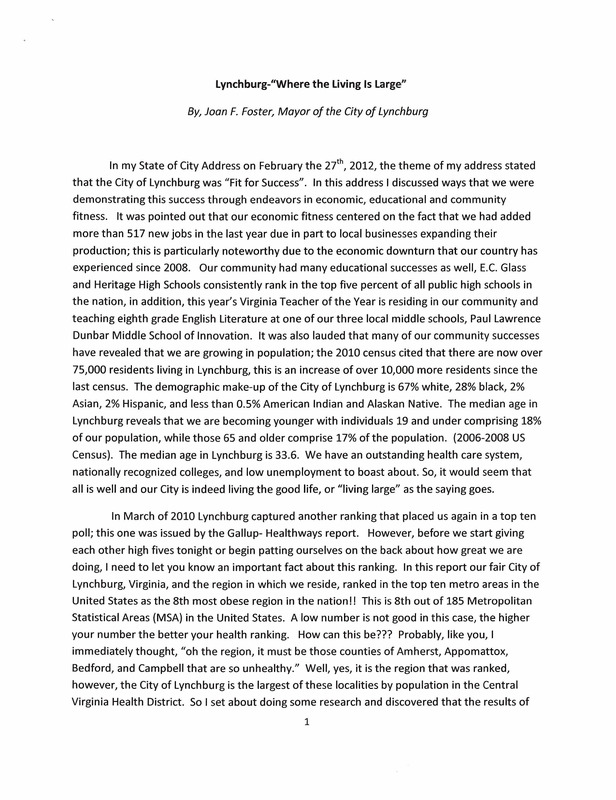
Joan F. Foster, Mayor of Lynchburg, details the city's achievements and challenges in her 2012 State of the City Address. She emphasizes Lynchburg's economic and educational successes, but highlights a significant health issue: high obesity rates. To combat this, the city launched the "Live Healthy Lynchburg" initiative, focusing on improving nutrition, physical activity, and overall community health through various programs and partnerships.
This paper by James B. Noell provides a comprehensive overview of Lynchburg, Virginia's significant contribution to the Confederate forces during the American Civil War. It details the military service and biographies of five generals associated with Lynchburg, emphasizing their roles, battles, and the broader impact of Lynchburg's population on the Confederacy's military efforts. The paper is organized by detailing each general's background, military career, and post-war life, offering insights into the strategic significance of Lynchburg and its citizens in the Civil War.
Born in 1886 on 416 Main Street (beside today’s Texas Inn), Dr. Douglas Southall Freeman’s family moved to Richmond when he was five-years-old. Dean Turner explains why Freeman was one of the most brilliant men ever born in Lynchburg. Freeman received two Pulitzer Prizes -- one for his four-volume biography of Robert E. Lee and a second for his six-volume account of the life of George Washington.
Peter Houck's lecture, delivered on April 13, 1995, offers an in-depth exploration of the life and legacy of John Warwick Daniel, a prominent figure from Lynchburg, Virginia. Houck's narrative covers Daniel's lineage, his valor in the Civil War where he earned the nickname "the Lame Lion of Lynchburg," his subsequent legal career, and his significant role in politics as a U.S. Senator advocating for the Free Silver movement. Daniel's life story is presented as a testament to his fortitude, oratory skills, and dedication to Virginia's heritage, making a compelling case for considering him Lynchburg's most illustrious character. Houck concludes by mentioning his own efforts to preserve Daniel's childhood home as a museum, underscoring the enduring importance of Daniel's contributions to Virginia and its history.
Madinat al-Zahra: A Jewel of Andalusia is a detailed examination of the city-palace complex of Madinat al-Zahra, presented by Morteza Sajadian. The paper elaborates on its foundational role in the evolution of Islamic art and architecture in Andalusia, particularly during Spain's tenth-century Islamic cultural zenith. Highlighting Madinat al-Zahra's transformation from a summer residence to a significant administrative and artistic center, Sajadian underscores its architectural and decorative contributions to Islamic heritage. Despite extensive destruction over centuries, the city-palace's ornamental style and influence on later Islamic architecture in Spain, including the Alcazar and Alhambra, are emphasized. Sajadian criticizes the limited and conflicting scholarly discourse on Madinat al-Zahra, advocating for deeper stylistic analysis and appreciation of its historical and cultural significance.
T Gibson Hobb's paper focuses on the history of Lynchburg, Virginia's water works highlights its evolution from a system of wells and springs to a modern public utility. The city's pioneering water infrastructure, built in the early 19th century, included dams, a pump house, and reservoirs, reflecting advancements in engineering and public health. The system evolved over time, adapting to the city's growth and technological changes.
Man in Society: A Macroanalysis by Richrd P. Gifford, explores human societal development using a hypothetical "anthropochronoscope" to analyze history's key phases. Gifford contrasts ancient societies of Egypt, Greece, and Austria, highlighting differences in individualism, societal structure, and achievements. He discusses the oscillation of power and cultural influence between East and West, emphasizing the importance of understanding and integrating diverse philosophies to prevent future conflicts.
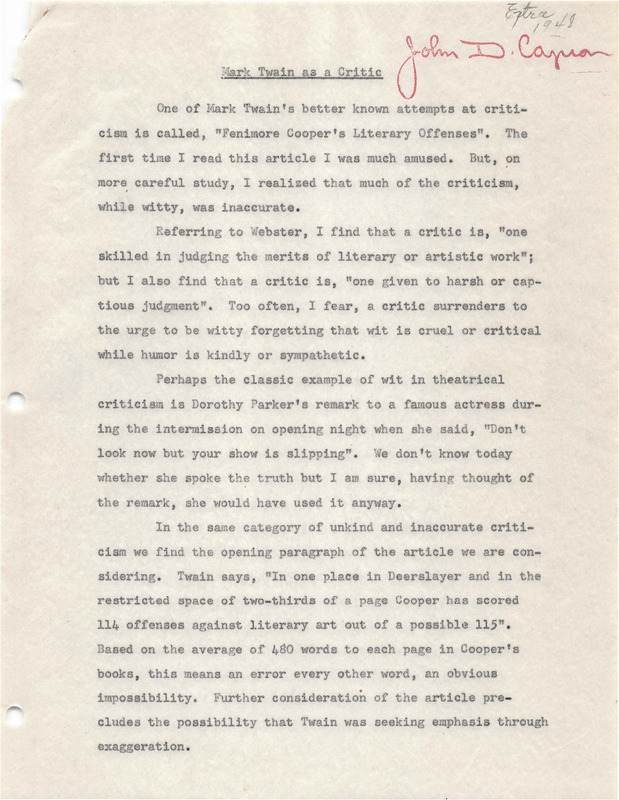
Text of a paper delivered to the Sphex Club in Lynchburg. John D. Capron's paper, "Mark Twain as a Critic," scrutinizes Twain's critique of Fenimore Cooper's work, notably "Deerslayer." Capron argues that while Twain's observations are humorous, they often lack accuracy and fairness. He emphasizes that a critic should prioritize truth over wit, presenting examples where Twain's critique misinterprets or exaggerates Cooper’s text. Capron's examination includes detailed comparisons and personal verifications to challenge Twain's judgments, ultimately advocating for more honest and careful literary criticism.
“Accepted as a thoroughly American humorist,” some experts believe Mark Twain possessed an inner life of pessimism, rage and despair. These feelings led to a negative view of the nature of man, of God and the universe. Other experts disagree, defending Twain as a humorist whose writing could be misunderstood. Examples from Twain’s writings are used to support these widely differing views.