The collection of the Sphex Club, of Lynchburg, Virginia, includes minutes of meetings, the constitution and bylaws of the Club, a roster of its members, and a listing of Sphex papers presented by members and guests of the Club. In addition to this guide, the collection is outlined in more detail in “Sphex in the Jones Memorial Library,” Chapter VI of the Club history, The Sphex Club of Lynchburg, Virginia: The First One Hundred Years, 1910-2010, by James M. Elson.
Access Rights
Lectures delivered by members appear as papers in the Item Set. Papers are available in print at the library. Select papers have been digitized (including all papers delivered to the Club prior to 1952).
Authors retain copyright to their work. Papers may not be reproduced or reprinted without permission of the author and the library.
Text of a lecture delivered to the Sphex Club in Lynchburg. Eric Sorenson, Sr. examines the scientific searches for the existence of extra-terrestrial life. Then he explains logical reasons why we have not yet found life elsewhere. Sorenson ends by quoting the scientist Martin Rees, “The absence of evidence is not evidence of absence."
Where Did My Hero(es) Go? by George M. Snead, Jr. discusses the life and legacy of Charles Augustus Lindbergh, Jr. It traces Lindbergh's journey from his early life through his historic flight and subsequent contributions to aviation, highlighting the challenges he faced with public perception and media scrutiny. Snead examines the evolution of Lindbergh's heroism and the impact of misinformation on his public image.
Text of a lecture delivered to the Sphex Club in Lynchburg. The paper, "Where's the Mountaintop" by Julius Sigler, offers an in-depth exploration of the American hero archetype, exemplified by the life and legend of David Crockett. Sigler juxtaposes the historical Crockett, a pioneer, legislator, and Alamo martyr, with the mythologized "Davy" Crockett, a folk hero woven into the American cultural fabric through tall tales, plays, and television. Through the examination of Crockett's real exploits alongside his legendary feats, Sigler illustrates the profound impact of Crockett's legacy on American identity and the concept of heroism. The narrative is structured around Crockett's biography, highlighting key events from his upbringing, political career, and eventual heroic stand at the Alamo, while also delving into the creation and perpetuation of his larger-than-life legend.
In 2018 California has more irrigated acreage and produces a wider variety of commercial crops than any other state in the USA. Enough useable water has always been the greatest challenge for California since the Gold Rush of 1849. A history is traced of the complex challenge of providing water to such a diverse state which sometimes seems to experience overwhelming needs for clean water.
Text of a lecture delivered to the Sphex Club in Lynchburg. Thomas C. Tiller's paper "WHO GOES THERE?" examines the complex issue of dissent in wartime, specifically focusing on the balance between national security and the protection of civil liberties. Tiller explores historical instances where the U.S. government has restricted freedom of speech during times of war, such as the Alien and Sedition Acts of 1798, Lincoln's suspension of habeas corpus during the Civil War, and the Espionage and Sedition Acts during World War I. By referencing Geoffrey R. Stone's "Perilous Times: Free Speech in Wartime," Tiller underscores the recurring theme of governments curtailing civil liberties under the guise of national security. The paper emphasizes the importance of maintaining a robust dialogue on governmental policies and actions, especially in times of conflict, to prevent the erosion of fundamental freedoms. Tiller argues that open debate is crucial for a democratic society to avoid "tragic blunders" and to ensure that security measures do not undermine the very principles they aim to protect.
Demographic and other trends are increasing demands placed on the judicial system. History of the evolving requirements to provide legal representation for the indigent and the various mechanisms to address the need.
Text of a lecture delivered to the Sphex Club in Lynchburg. This paper, titled "Who Killed Little Mary?" by Marc Schewel, delves into the complex and harrowing case of Mary Phagan's murder in 1913, highlighting the societal and judicial intricacies that led to the conviction of Leo Frank. Schewel explores themes such as racial prejudice, anti-Semitism, and the impact of media sensationalism on the legal process. Through a detailed examination of the investigation, trial, and public reaction, the paper reveals the multifaceted nature of justice and its susceptibility to external influences. Schewel's work underscores the intertwining of social attitudes with the pursuit of justice, offering a nuanced perspective on a historically significant legal case.
Text of a lecture delivered to the Sphex Club in Lynchburg. Eric J. Sorenson discusses the early development of Christian dogma, particularly focusing on the nature and identity of Jesus Christ. It traces the ambivalence about Jesus's divinity, the impact of the crucifixion and resurrection, and the subsequent doctrinal disputes among early Christians. The paper highlights key figures, heresies, and theological debates that shaped orthodox Christian beliefs, culminating in the Council of Nicea.
Melvin R. Watson's paper "Whose Life Is It Anyway?" discusses the right-to-die issue through real and fictional cases, including Ken Harrison, Larry McAfee, and Nancy Cruzan. Watson examines ethical, medical, and legal perspectives on euthanasia and patients' autonomy. The paper highlights evolving attitudes towards passive and active euthanasia and emphasizes the importance of Living Wills in ensuring patients' end-of-life wishes are respected.
For his gallant actions throughout WW II, James A. Huston received many of the highest military awards presented by France and the United States. Dr. Huston highlights several of his books. His main focus in the presentation centers on his special relationship with President Harry Truman and the major accomplishments Truman made during his years as president.
Reverend Dennis Roberts' presentation "Witch Hunt" delved into the historical witch hunts of early modern Europe, focusing on the Germanic regions and the period from 1450 to 1750. It examined the societal and religious factors contributing to the persecution, particularly misogyny and patriarchy, noting that most victims were women. The talk also explored the enduring impact of these witch hunts on the treatment of women and questioned the modern use of the term "witch hunt" as a means to subtly perpetuate misogyny.
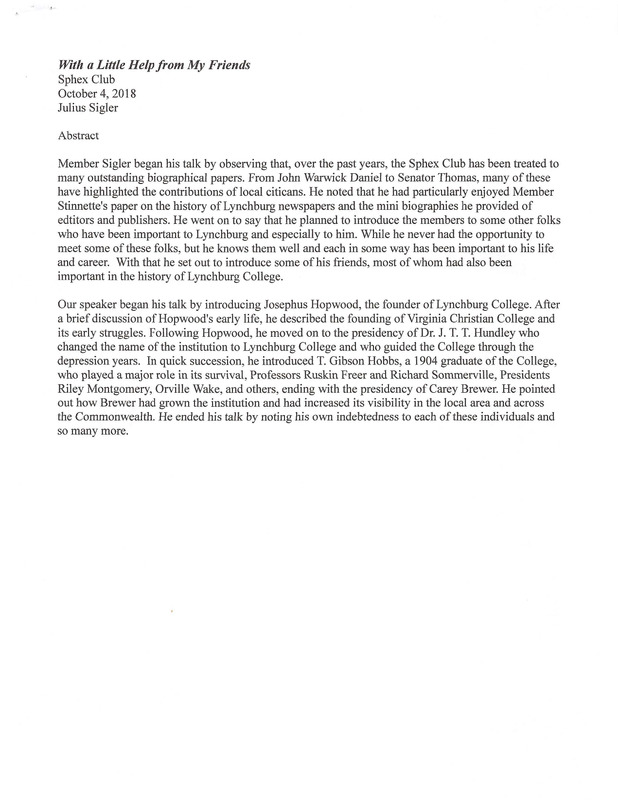
Text of a lecture delivered to the Sphex Club in Lynchburg. This paper by Julius Sigler offers a comprehensive overview of the key figures and developments in the history of Lynchburg College (LC), emphasizing the transformative role of education and community leadership in Lynchburg, Virginia. Sigler shares personal anecdotes and the biographies of influential individuals associated with LC, including its founding by Josephus Hopwood and the subsequent contributions of various educators, administrators, and students who have shaped the institution's legacy. The narrative highlights the importance of education grounded in Christian principles, the evolution of LC's academic and physical landscape, and the personal impact of these figures on Sigler's life and career.
This academic presentation by Dr. Sabita Manian, titled “Within and Without the Veil,” explores the resurgence of Far-Right Neo-Nationalism in Europe and North America, and its connections to the war in Ukraine. Dr. Manian draws from W.E.B. Du Bois’ concept of the "veil" to examine the intersection of domestic and international politics, the challenges to democracy, and the impact of symmetrical and asymmetrical warfare on liberal values. Key points include the role of mainstream media in highlighting the rise of far-right politics, the influence of hate forums and conspiracy theories in undermining democracies, and Putin’s destabilizing actions in Ukraine.
This paper by Herbert R. Moore Jr. delves into Moore's personal reflections on his childhood hero, Fred Harman, the creator of Red Ryder and Little Beaver. Harman, related to Moore through marriage, is celebrated for his contributions to Western art and comics. The paper recounts Harman's life journey from a cowboy in Colorado to a renowned artist, highlighting his work alongside Walt Disney, creation of the iconic Red Ryder comic strip, and his legacy in Western art. Moore shares anecdotes from Harman's life, emphasizing his artistic talent, influence on American culture, and the authenticity he brought to his depictions of the American West.
Work in Progress by Joan Jones, delves into the evolution of educational approaches towards gifted children in Lynchburg, from the era of Superintendent Dr. Paul Munro's homogenized view of student abilities to the innovative strategies implemented by Dr. Fred Young. Through personal anecdotes and a historical overview, Jones critiques the static IQ-based identification of giftedness, advocating for Howard Gardner's theory of Multiple Intelligences (MI) as a more inclusive and humane framework. She highlights the dynamic nature of education, the necessity of recognizing and nurturing diverse talents, and the potential shifts towards MI-inspired curricula, emphasizing the critical role of individualized education in developing every child's potential.
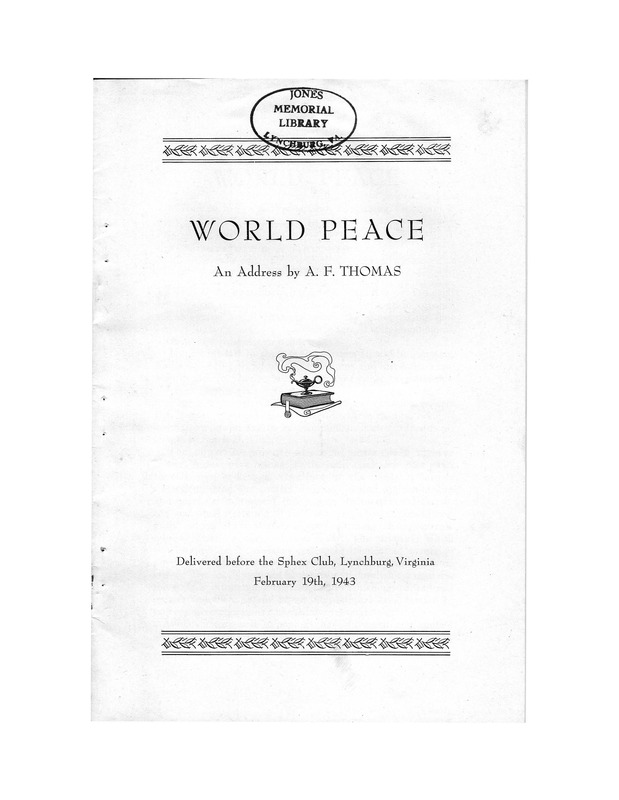
Text of a lecture to the Sphex Club in Lynchburg. The paper "World Peace" by A.F. Thomas emphasizes the necessity of planning for post-war social readjustments based on moral, political, and economic principles. Thomas advocates for an international government to ensure global cooperation and justice, critiquing the failures of absolute national sovereignty and urging the alignment of sovereign power with moral law to prevent future conflicts.
The paper "The Untold Story of Women's Suffrage in Lynchburg, Virginia" by Ted Delaney examines the local women's suffrage movement, highlighting key figures like Elizabeth Dabney Langhorne Lewis and their efforts and obstacles. It traces the national context of women's suffrage, the formation of local suffrage leagues, their activities, and the eventual success and impact of the 19th Amendment on Lynchburg's women.
Christina Delzingaro's presentation, "Yet Another Thing I Never Learned in School," explored the setbacks faced by African Americans in accumulating generational wealth due to white physical and policy violence starting from the Reconstruction Era. It detailed the impact of over 175 racially motivated massacres and oppressive policies like Jim Crow laws and redlining on the economic and political advancement of black Americans, highlighting the long-lasting effects of these actions on the wealth disparity between white and black families in the U.S.
James M. Elson's paper outlines his plans for two distinct funerals to honor his life and his two wives. Emphasizing meticulous preparation, the paper details the services, musical selections, and readings, highlighting the significance of music and personal touches. Elson shares his life's background and the rationale behind his unique funeral plans, inviting feedback from his audience.
This paper by Philip Lightfoot Scruggs revisits and challenges Thomas Wolfe's assertion "You can't go home again" through personal experiences and observations. Scruggs, whose life spanned significant cultural and social changes, explores the nuances of returning to familiar places and the evolving concept of home. He reflects on his diverse career, the impact of the Great Depression, and shifts in his hometown of Lynchburg, using these as lenses to argue that one can indeed "go home again," albeit in a changed world. The paper delves into themes of nostalgia, cultural and personal transformation, and the enduring connections that define "home."