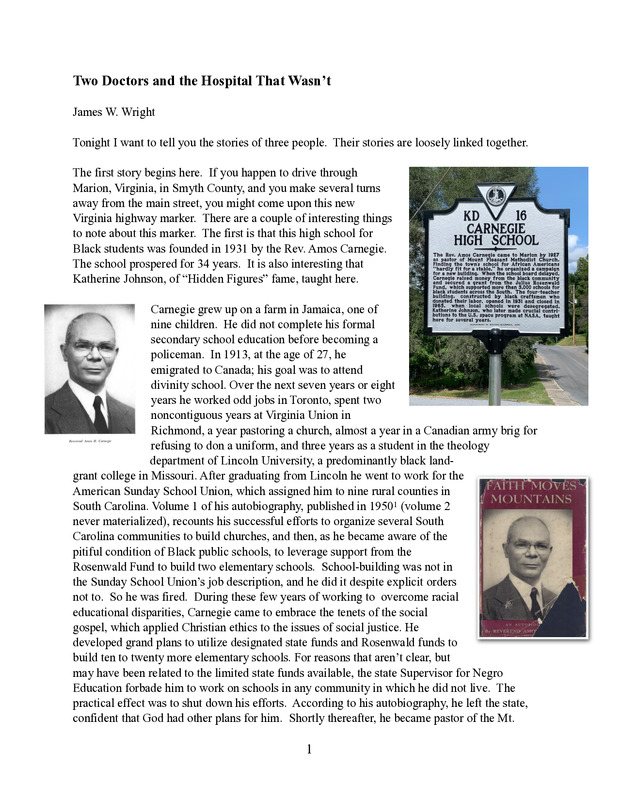
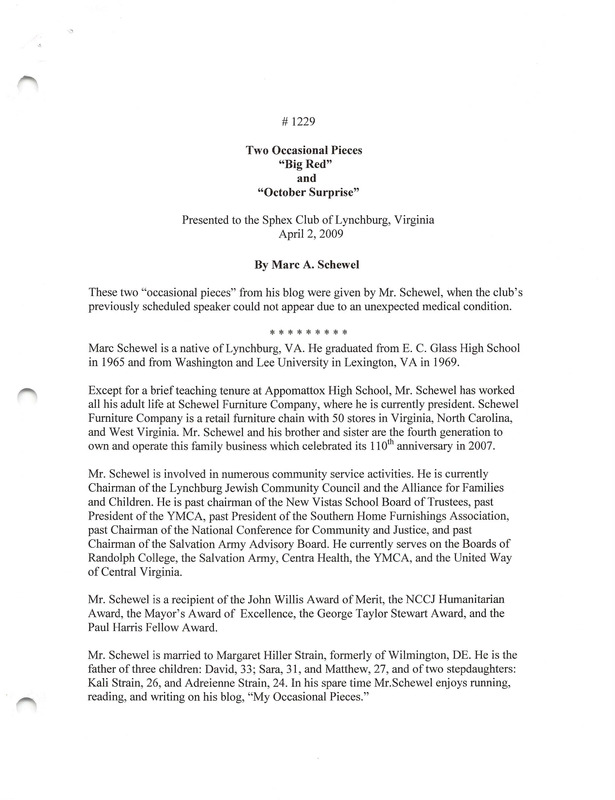
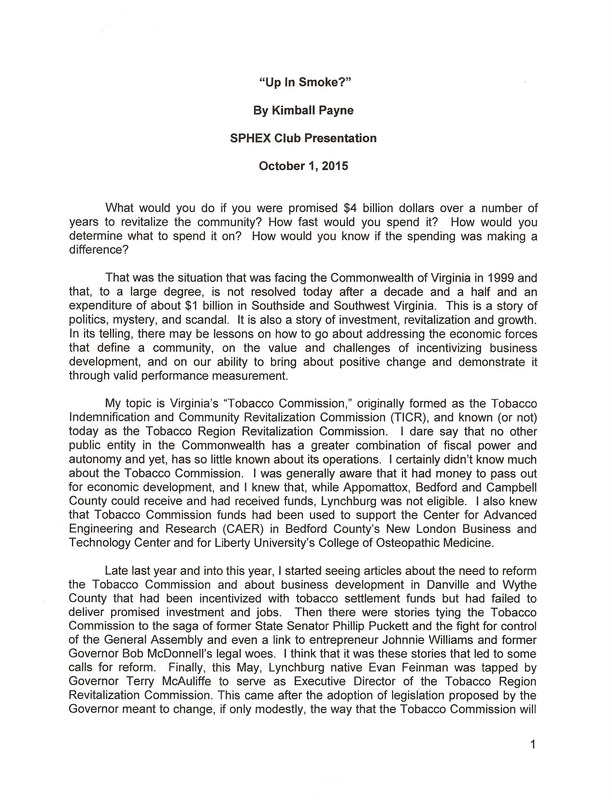
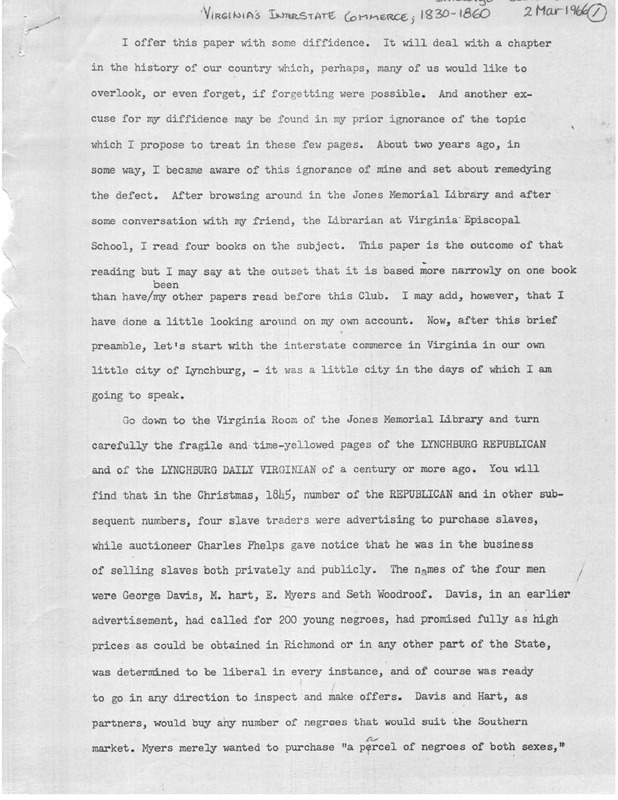
The collection of the Sphex Club, of Lynchburg, Virginia, includes minutes of meetings, the constitution and bylaws of the Club, a roster of its members, and a listing of Sphex papers presented by members and guests of the Club. In addition to this guide, the collection is outlined in more detail in “Sphex in the Jones Memorial Library,” Chapter VI of the Club history, The Sphex Club of Lynchburg, Virginia: The First One Hundred Years, 1910-2010, by James M. Elson.
Access Rights
Lectures delivered by members appear as papers in the Item Set. Papers are available in print at the library. Select papers have been digitized (including all papers delivered to the Club prior to 1952).
Authors retain copyright to their work. Papers may not be reproduced or reprinted without permission of the author and the library.
Richard P. Gifford's "Thy Kingdom Come: Evolution, History, and the Bible" explores the intersection of biblical creation, evolutionary theory, and historical accounts of human origins. The paper integrates perspectives from the Bible, geology, paleontology, and anthropology to propose a unified view of human evolution. It suggests that while science can explain how humans evolved, the why remains a matter of faith, proposing that human uniqueness is rooted in divine creation and purpose.
Early American culture, academia and Economics were defined by Prostestantism. Urban poverty in the emerging industrial economy split the older Protestant economists and the young evangelicals in a struggle for influence. The gradual acceptance of social reforms promoted by the evangelical economists made them the dominant voice of the first two decades of the 20th century.
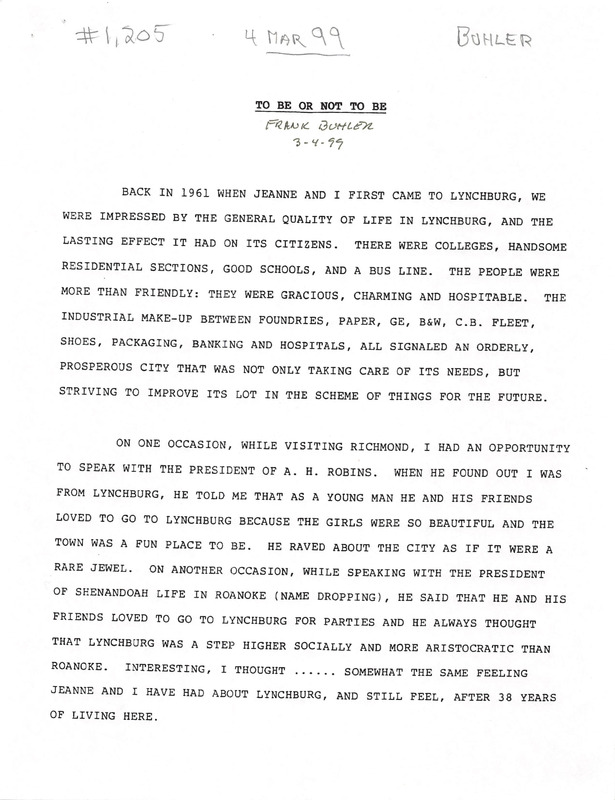
The paper by Frank Buhler discusses the historical evolution and cultural significance of Lynchburg, Virginia, with a focus on the revitalization of its downtown area. It details the decline and subsequent efforts to revive Lynchburg's core, highlighting key projects like the Academy Theater, Percival's Island, and other cultural landmarks. Buhler also draws parallels between Lynchburg and Salzburg, Austria, suggesting potential for a similar cultural renaissance.
The history of bonsai and penjing. The different styles of bonsai as well as details about the proper care for a variety of bonsai are explained. Their need for constant care makes bonsai “part of the family.”
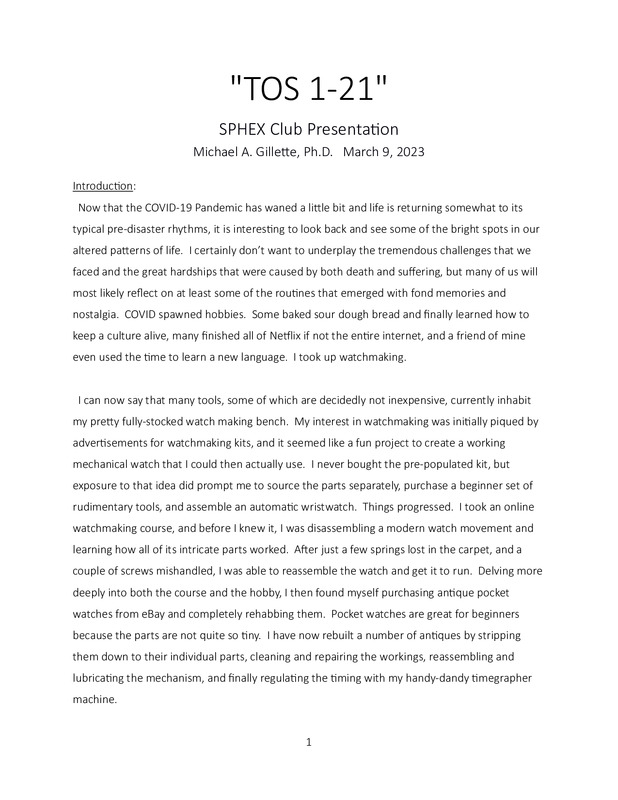
Text of a lecture delivered to the Sphex Club of Lynchburg, Va. Watchmaking as a hobby leads to a discussion of the nature of time and the impossibility of time travel.
Should marijuana be legalized for all or used only for medical use? The majority of those 65 and over say “No” for many reasons. A majority of young people say “Yes”. Legalizing and taxing the sale of marijuana would create a 14 billion dollar savings for tax payers. Scientists seem to be split in their views about legalizing marijuana.
Ted Delaney's presentation "Trees of the Future" for the Sphex Club explores the evolution and significance of genealogy. It covers the historical roots, modern-day business, and technological advancements transforming the field. Key topics include the rise of genealogy as a billion-dollar industry, the role of DNA testing, and the extensive use of digital records. Delaney emphasizes the personal connection individuals have to their ancestry and the broader implications for history and medicine.
This academic paper delves into the recurrent motif of towers in literature and history, particularly focusing on the "topless towers of Ilium" from Marlowe's Dr. Faustus and their broader significance in myth, history, and strategic geography. McIntosh explores how the allure and tragedy of these towers, from the ancient city of Troy to the strategic fortifications of the Dardanelles and Bosporus straits, have echoed through literary works and military campaigns, underscoring their symbolic and literal importance across epochs. The paper examines the intersections of myth, literature, and the strategic imperatives that have shaped the geography and history of what is now Turkey, from the Trojan War to the Gallipoli Campaign, culminating in a reflection on the enduring legacy of such towers in the collective imagination and their implications for national identity and memory.
George T. Stewart's paper humorously explores the theme of total depravity through various lenses, including human nature, Calvinist theology, and the pervasive annoyances of insects. It starts with a whimsical account of Florida's supposed Garden of Eden, delves into John Calvin's doctrines, and concludes with the torments inflicted by ticks and chiggers, illustrating humanity's continuous struggle with both moral and literal pests.
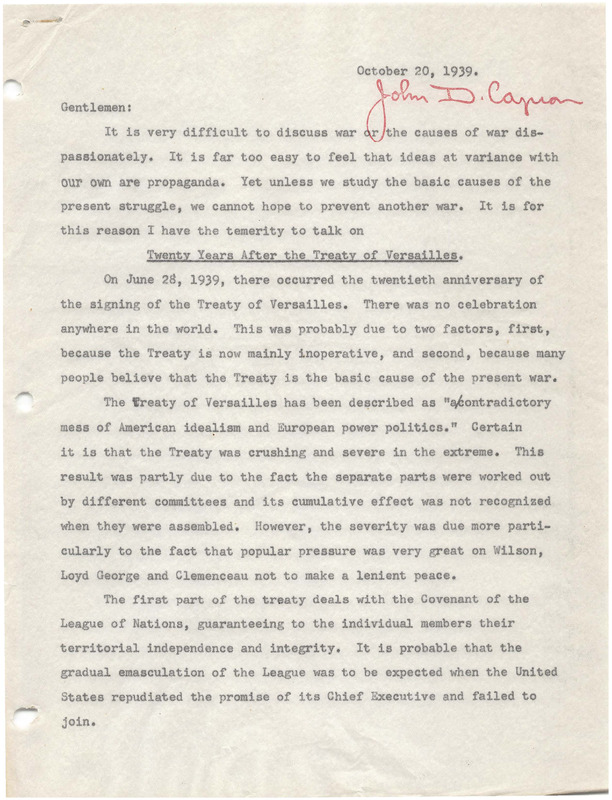
Text of a paper by John Capron, delivered to the SPHEX Club on October 20, 1939, examines the consequences of the Treaty of Versailles, 20 years post-signing. It critiques the treaty's role in precipitating World War II, highlighting its failure to celebrate or fulfill its intended goals, particularly in fostering global peace and stability. Capron argues that the treaty, with its punitive measures against Germany, including territorial losses and reparations, directly contributed to the economic and political destabilization of Germany. This destabilization, he posits, created conditions ripe for the rise of dictatorships, notably Adolf Hitler's regime. The paper discusses the treaty's impact on various regions and the League of Nations' ineffectiveness, concluding that missed opportunities for peaceful adjustments post-World War I led to the inevitability of World War II.
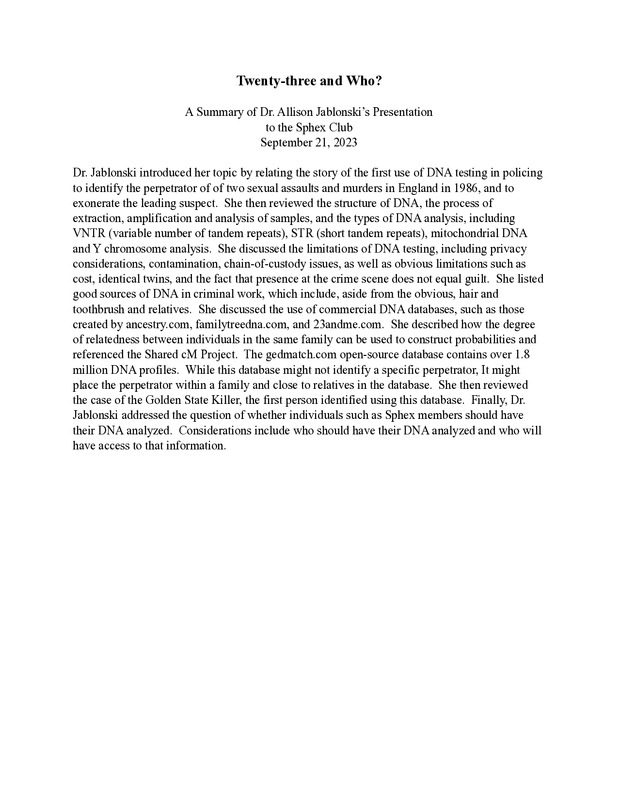
Text of a lecture to the Sphex Club of Lynchburg. In her presentation "Twenty-three and Who?", Dr. Allison Jablonski delved into the evolution and significance of DNA testing in criminal investigations, starting with its first use in 1986 in England to solve sexual assaults and murders. She covered the technical aspects of DNA analysis, including various methods like VNTR and STR, and discussed challenges such as privacy concerns, potential contamination, and the limitations of DNA presence at crime scenes. Dr. Jablonski also explored the role of commercial DNA databases in aiding criminal investigations, exemplified by the case of the Golden State Killer, and concluded with a discussion on the personal and ethical considerations of individuals, like Sphex Club members, having their DNA analyzed, emphasizing the implications of privacy and data access.
John Turner discusses the contrasting responses of two literary giants, Oliver Wendell Holmes and James Russell Lowell, to Darwinian Theory. Holmes accepted many tenets as an extension of what he already believed rather than a substitute. Lowell was influenced by Darwin’s thought but believed “nature is too expansive a force to be safely bottled up in any scientific formula no matter how incontrovertible.” Both men retained their personal religious beliefs.
In his presentation entitled “Two Lynchburg Lawyers and the “Virginia-West Virginia Debt Case,” Judge Norman K. Moon discusses the long, contentious court cases that finally led to the Supreme Court’s determination that West Virginia owed and was obligated to pay Virginia's pre-civil war public debt of over $12 million dollars. In addition, Moon discusses the lives, relationship and actions of two prominent Lynchburg attorneys who successfully represented Virginia in this historic case.
Text of a lecture delivered to the Sphex Club in Lynchburg. Big Red, presented by Marc A. Schewel, offers a critical analysis of America's reliance on cheap oil and the consequent proliferation of sport utility vehicles (SUVs). Schewel critiques zoning regulations, low gas prices, and the lack of stringent fuel economy standards, which have collectively fostered a car-dependent culture and an SUV boom. He discusses the negative impacts of SUVs on fuel consumption, road safety, and the environment, and narrates personal experiences to underline the dangers and inefficiency of SUV ownership. The paper suggests that a shift in consumer behavior and policy reform are essential for addressing these issues. Schewel's second paper, "October Surprise," delves into the personal journey of the author's lifelong fascination with baseball, highlighted by a detailed recounting of the 1960 World Series. The narrative seamlessly weaves the author's initial detachment from sports, a transformative summer camp experience, and the culminating thrill of witnessing the Pittsburgh Pirates' historic victory. It's an exploration of baseball's intricate statistics, historical moments, and the unique connection between the sport and its fans, culminating in a father-son bonding experience at the World Series. The author reflects on the game's nuances, the impact of television on its spectatorship, and the personal significance of baseball memorabilia.
Dr. Sally Selden’s presentation focused on Jane Addams (1860-1935) who founded the Hull House in Chicago. Her contributions are considered to be the founding of modern social work. Addams also was a founding figure in the NAACP and The American Civil Liberties Union. Selden discussed Addams' involvement and accomplishments in six major issues. In 1931 Jane Addams became the first woman to receive the Nobel Peace Prize.
Text of a lecture delivered to the Sphex Club of Lynchburg. The history of the Virginia Tobacco Commission and its impact on Southside and Southwest Virginia.
Text of a lecture delivered to the Sphex Club in Lynchburg. The paper "Up in the Air" by Nancy Blackwell Marion focuses on a collection of 52 aerial photographs of the Lynchburg area taken in 1924 by Underwood & Underwood. It begins with a history of aerial photography, highlighting key figures like Nadar, and describes the evolution of the medium. The paper then showcases and discusses the historical significance of the Lynchburg photographs, providing a visual and cultural snapshot of the area in the early 20th century.
Bob Wimer begins his presentation with this goal: “I hope to show you tonight why the death penalty is not a deterrent to murder and why it should be abandoned in favor of the far more humane – but harsher-true life sentence without parole.” Wimer counters one “myth” after another that supports the use of the death penalty – a punishment not used by any European country at the time of his presentation.
In "Vignettes: Genesis ... To Joshua," Dr. Garren reflects on his life journey, from his childhood in Augusta, Georgia, to his longstanding marriage and varied professional experiences. He shares memories of influential people and moments that shaped him, including his work at NASA, military service, and contributions to the University of Lynchburg, culminating in a reflection on his battles and victories throughout his life.
The paper discusses George Wythe, a lesser-known but influential American founding father, focusing on his contributions as a legal mentor, politician, and delegate at the Continental Congress. Wythe's teachings and relationships, particularly with Thomas Jefferson, his advocacy for independence, and his role in the Virginia Ratification Convention are highlighted. The paper also covers his personal life, including his early years, education, and the tragic circumstances of his death.
The paper "Virginia's Early Money of Account" by Raymond H. Williamson explores the historical development of Virginia's financial system from the early 1600s to the 19th century. It details the use of various forms of money, including tobacco and Spanish dollars, the impact of British mercantile policies, and the eventual transition to a decimal-based monetary system. The paper is organized chronologically and examines the economic strategies and challenges faced by Virginia's colonists.
Text of a lecture to the Sphex Club in Lynchburg. The paper titled "Virginia’s Lost Industry" by John D. Capron, delivered on June 10, 1942, examines the history and decline of the iron industry in Virginia from 1619 to the 20th century. It traces the establishment, boom, and eventual stagnation of iron furnaces, highlighting the technological, economic, and wartime factors that influenced the industry. Key points include the initial rise of iron production, its pivotal role in various American wars, and the industry's decline due to depleted resources, outdated technology, and economic shifts.