The collection of the Sphex Club, of Lynchburg, Virginia, includes minutes of meetings, the constitution and bylaws of the Club, a roster of its members, and a listing of Sphex papers presented by members and guests of the Club. In addition to this guide, the collection is outlined in more detail in “Sphex in the Jones Memorial Library,” Chapter VI of the Club history, The Sphex Club of Lynchburg, Virginia: The First One Hundred Years, 1910-2010, by James M. Elson.
Access Rights
Lectures delivered by members appear as papers in the Item Set. Papers are available in print at the library. Select papers have been digitized (including all papers delivered to the Club prior to 1952).
Authors retain copyright to their work. Papers may not be reproduced or reprinted without permission of the author and the library.
This paper by Cranston Williams details the history and development of Southern Pine newsprint, beginning with its origins and significant milestones. It covers the establishment of mills, the impact on the newspaper industry, and the economic implications for the Southern United States. Key historical figures and events, such as the first Southern Pine mill at Lufkin and the involvement of Dr. Charles H. Herty, are highlighted.
This paper presents a comprehensive history of civil engineering, detailing the evolution of engineering principles from ancient times to the modern era. It covers significant developments like irrigation in Mesopotamia and Egypt, Roman aqueducts and roads, medieval bridges, and modern advancements in structural materials and designs. The paper emphasizes the role of civil engineering in shaping public infrastructure, transportation, and public health systems, highlighting the pivotal role of material science in these advancements.
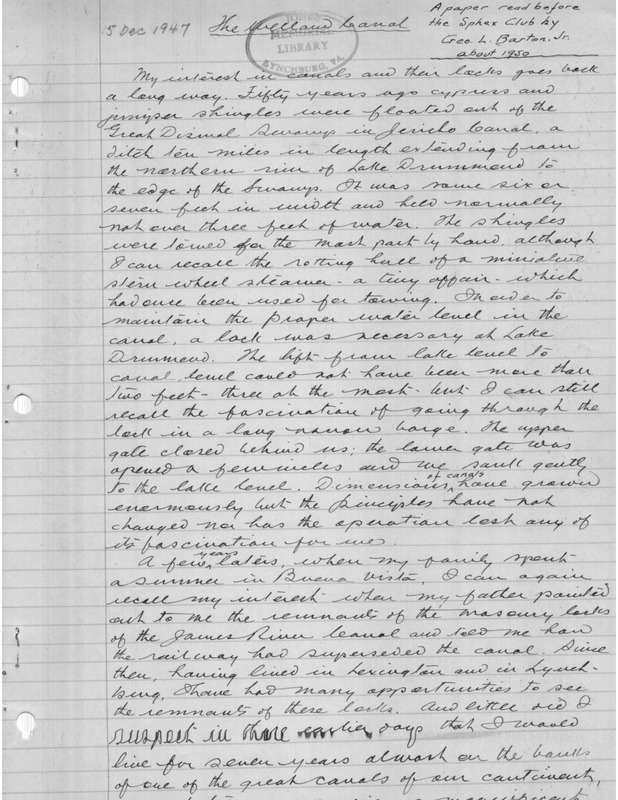
Thomas Ledford's paper discusses the end of the James River and Kanawha Canal and how it was transformed into a steam railroad right of way that operates today as the CSX Corporation. During Washington and Jefferson’s era the need for western expansion to improve the economy became evident. The two giants of that era were canals and railroads. Ledford explains why the canals eventually lost the “struggle between giants.”
Text of a lecture delivered for the Sphex Club of Lynchburg, Va. A summary of the history and current status of Israel and the Palestinian people and proposed solutions to the current social and political stalemate between Israel and the Palestinian people.
When the Webster’s Third Dictionary arrived in 1961, it set off a tempest of anger, condemnation and rejection. Many highly respected people said, “Take Webster’s Third out of print.” This fascinating paper explores many of the changes from Webster’s Second dictionary that were condemned. After discussing the changing nature of language and accepting some of the critics’ points as reasonable to consider, Dr. John Turner concludes by sharing his reasons for endorsing Webster's Third Dictionary.
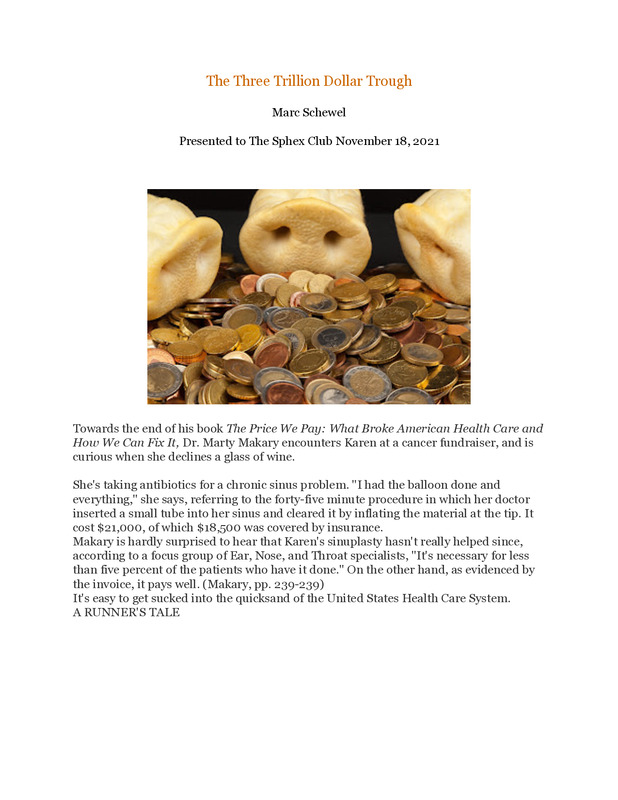
Text of a lecture delivered to the Sphex Club in Lynchburg. Marc Schewel's presentation examined the inefficiencies and high costs of the U.S. healthcare system, which spent approximately $3.65 trillion in 2018. He highlighted the discrepancies between this high expenditure and the poorer health outcomes in the U.S. compared to other high-income countries, scrutinizing various sectors of the healthcare industry, including hospitals, pharmaceutical companies, and insurance providers, for their role in inflating costs.
Judge William W. Sweeney's paper, "The Trial of Christ," details the historical and judicial context of Jesus Christ's trial, emphasizing its illegality and the influences of Roman and Hebrew laws. The paper explains the procedural flaws and political pressures that led to Jesus' crucifixion, highlighting key events like the cleansing of the temple, the role of the Sanhedrin, and Pilate's reluctant involvement.
James R. Caskie's paper revisits James R. Caskie's review of Walker Lewis' legal analysis of the John Peter Zenger trial, which played a pivotal role in establishing freedom of the press in the American colonies. The paper, originally tailored for lawyers, is simplified for a broader audience, emphasizing Zenger's battle against the corrupt Royal Governor William Crosby in 1734-1735, who abused his power to suppress true but critical publications.
This paper, presented by Richard P. Gifford, explores the impact of Vikings on history. It covers their origins, raids, and settlements across Europe and beyond. Gifford argues that Vikings were catalysts in shaping Western civilization, highlighting their roles as traders, settlers, and organizers. The paper underscores the Vikings' influence on regions like England, Iceland, and Russia, emphasizing their enduring legacy.
The paper reflects on a pivotal personal experience of the author involving Judge Moon and a trial advocacy class that altered the course of the author's legal career, leading him from aspiring tax or corporate lawyer to circuit court judge. The narrative expands into an in-depth exploration of teaching methodologies in the trial advocacy class at the University of Virginia, emphasizing the integration of legal, Latin terms, and rhetorical skills focused on ethos, pathos, and logos. Judge Cook then discussed at length the life and impact of Frederick Douglass, with an emphasis on the power of Frederick Douglass’s rhetoric to educate and inspire law students.
Text of a lecture delivered to the Sphex Club on April 2, 2026. Stephen C. Smith presents a comprehensive overview of whiskey production, classification, and terminology, while comparing whiskey to other distilled spirits such as vodka, gin, tequila, rum, and brandy. He explains the science of fermentation, distillation, and barrel aging, including mash bills, congeners, pot versus column stills, and the effects of oak maturation. The paper details the legal and cultural distinctions among major whiskey styles, including bourbon, Tennessee whiskey, rye whiskey, Irish whiskey, Scotch whisky, Canadian whisky, and Japanese whisky. Smith emphasizes how regulations governing ingredients, distillation proofs, aging requirements, and labeling shape each spirit’s flavor and identity. He also explores concepts such as bottled-in-bond, cask strength, single malt, and double-oaked whiskey. Ultimately, the talk demonstrates how tradition, chemistry, geography, and law combine to create the diverse “water of life.”
Judge William W. Sweeney retells the story of “the Wreck of the Old 97.” He explores what happened before the wreck that brought a new crew to the train. He then looks at the possible reasons for the train’s derailment. Sweeney concludes by discussing the famous people who have sung about the wreck of the Old 97.
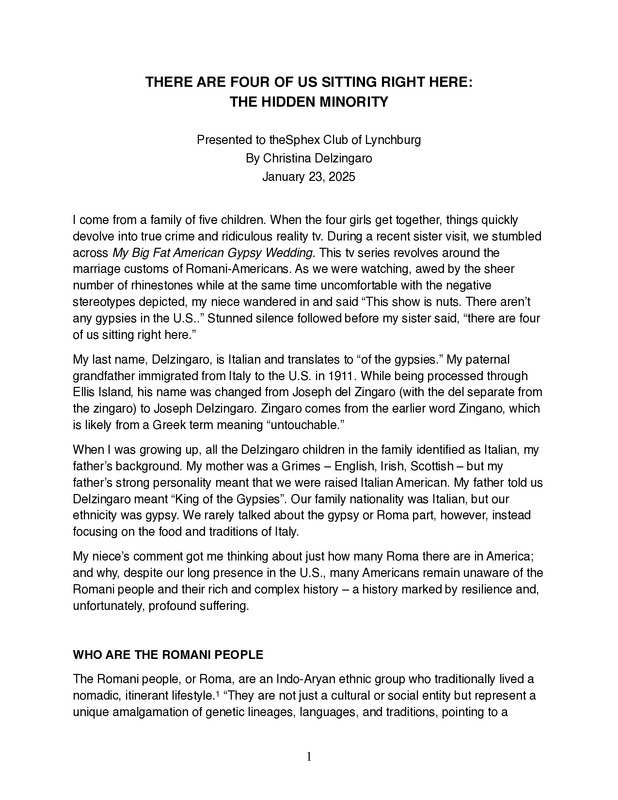
On January 23, 2025, Christina Delzingaro shared a deeply personal and scholarly exploration of Romani identity, migration, and marginalization. Her talk traced Roma roots in India, their global diaspora, and centuries of persecution—including enslavement and genocide. Delzingaro highlighted cultural resilience, misconceptions, and her own family’s experience, urging recognition of Roma as a historically silenced but enduring ethnic group within American and global society.
The academic paper presented by George Dawson focuses on the Medicare funding crisis in the United States. Dawson explores the financial insufficiency of the Medicare Hospital Insurance Trust Fund and contrasts it with the better-funded parts of Medicare, highlighting the disparity in healthcare spending across different U.S. regions. His analysis points out that higher expenditures do not necessarily lead to better healthcare outcomes. The paper discusses potential solutions to address the Medicare shortfall, emphasizing the need for legislative action and reforms.
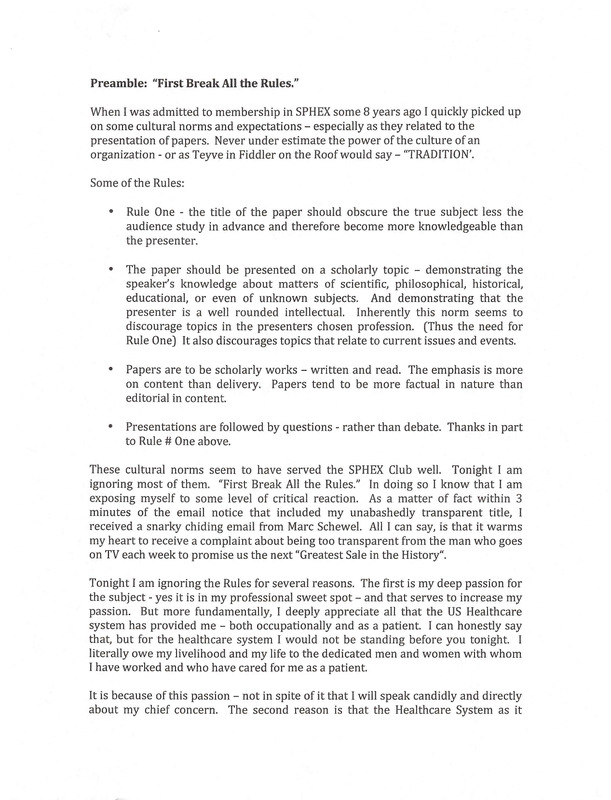
The paper "Things You Don't Know About the Healthcare System... And Why You Should" by George Dawson, presented to the SPHEX Club, critically examines the inherent flaws within the U.S. healthcare system. Dawson, leveraging his dual perspectives as a hospital administrator and a patient, articulates systemic failures including variability in medical quality and discrepancies in hospital performance. His presentation challenges conventional norms of scholarly discourse at SPHEX, embracing a candid and fact-based TED talk style to advocate for significant reforms aimed at enhancing transparency, efficiency, and patient care.
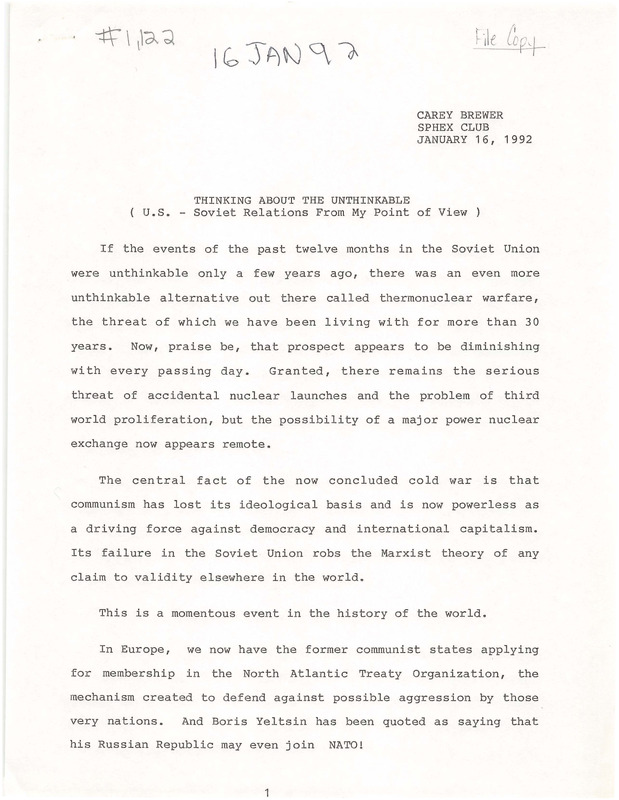
The paper, presented by Carey Brewer, reflects on the conclusion of the Cold War, highlighting the ideological collapse of communism and the diminishing threat of nuclear warfare. Brewer discusses the historical context of U.S.-Soviet relations, the nuclear arms race, and the policy debates over containment versus confrontation. He emphasizes the importance of ongoing disarmament efforts and the role of U.S. leadership in maintaining global stability.
Thomas Ledford shares a description of Lynchburg’s Old Court House carried by the Lynchburg Virginian newspaper on April 9, 1855. “On the very spot where a short time ago stood our chief disgrace built in 1813, now stands our chief pride and ornament.” It is built in the Grecian Revival style of architecture and was designed by William S. Ellison. A third courthouse was built in 1955. The restoration of the Old Court House concluded in 1977.
Julie Doyle's presentation on March 3, 2022, "This Road Less Traveled Moves Like Water," explored the concept and application of Restorative Justice in various settings, emphasizing its adaptability and impact on community harmony and offender accountability. The talk highlighted the work of Mckayla Warwick in Philadelphia, restorative justice's roots in indigenous practices, and its growing integration into U.S. court systems, particularly in Cook County, Illinois.
This academic paper, presented by Dr. John T. T. Hundley, explores the life and contributions of Dr. Thomas Walker, a notable figure in early American history. It delves into Walker's background, including his English heritage, medical career, extensive land grants in Virginia, and political involvement. The paper highlights Walker's pioneering expeditions into Kentucky, his role in the Fort Stanwix Conference, and his survey work. Despite his accomplishments, Walker is portrayed as a background figure in history, prompting a discussion on historical recognition. The paper suggests that, while not widely celebrated, Walker's impact is acknowledged through academic research and publications.
The academic paper revolves around the annual lecture at the SPHEX Club by ADM Cagle, focusing on contentious issues like American defense strategies, historical incidents like the Panama Canal controversy, and gender roles in combat. The paper outlines the progression of American foreign policy through anecdotes and detailed accounts of military decisions, emphasizing the consequences of these policies and the necessity for contentious discourse in forums like SPHEX. It also discusses the complex challenges of integrating women into combat roles, highlighting the physical and operational concerns.
This academic paper by George N. Rainsford is not a scholarly work but an explorative discussion on the nature of learning and understanding through questioning. It covers the progression of questioning from elementary through college education, emphasizing the shift from seeking definite answers to exploring open-ended questions. The paper then delves into three main questions—Who am I? Where am I? What time is it?—to explore human identity, our place in the universe, and our perception of time. It discusses the human condition from biological, zoological, societal, and philosophical perspectives, examining the challenges of living in a diverse, changing world and the ongoing quest for knowledge and understanding in the fields of astronomy, physics, and metaphysics. The paper concludes with reflections on human creativity and the importance of shaping our future.
Thunder in the Mountains by George M. Snead Jr. explores the last phases of the Apache Campaign against Geronimo in the late 1880s. The paper discusses the origins and movements of the Apache, key battles, and military strategies, highlighting the challenges faced by U.S. forces and Geronimo's resistance. It also critiques the treatment of the Apache post-surrender and the misattribution of credit among U.S. military leaders.