The collection of the Sphex Club, of Lynchburg, Virginia, includes minutes of meetings, the constitution and bylaws of the Club, a roster of its members, and a listing of Sphex papers presented by members and guests of the Club. In addition to this guide, the collection is outlined in more detail in “Sphex in the Jones Memorial Library,” Chapter VI of the Club history, The Sphex Club of Lynchburg, Virginia: The First One Hundred Years, 1910-2010, by James M. Elson.
Access Rights
Lectures delivered by members appear as papers in the Item Set. Papers are available in print at the library. Select papers have been digitized (including all papers delivered to the Club prior to 1952).
Authors retain copyright to their work. Papers may not be reproduced or reprinted without permission of the author and the library.
John T. Cook's academic paper "Repairing Her Faults," presented to the Sphex Club, discusses the significance of rhetorical brevity and effectiveness through historical examples, notably Abraham Lincoln's Gettysburg Address. Cook explores the Virginia Constitution's evolution, highlighting various iterations and their societal impacts, including disenfranchisement and discrimination practices. He draws parallels between past legal frameworks and modern constitutional needs, emphasizing the importance of revising legal structures to reflect contemporary values and rectify historical injustices.
The paper, "Report from Formosa" by Dr. Richard C. Rowland, provides a detailed account of his observations in Taiwan, facilitated by a Fulbright award and a State Department grant. Rowland discusses the geographical beauty, demographic density, and societal aspects of Taiwan, focusing on the daily lives of its people, land reform measures, the challenge of birth control, and the political climate. His narrative blends personal experiences with an analysis of Taiwan's economy, agricultural practices, and its unique democratic doctrine amidst a backdrop of press censorship and martial law. The paper is structured around Rowland's travels and encounters, offering insights into Taiwan's culture, governance, and the looming uncertainties facing its progress.
Restraining Ophelia by Elisabeth Muhlenfeld explores the evolution of social norms and restrictions placed on female students at institutions like Sweet Briar College, drawing from historical student handbooks and personal anecdotes. Muhlenfeld reflects on the absurdity of these outdated rules, contrasting them with contemporary understandings of gender equality and personal freedom. The paper delves into the broader implications of these restrictions, examining how they reflect societal attitudes towards women and contribute to our understanding of changing mores over time.
Dr. Philip Thayer's "Revolting Youth" explores the cultural divide between the youth of the 1970s and the older generation. Thayer discusses the serious cultural crisis, highlighting youth's rejection of traditional values and the significant communication gap. He contrasts the active revolutionary youth with the more passive, disengaged segment, ultimately predicting profound societal changes driven by this generation's challenges and critiques.
This academic paper by Lamar Cecil explores historical shifts in global power dynamics, focusing particularly on the rise of Japan as a significant world power beginning with the Russo-Japanese War in 1904. Cecil draws parallels between past and present geopolitical challenges, examining American perceptions of certainty in victory, which have evolved over time due to various military and political confrontations. The paper discusses the historical context of enemies unfamiliar to Western culture and strategy, emphasizing the need for a nuanced understanding of such adversaries in contemporary conflicts.
The struggle to save the Chesapeake Bay won't be successful if "business as usual" continues as is the unfortunate story in 2004. Gilmer discusses problems the Chesapeake faces and suggestions that might "Save the Bay."
Autobiography and the individual perceptions and influences that determine an author's style, with extended reference to autobiographies by David Brinkley and Katharine Graham
The author's recent trip to Scandinavia informs his favorable impressions of the governments, socioeconomic conditions, and health of the populations of Denmark, Sweden, Norway and Finland. His discussion includes comments on the histories, industrial development, farming, education, and healthcare in these countries.
James A. Huston describes the “most remarkable woman of the ancient world.” Zenobia’s life story is presented as a play. Zenobia (b. 240 AD) was skilled with weapons and horses. With her husband Odenathus, Zenobia battled the Persians. After her husband’s assassination, Zenobia liberated Egypt from Rome but eventually her forces were defeated in 272 AD. Huston believes that if Zenobia had been victorious, “we would now live in a much more pleasant world.”
The paper by J. Everette Fauber discusses the detailed restoration of the John Carlyle House in Alexandria, Virginia. It describes the extensive research, archaeological work, and structural challenges faced during the project, emphasizing the importance of historical accuracy and preservation. The restoration involved securing the building, replacing deteriorated materials, and confirming historical events associated with the house.
The paper, "Second Hand But New," recounts Melvin R. Watson's experiences during a 1986 church-sponsored trip to China. Organized into observations on education and religion, the narrative highlights China's rapid modernization post-Cultural Revolution, its educational reforms, the state of Christianity, and daily life in both urban and rural settings. The author's reflections underscore China's challenges and progress.
Secrets and Old Acquaintances by Joe Burton Linker, Jr. explores the profound influence of cryptography on WWII, particularly through the Allied and Axis powers' use of secret codes. Linker's narrative focuses on the critical role of intercepted and decoded messages in shaping military strategies and outcomes, exemplified by the theft of the United States' Black Code and the detailed reports by Colonel Fellows, which were intercepted by the Axis powers. The paper delves into the history of cryptography, highlighting its development and its pivotal role in various historical contexts, from ancient Greece to modern conflicts, showcasing the inseparable bond between cryptography, military strategy, and historical outcomes.
Charles Warren's paper "Seeing Double--Immodestly" discusses the scientific journey leading to the discovery of the DNA double helix by James Watson and Francis Crick. The narrative covers the historical context of cell theory, Mendelian genetics, and the pivotal role of various scientists. The paper emphasizes the rapid developments in molecular biology, ethical considerations, and the profound impact of biotechnological advancements on society.
This academic paper by Philip Lightfoot Scruggs explores the seminal contributions of Virginia to the United States, focusing on migration, genealogy, and cultural influence. Scruggs discusses how Virginia, as the largest and most populous colony, seeded the development and population of the nation. He highlights the migrations of Virginians across the country, their significant impact on various states, and the lasting legacies of notable Virginians in history. The paper is organized around the themes of migration patterns, genealogical research, and Virginia's broad influence, incorporating anecdotes and examples to illustrate Virginia's seminal role.
Noell's paper is on Asa G. Candler, a prominent businessman and philanthropist, born in Georgia in 1851 to a Quaker family. Initially pursuing pharmacy, he eventually entered the drug business. His acquisition of the Coca-Cola formula in 1888 significantly shifted his career focus, leading to Coca-Cola's global success through innovative marketing. Candler's philanthropy, especially towards Emory University and Methodist institutions, marked his later years.
In his inaugural Sphex Club Presentation titled "Seven," Professor Tory L. Lucas explores the intersection of the Seven Deadly Sins with legal ethics, focusing on how these sins underpin major ethical violations within the legal profession. Through historical context and contemporary examples, Lucas argues that these sins, particularly Greed, exemplify the detrimental effects of prioritizing self-interest over others. The talk emphasizes the importance of reciprocal relationships guided by the Golden Rule and concludes with a Cherokee parable illustrating the ongoing internal battle between good and evil forces, suggesting the outcome depends on which force one chooses to nurture.
The paper "SFP: How Do YOU Use It?" by E. Allen Culverhouse discusses the impact of self-fulfilling prophecies (SFP) on interpersonal relations and self-perception. It emphasizes how people's expectations can influence their own behavior and that of others, potentially shaping the outcomes of interactions based on these preconceived beliefs. The paper delves into various aspects, such as the implications of SFP in different contexts like management and education, and underscores the importance of positive versus negative expectations.
The paper, "Shadows Larger Than ...reality" by E. Allen Culverhouse explores the complex dynamics of public employee unionism, grievance procedures, and employee-employer relations in Virginia during the 1970s and 1980s. The author analyzes legislative efforts aimed at both promoting and regulating public employee representation, with a specific focus on the formation of bargaining laws and grievance procedures. The paper discusses the legislative changes that attempted to make unions unnecessary by improving internal grievance mechanisms, and it highlights significant legislative sessions and proposals, examining their implications on public employee relations.
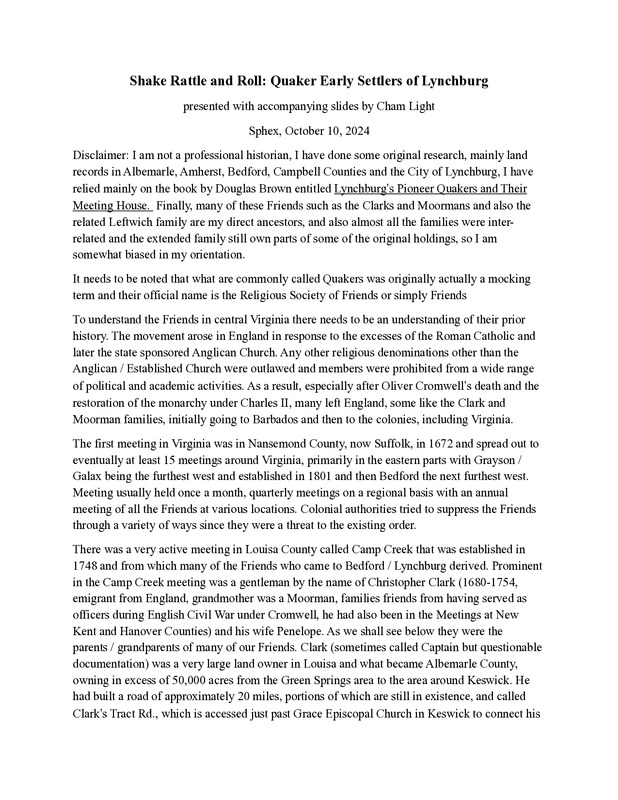
Text of a lecture delivered to the Sphex Club of Lynchburg, Va. by R. Chambliss Light, Jr. On October 10, 2024, Cham Light traced the early Quaker presence in Lynchburg through family genealogy and historical land records. The talk followed key families like the Clarks, Moormans, and Lynches, revealing their roles in founding South River Meeting and shaping regional development. Light emphasized religious convictions, internal divisions over slavery, and the migration of Friends westward as they grappled with evolving political and moral pressures.