The collection of the Sphex Club, of Lynchburg, Virginia, includes minutes of meetings, the constitution and bylaws of the Club, a roster of its members, and a listing of Sphex papers presented by members and guests of the Club. In addition to this guide, the collection is outlined in more detail in “Sphex in the Jones Memorial Library,” Chapter VI of the Club history, The Sphex Club of Lynchburg, Virginia: The First One Hundred Years, 1910-2010, by James M. Elson.
Access Rights
Lectures delivered by members appear as papers in the Item Set. Papers are available in print at the library. Select papers have been digitized (including all papers delivered to the Club prior to 1952).
Authors retain copyright to their work. Papers may not be reproduced or reprinted without permission of the author and the library.
This paper discusses the Panama Canal Treaties amidst significant debate, comparing current U.S. foresight to that of 1956, a period of major geopolitical shifts. It criticizes the main arguments for ceding control by 2000, emphasizing the Canal's continuing strategic importance and the need for U.S. military presence and authority. It advocates for revising the treaties to secure U.S. interests, citing historical errors in negotiations and potential threats.
Text of a lecture to the Sphex Club in Lynchburg. The paper "Patriotism and Prejudice" by Robert C. Wood, III examines the internment of Japanese Americans during World War II following the attack on Pearl Harbor. It details the fear, racial prejudice, and political and military actions that led to the internment, highlighting key players and legal battles. The paper argues that the internment was driven by hysteria and prejudice rather than genuine military necessity.
This academic paper by George Dawson focuses on the merger of Lynchburg General Hospital and Virginia Baptist Hospital into Centra Health. It explores the intricate dynamics of hospital cooperation, competition, and strategic decision-making in Lynchburg's healthcare sector from the 1970s through 1987. The narrative highlights key legislation, community and medical staff involvement, and the shifting landscape of healthcare administration that influenced the merger, framed within broader antitrust concerns and healthcare policy.
Frank H. Buhler's "Personal Reflections and Great Expectations" recounts his visits to ancestral homes in Germany and Sweden, exploring his family history and the broader impact of immigration on the United States. Buhler reflects on the experiences of various immigrant groups, their motivations, and their contributions to American society, emphasizing the individuality within the collective immigration narrative.
Text of a lecture delivered to the Sphex Club in Lynchburg. Joe Stinnett's paper, "Pharaoh Meets the Farmer," explores the evolution and essence of jazz music, focusing particularly on the life and work of Sun Ra. It traces jazz's roots from Congo Square to its transformation into bebop and free jazz. Sun Ra's eclectic interests and innovative contributions to jazz, combining mysticism, afro-futurism, and avant-garde music, are highlighted, illustrating his profound yet unconventional impact on the genre.
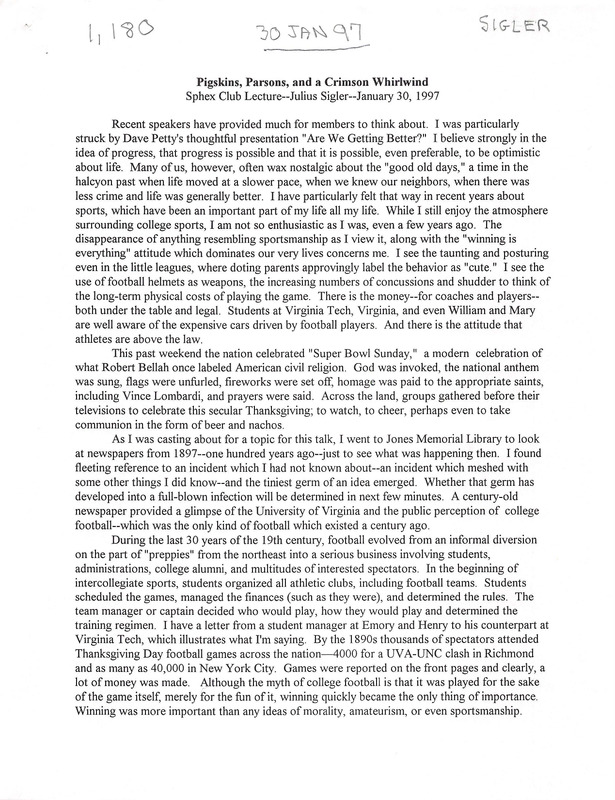
Text of a lecture delivered to the Sphex Club in Lynchburg. This academic paper explores the evolution of college football in the United States, focusing on its impact on higher education institutions from the late 19th to the early 20th centuries. It discusses the relationship between football and college reputations, enrollment, alumni loyalty, and financial contributions, highlighting the sport's role in fostering school spirit and community identity. The paper also addresses the controversy surrounding football's violence and the ethical dilemmas posed by the professionalization of college athletes. It concludes by questioning the contemporary role of sports in education and whether it aligns with the values of character building and amateurism.
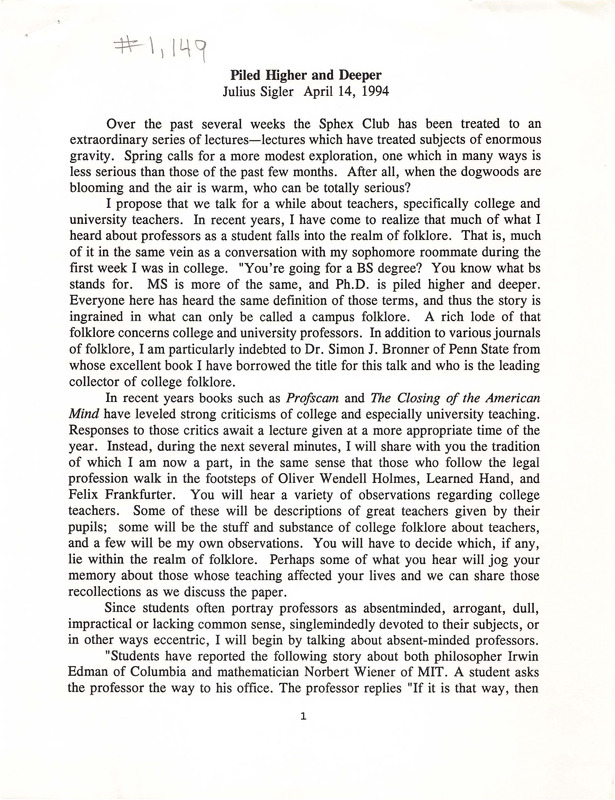
Text of a lecture delivered to the Sphex Club in Lynchburg. This paper by Julius Sigler explores the realm of college and university teaching, challenging common stereotypes and delving into the rich folklore surrounding professors. Sigler uses anecdotes, comparisons to legendary figures, and personal observations to illustrate the eccentricities, pedagogical methods, and impactful memories associated with academic teaching. He draws from diverse sources, including his experiences and those of others, to offer a nuanced view of educators who shape minds in settings ranging from formal lectures to intimate mentorships. The paper emphasizes the art of teaching and the enduring influence of educators who navigate the balance between imparting knowledge and inspiring inquiry.
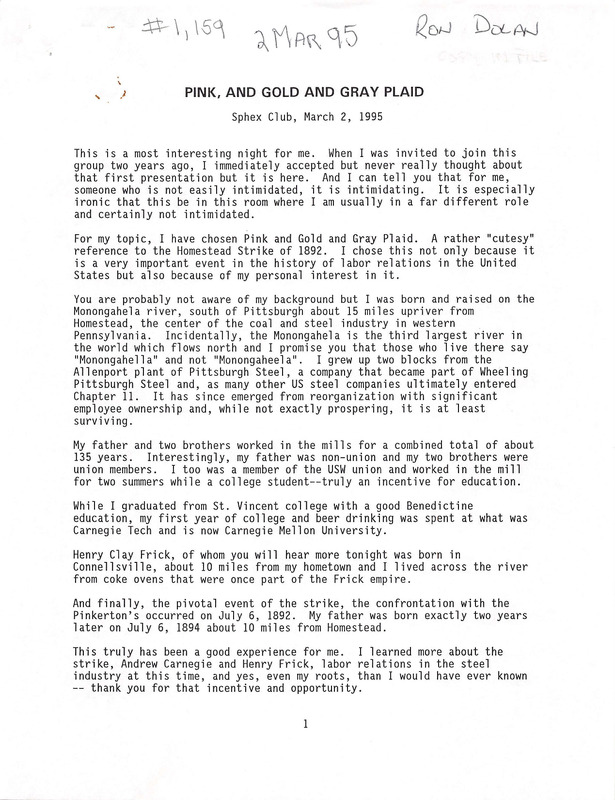
Ron Dolan's lecture "Pink, Gold, and Gray Plaid" delves into the Homestead Strike of 1892, focusing on labor relations and significant figures like Andrew Carnegie and Henry Frick. Dolan, with personal ties to the Pittsburgh steel industry, examines the event's historical context, key players, and its impact on labor unions, emphasizing the conflict between workers' rights and industrial management.
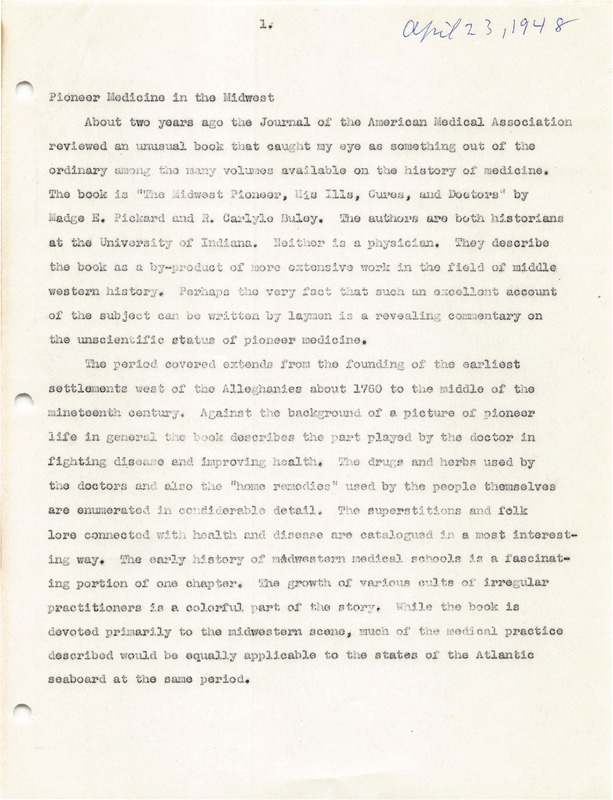
Text of a lecture to the Sphex Club in Lynchburg. A description of frontier medicine in the late eighteenth and nineteenth century, with attention to medical schools, treatment modalities, "irregular" medical practitioners, and quach cures.
John Turner discusses the origin of the names of cities and states and even bodies of water in the United States. Turner also explains how the pronunciations vary for many cities with the same name. Hundreds of names are discussed such as “Roanoak” coming from an Indian name, Salem being a religious name, Danville being a French name, and “burg” meaning a fortified place.
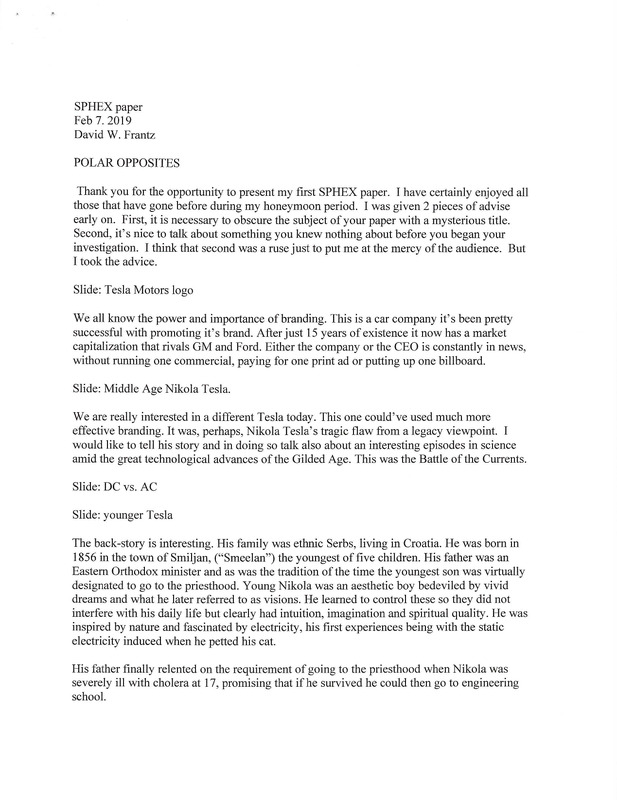
David W. Frantz's SPHEX paper, "Polar Opposites," explores the life and work of Nikola Tesla, emphasizing his contributions to electrical engineering, particularly the development of alternating current (AC) systems. The paper contrasts Tesla's imaginative genius with Thomas Edison's pragmatic approach, detailing their rivalry during the "War of Currents." Frantz also highlights Tesla's personal struggles and eccentricities, his visionary ideas, and his ultimate legacy in the field of electricity.
James R. Caskie's paper critiques the interpretations made in a series of editorials by The Lynchburg News regarding voter eligibility in the Democratic Primary. Caskie, disputing the editorials' claims that certain voters were ineligible due to previous voting behaviors, argues that these interpretations misapply legal standards and potentially influenced election outcomes. He examines the Virginia Primary Law's history, provisions, and legal principles to clarify misconceptions and defend voters' rights to participate in primaries regardless of past affiliations.
The paper "Poor Folks Lawyer" by Robert Dabney Morrison provides an insightful account of Morrison's experiences and observations working with the Legal Aid Society of Greater Lynchburg. Starting his tenure on July 21, 1975, after a long hiatus from practicing law, Morrison describes his initial apprehensions, the warm welcome he received, and his gradual acclimation to the role. He outlines the purpose of Legal Aid—to offer legal services to those unable to afford them—and details the types of cases handled, emphasizing family law. Morrison shares intriguing anecdotes that highlight the unique challenges and rewards of serving low-income clients, including a significant case involving the custody of triplets. He praises the local support for Legal Aid and expresses a firm stance against federal funding, advocating for local control and the maintenance of state power. The narrative showcases the impact of Legal Aid on the community and the personal fulfillment derived from providing legal assistance to those in need.
Text of a lecture to the Sphex Club in Lynchburg. Robert C. Wood III's "Pop Quiz" session, held on February 18, 2010, is a detailed exploration of U.S. constitutional law, focusing on the judiciary and Supreme Court's roles. Wood uses a classroom quiz format to engage the audience in a comprehensive review of landmark Supreme Court cases, constitutional amendments, and judicial philosophies. The session emphasizes the evolution of legal interpretations, the balance between federal and state powers, and the impact of judiciary decisions on American society and civil liberties.
The paper by Everette Fauber, Jr., titled "Predestination," explores the historical development and influence of the Scotch-Irish people from their origins in Scotland to their settlement in America. The narrative covers invasions, religious transformations, and the establishment of educational institutions like Augusta Academy, which evolved into Washington and Lee University. The paper highlights key historical events, influential figures, and architectural developments related to the university's growth.
Kenneth R. Garren's presentation "Presume Guilt; Prove Innocence" discusses the evolution of safety practices in the U.S. space program, emphasizing fatal accidents like Apollo 1, Challenger, and Columbia. Garren reflects on his experiences at NASA Langley and advocates for a fundamental shift in NASA's approach to safety. The talk is organized into sections covering historical missions, major accidents, their causes, and recommendations for future safety protocols.
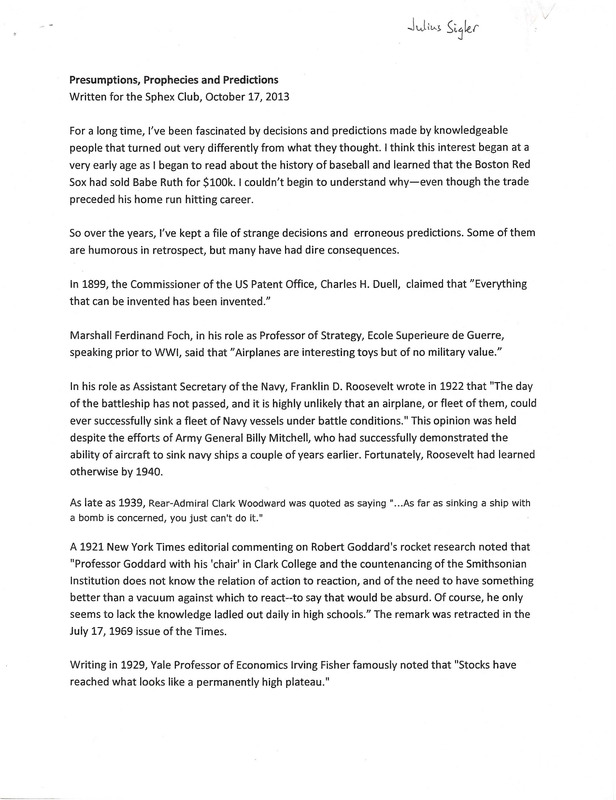
Text of a lecture delivered to the Sphex Club in Lynchburg. The paper, titled "Presumptions, Prophecies, and Predictions," explores the myriad ways in which expert predictions and decisions have historically faltered, often with significant consequences. Drawing from a broad spectrum of examples across technology, military strategy, economics, and more, the author illustrates the frequent disparity between confident forecasts and actual outcomes. Key instances include the underestimation of the telephone, the automobile, and digital technology's impact, highlighting the complex interplay between innovation, societal acceptance, and the limitations of foresight. The paper concludes by reflecting on the implications of these prediction failures for understanding future trends and decision-making processes.
The paper "Prevaricators, Pundits and Politics" by Robert Wimer discusses the degradation of political discourse in America, attributing it to partisan media and polarizing figures. The paper highlights the impact of various conservative and liberal pundits and their best-selling books, emphasizing the loss of civility and the rise of hateful rhetoric in political debates. It explores the historical context of political discourse and calls for a return to thoughtful, balanced discussion.
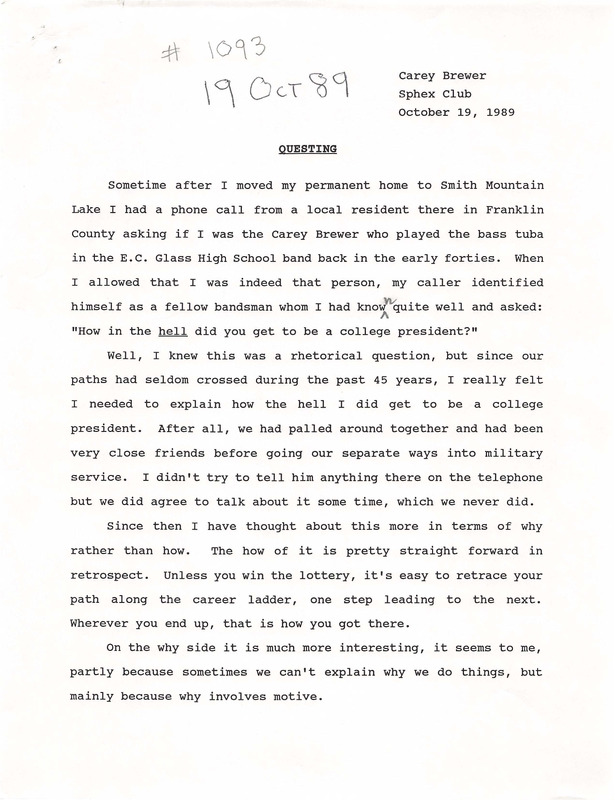
Carey Brewer reflects on his diverse career trajectory leading to his college presidency, discussing pivotal influences and experiences, including early aspirations, federal service, and encounters with prominent figures like John F. Kennedy. He emphasizes the unpredictable and incidental nature of career development and contrasts his roles before and after his presidency, underscoring the profound impact of personal interactions and accidental opportunities on his professional path.
Peter Marcy's presentation "Quiz Show Answers" intriguingly focused on the rich history of ballet, tracing its origins back to 15th-century Northern Italy, rather than ancient Greece or Rome. Marcy highlighted the evolution of ballet from aristocratic amateur performances to a professional art form, emphasizing key developments like the establishment of the Paris Opera Ballet School under Louis XIV and the invention of the pointe shoe by Marie Taglioni. He further explored the transformative contributions of Marius Petipa and the Ballet Russes, led by Sergei Diaghilev, which collaborated with notable composers and artists of the 20th century. Marcy concluded by discussing the influence of George Balanchine and the American Ballet Theater, suggesting future ballet centers might emerge in Asia, reflecting shifts in political and cultural power.
John Cardwell's paper, presented at the SPHEX Club, explores the intricate relationships between mathematics, science, and technological progress, emphasizing how mathematics has historically aided societal development through innovations in fields like arithmetic, geometry, and calculus. He advocates using mathematical models, specifically chaos theory, to better understand and address contemporary global challenges like terrorism and social conflicts, suggesting that mathematical insights could provide new perspectives on complex, dynamic systems in a globalized world