The collection of the Sphex Club, of Lynchburg, Virginia, includes minutes of meetings, the constitution and bylaws of the Club, a roster of its members, and a listing of Sphex papers presented by members and guests of the Club. In addition to this guide, the collection is outlined in more detail in “Sphex in the Jones Memorial Library,” Chapter VI of the Club history, The Sphex Club of Lynchburg, Virginia: The First One Hundred Years, 1910-2010, by James M. Elson.
Access Rights
Lectures delivered by members appear as papers in the Item Set. Papers are available in print at the library. Select papers have been digitized (including all papers delivered to the Club prior to 1952).
Authors retain copyright to their work. Papers may not be reproduced or reprinted without permission of the author and the library.
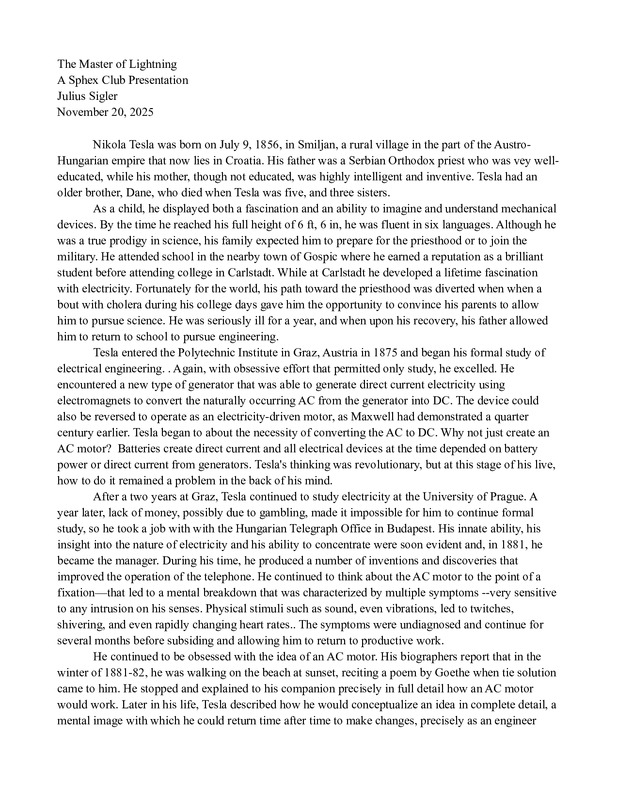
Text of a lecture to the Sphex Club delivered on November 20, 2025. Nikola Tesla’s life and work transformed the modern world through his pioneering development of alternating current (AC) electrical systems. Born in 1856 in what is now Croatia, Tesla displayed extraordinary intellectual gifts and became fascinated with electricity while studying engineering in Europe. After working in telecommunications and for Edison’s company in Europe and America, he developed revolutionary AC motors, generators, and transformers that solved the limitations of direct current systems. Supported by George Westinghouse, Tesla’s inventions powered the triumph of AC electricity, including the lighting of the 1893 Columbian Exposition and the Niagara Falls power project. Beyond power transmission, Tesla pioneered radio, wireless communication, remote control, and high-frequency electrical research. Though financially unsuccessful and increasingly isolated later in life, Tesla’s inventions and visionary ideas profoundly shaped modern electrical technology and global industrial development.
New solutions to the energy crisis that many people and companies will not prefer – “Not in my backyard.” But as the oil supply runs out, positive changes must be made.
Text of a lecture delivered to the Sphex Club in Lynchburg. Ellen G. Nygaard's presentation "No Worries Mon!" delves into Jamaica's health and socio-economic challenges, highlighting her experiences with the Central Virginia Medical Mission Team. She outlines Jamaica's struggle with poverty, inflation, and drug trafficking, alongside improvements in health indicators like life expectancy and disease management. Nygaard contrasts these issues with health disparities in the United States, emphasizing the universal nature of developing world problems, including inadequate healthcare access.
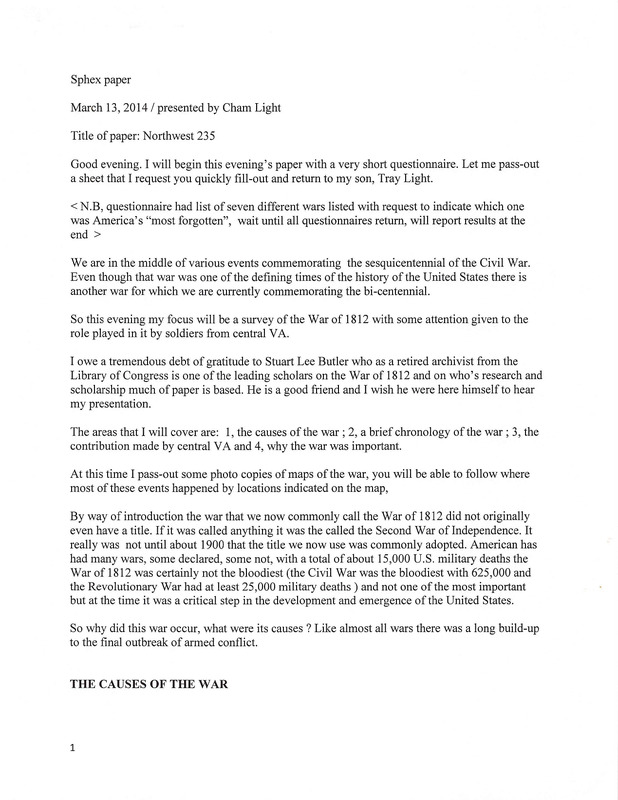
Text of a lecture to the Sphex Club of Lynchburg. R. Chambliss Light, Jr.'s presentation, titled "Northwest 235," provides an in-depth examination of the War of 1812, focusing on its causes, key battles, and the significant contributions of Central Virginia soldiers. Light references Stuart Lee Butler's scholarship on the topic, emphasizing the war's complexity, including the American motivations for war, such as British impressment of American sailors and trade restrictions. He also highlights the war's impact on national identity and military strategy in the U.S., the role of African Americans in the conflict, and the Treaty of Ghent's conclusion without territorial changes but with significant political and cultural legacies.
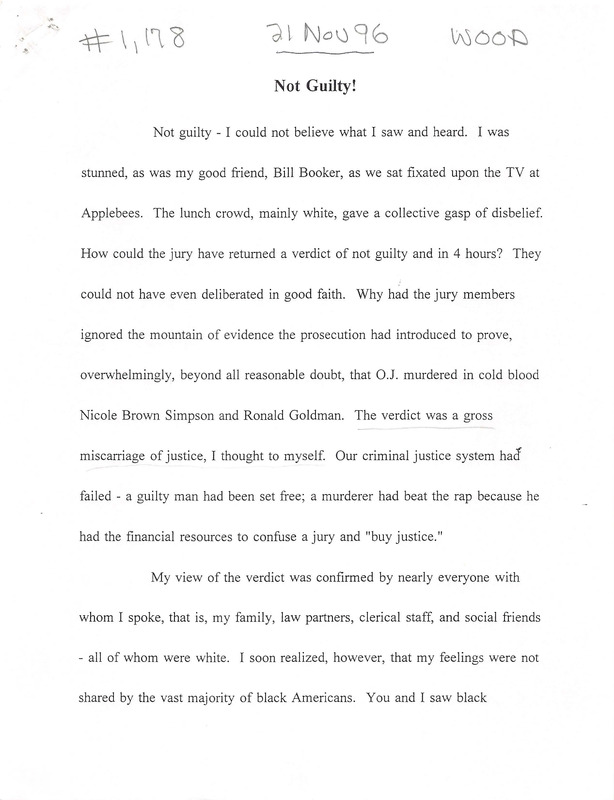
Text of a lecture to the Sphex Club in Lynchburg. Robert C. Wood III discusses the controversial O.J. Simpson verdict, highlighting the deep racial and societal divisions it exposed. He examines the jury's decision through the lenses of police conduct, the adversarial justice system, and the influence of race and wealth. Wood challenges the audience to consider broader issues of truth, justice, and systemic biases, ultimately questioning the role of jury nullification and the implications of the trial on American society.
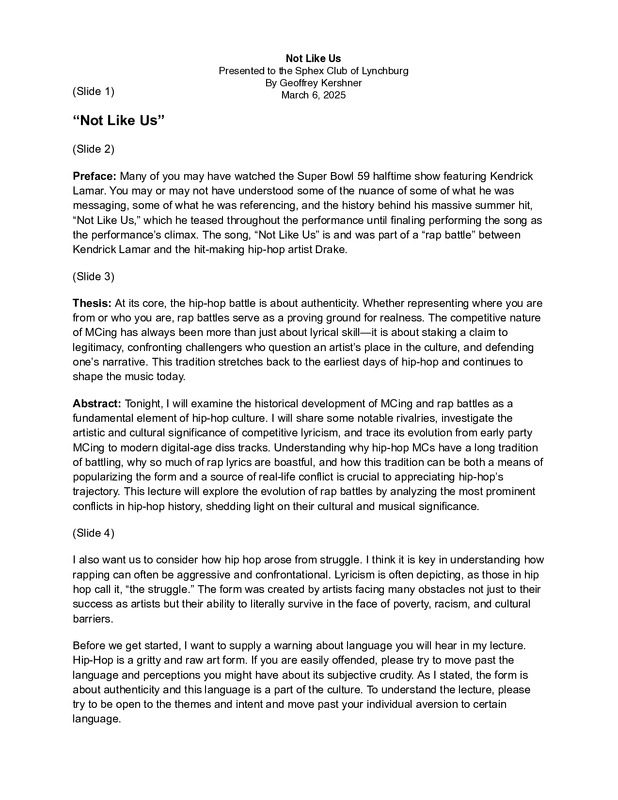
Text of a lecture delivered to the Sphex Club of Lynchburg, Va. On March 6, 2025, Geoffrey Kershner examined the evolution of rap battles within hip-hop culture, from 1970s Bronx block parties to modern lyrical rivalries like Kendrick Lamar vs. Drake. Highlighting authenticity, competition, and regional pride, Kershner contextualized key battles such as The Bridge Wars and Tupac vs. Biggie. His talk explored how braggadocio, confrontation, and storytelling remain vital to hip-hop's cultural and artistic identity.
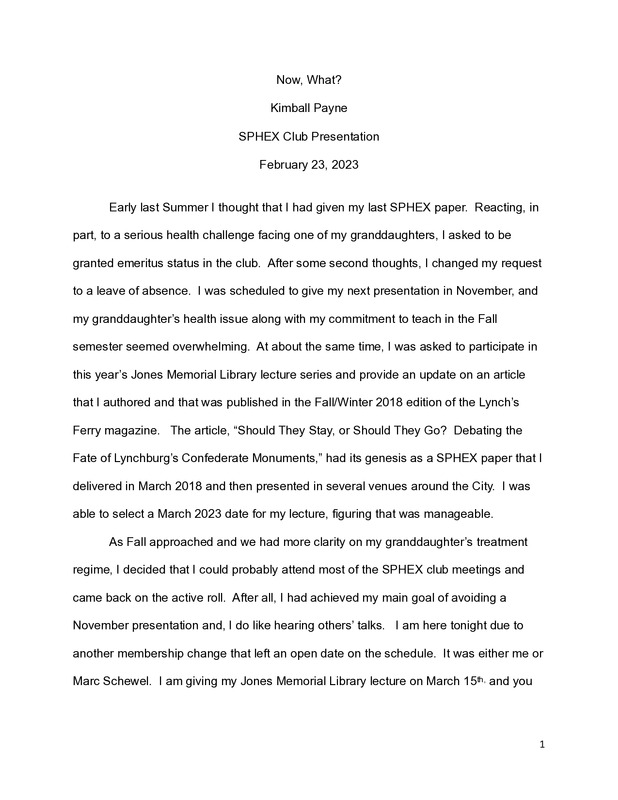
Text of a lecture delivered to the Sphex Club in Lynchburg. An update on the status of Confederate monuments given a change in legislation, including actions taken by various Virginia localities.
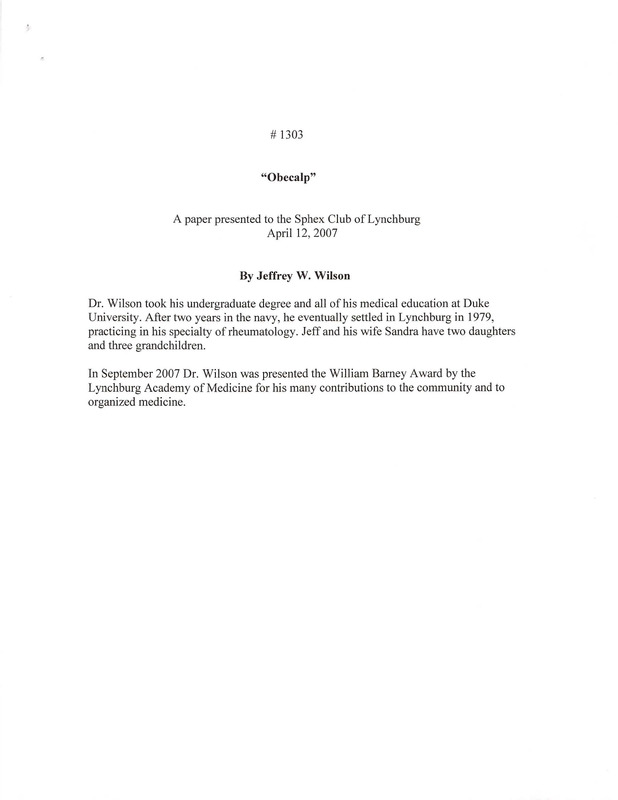
Text of a lecture to the Sphex Club in Lynchburg. This paper, presented by Jeffrey W. Wilson to the SPHEX Club, recounts the author's experiences as a Navy medical officer and the use of placebos, particularly "Obecalp," which is "placebo" spelled backward. It highlights the placebo effect's significance in medical practice, demonstrating its impact through anecdotes and broader discussions on mind-body connections, biofeedback, and patient-physician relationships. The paper emphasizes that a patient's belief and the doctor-patient relationship can significantly affect treatment outcomes.
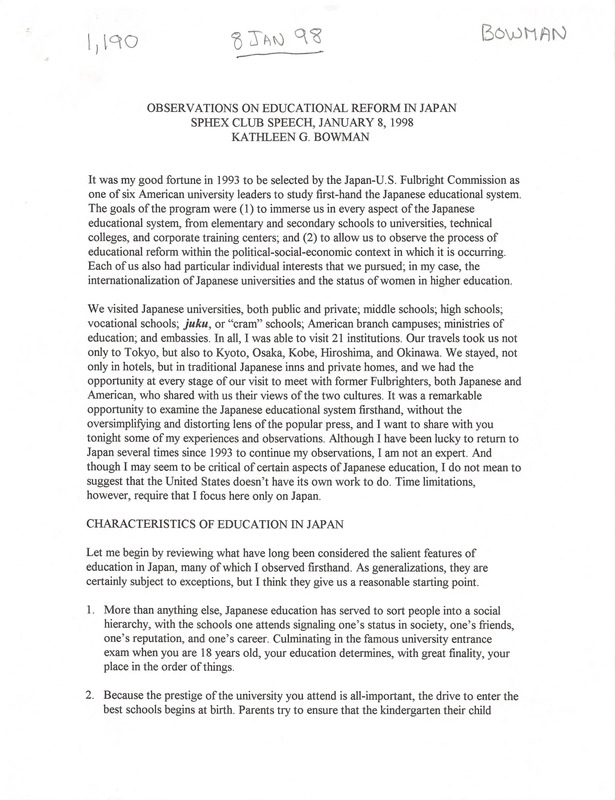
Observations on the status and character of the Japanese educational system. As a member of the Japan-US Fulbright Commisson the author analyzes strengths, weaknesses and the prospects for further reforms.
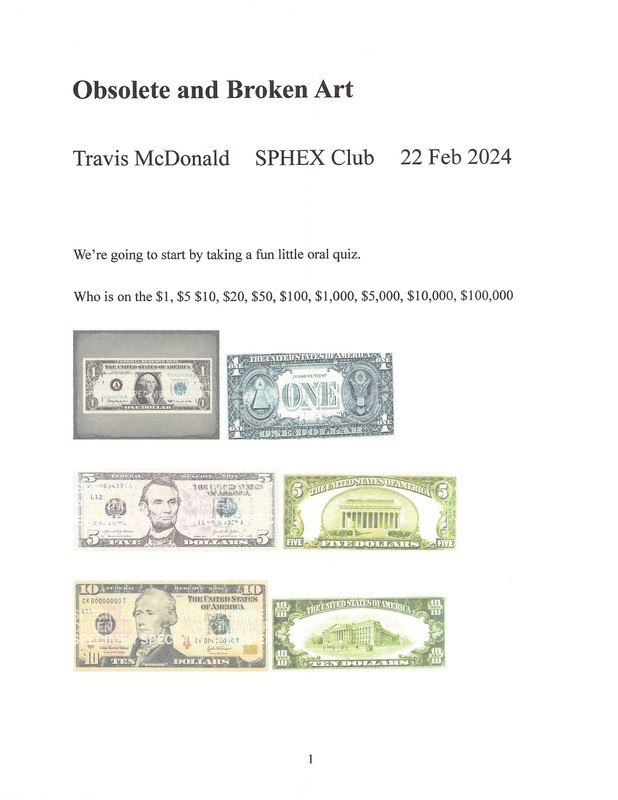
Text of a presentation to the Sphex Club in Lynchburg. Travis McDonald's paper, "Obsolete and Broken Art," discusses the history and artistic significance of U.S. paper currency, particularly focusing on the evolution and design of notes from the 18th to the 19th centuries. The paper highlights the Panic of 1837, the National Banking Act, and the issuance of the 1896 "education notes." McDonald emphasizes the artistic and historical value of these notes, their production process, and their impact on American art.
Raymond H. Williamson's paper "Offbeat Virginiana," explores lesser-known historical events in Virginia, particularly Lynchburg, using contemporary newspaper excerpts from 1862-1974. Key topics include early metrication efforts by the Confederacy, a post-Civil War robbery in Lynchburg, and the construction of prominent statues. The paper connects these diverse events to illustrate the rich, albeit minor, history of the region.
Text of a lecture delivered to the Sphex Club of Lynchburg. Travis McDonald's presentation "Oh Rats!" explored the discovery of rat nests at Thomas Jefferson's Poplar Forest, revealing various materials collected by rats over time. This unique find led to questions about rat behavior and nesting habits in buildings, pushing the boundaries of ethology and contributing to historical and architectural understanding.
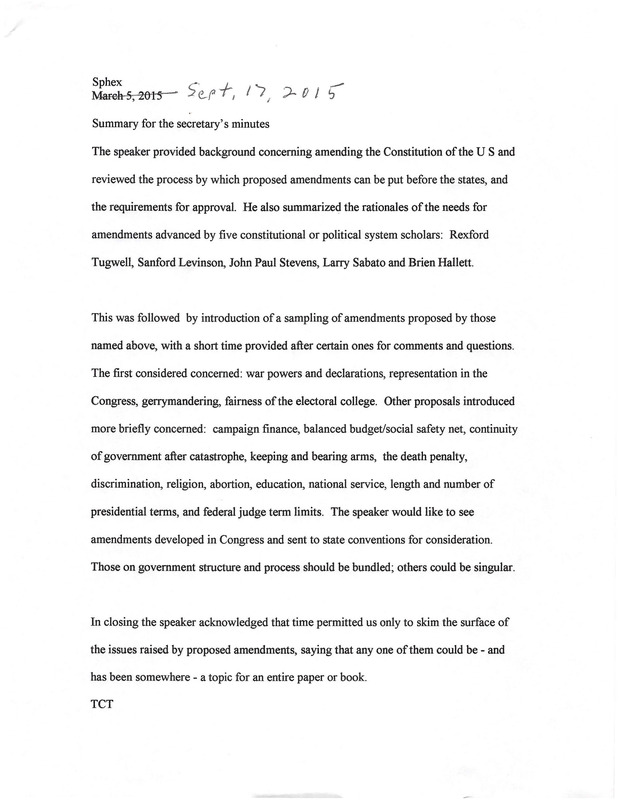
Text of a lecture to the Sphex Club in Lynchburg. The paper discusses proposals for amending the U.S. Constitution, focusing on the need for structural reforms and addressing flaws in representation and governance. It highlights various suggestions from scholars like Rexford Guy Tugwell, Larry Sabato, and Sanford Levinson on changes related to war powers, Congress, gerrymandering, the Electoral College, campaign finance, balanced budgets, and the death penalty. The author advocates for amendments proposed in Congress to improve government functionality and addresses the complexity and range of potential amendments.
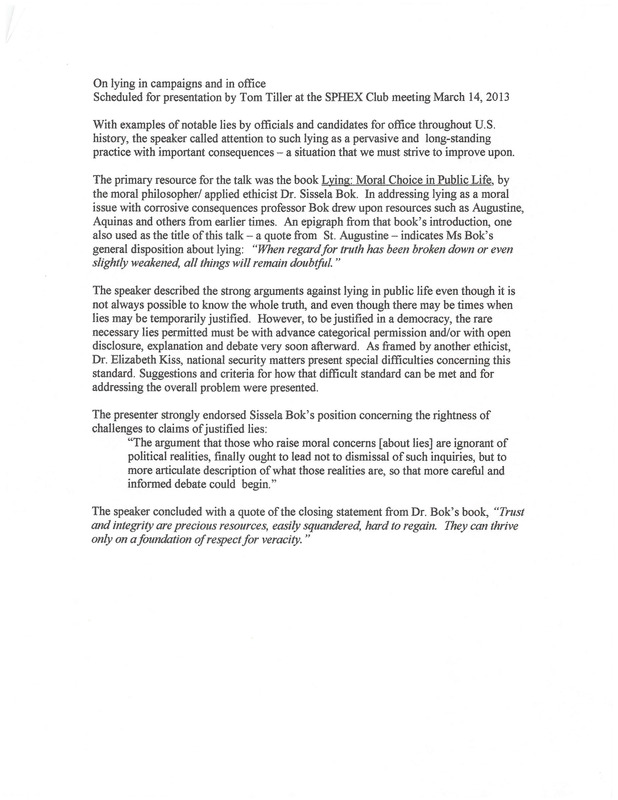
Text of a lecture delivered to the Sphex Club in Lynchburg. This paper by Thomas C. Tiller addresses the pervasive issue of lying in political and public life, highlighting the historical context and the moral dilemmas associated with it. Tiller discusses various aspects of lying, from campaign falsehoods to strategic government deceptions, emphasizing the moral and ethical implications. He references the work of Sissela Bok on lying, exploring the complexity of defining and justifying lies in a democracy. The paper concludes with a call for higher standards of truthfulness in politics, underscoring the importance of integrity and trust in sustaining democratic principles.
Text of a lecture delivered to the Sphex Club in Lynchburg. This paper delves into the multifaceted issues Israel faces at its 50th anniversary, covering political, economic, and religious challenges, including the ongoing conflict with Palestinians and internal societal divisions. The author references a variety of sources to provide a comprehensive overview of Israel's history, current events, and the peace process, including the implications of Zionism and the potential for a post-Zionist state. The analysis highlights the complexities of Israeli politics, the impact of immigration, and the deep-rooted tensions between secular and religious communities, as well as between different ethnic groups within the country. It concludes with a reflection on Israel's future and its capacity for peace with the Palestinians, invoking optimism for reconciliation and coexistence. Mr. Petty appended to his talk a brief discussion of the current status of the Sphex Club archives at the Jones Memorial Library as the club approached its 90th year, and the need for an updating of the archives.
George Dawson's paper, "One Fish, Two Fish, Red Fish, Blue Fish," explores America's relationship with seafood, highlighting the environmental impact of seafood consumption and the challenges faced by marine ecosystems. Dawson emphasizes the importance of responsible seafood consumption and environmental awareness, focusing on issues like the threat to Sockeye salmon in the Bristol Bay watershed and the rise of aquaculture.
Operation Mulberry: An Episode in Modern History by John W. Landis recounts the strategic and innovative development of artificial harbors, known as Mulberry Harbors, during World War II. Landis offers a firsthand account of the massive military build-up in southern England for the D-Day invasion and the subsequent installation of these harbors to ensure the Allies' logistical support following their landing in Normandy. Despite challenges, including a devastating storm, the harbors were crucial in maintaining the flow of supplies necessary for the invasion's success. The paper emphasizes the ingenuity, determination, and cooperation among the Allies, showcasing a pivotal moment in modern military engineering and logistics.
Text of a lecture to the Sphex Club in Lynchburg. Robert C. Wood III's reflective talk for the SPHEX Club, "Our Fair Ladies," delivered on November 1, 2012, traverses his life's significant events, embedding personal and historical narratives to underscore the shaping of personal identity and beliefs. Wood highlights key moments ranging from childhood memories of World War II, performing in an opera, to his experiences in law and as a football referee, leading up to a discussion on the transformative presence of women in the legal profession, particularly on the Supreme Court, symbolized by "Our Fair Ladies" - Justices Ginsburg, Sotomayor, and Kagan.
Text of a lecture to the Sphex Club in Lynchburg. The paper "Our Uncles: An Odd Couple" by Robert C. Wood, III, explores the complex relationship between John Adams and Thomas Jefferson. It highlights their contrasting personalities and political philosophies, their pivotal roles in the American Revolution and early government, and their eventual reconciliation through correspondence after years of political estrangement.
Text of a lecture delivered to the Sphex Club on November 6, 2025. Joseph Stinnett’s paper explores the little-known history of Black emigration from Lynchburg, Virginia, to Liberia between 1829 and 1865 through the American Colonization Society. Focusing on Washington Copeland, an enslaved carpenter who became a leading advocate for Liberian emigration, the talk examines the complex motivations behind colonization: white racism and coercion on one hand, and Black aspirations for citizenship, dignity, and self-determination on the other. Stinnett argues that many Black Virginians viewed Liberia as the only place where they could achieve full political rights denied them in the United States. The paper also critiques the Lost Cause mythology that obscured these histories after the Civil War. Through letters, records, and personal stories, Stinnett restores the humanity, agency, suffering, and determination of Lynchburg’s emigrants and their descendants.
Dr. William Quillian, president of Randolph-Macon Woman’s College introduced his presentation by sharing his “pleasure and pride in the treasures found in Randolph-Macon's Collection of Paintings.” He proceeded to discuss the background of the art collection and showed pictures of a number of paintings that can be seen in the collection. President Quillian mentioned by name many Sphex Club members who helped make this collection possible.