The collection of the Sphex Club, of Lynchburg, Virginia, includes minutes of meetings, the constitution and bylaws of the Club, a roster of its members, and a listing of Sphex papers presented by members and guests of the Club. In addition to this guide, the collection is outlined in more detail in “Sphex in the Jones Memorial Library,” Chapter VI of the Club history, The Sphex Club of Lynchburg, Virginia: The First One Hundred Years, 1910-2010, by James M. Elson.
Access Rights
Lectures delivered by members appear as papers in the Item Set. Papers are available in print at the library. Select papers have been digitized (including all papers delivered to the Club prior to 1952).
Authors retain copyright to their work. Papers may not be reproduced or reprinted without permission of the author and the library.
The paper titled "Martial Arts: What is real? What is not...?" by Kenneth R. Garren, Ph.D., explores the author’s journey and experiences with Taekwondo and other martial arts. Garren discusses his initial fascination, training progression, belt achievements, and insights on different martial arts styles' efficacy. His narrative is intertwined with personal anecdotes, demonstrating how martial arts impacted his confidence, leadership skills, and career.
The paper presents Wm. Martin Johnson's experiences and photographs from his travels in Africa, focusing on the diverse wildlife and the importance of conservation. It highlights the challenges faced by African animals, including poaching and habitat loss, and emphasizes the need for preserving these unique ecosystems.
The paper focuses on the Mecklenburg Declaration, a contentious historical document claimed by many in North Carolina as America's first Declaration of Independence, predating Jefferson's by over a year. It details its disputed authenticity, contrasting it with the Mecklenburg Resolves, and explores the broader historical and political context of Mecklenburg County in 1775. The narrative weaves through scholarly debates, regional pride, and the local celebration of Mecklenburg Declaration Day, emphasizing the enduring controversy and cultural significance of the declaration.
Norman K. Moon began his presentation by saying “This talk is about the exercise of peremptory challenges, those which the lawyer traditionally may exercise to remove a juror who was not removed for cause but whom the lawyer wants to remove for whatever or no stated reason.” Moon discusses what many believe are the dangers and many believe are the strengths of specific peremptory challenges.
Text of a lecture delivered to the Sphex Club of Lynchburg. Eric Sorenson, Sr. maintains that World War I was the most damaging of modern wars because it led to the leadership of Hitler, Lenin and Stalin and more tragedy. He then creates the case that a misdiagnosis by the famous doctor Morell Mackenzie on the German Emperor Frederick III led to Frederick’s death in 1888. He and his liberal ideas died after only 99 days of leadership. Sorenson discusses whether this “Victorian Tragedy” may have led to WWI.
Peter Marcy's lecture delves into the dynamics of the African slave trade through the lens of the competitive and cooperative relationships between the ports of Bristol and Liverpool during the 18th century. Marcy outlines the economic, legislative, and operational factors contributing to Liverpool's ascendance in the slave trade, overshadowing Bristol. He highlights the strategic use of the Isle of Man for cheaper goods, the design of faster ships, and aggressive business tactics as key advantages. The lecture meticulously details the risks, mortality rates, and profitability of the slave trade, offering insights into the human cost and economic motivations underpinning this dark chapter in British maritime history.
Text of a lecture delivered to the Sphex Club in Lynchburg. On February 6, 2025, Ott Rowlands presented on the theatrical and religious themes behind two plays exploring Appalachian snake handling. Blending history, faith, and personal narrative, the talk traced the origins of the practice, its biblical justification, and cultural symbolism. Rowlands examined both sociological and artistic portrayals, offering insight into the endurance of ritual, belief, and rural religious expression.
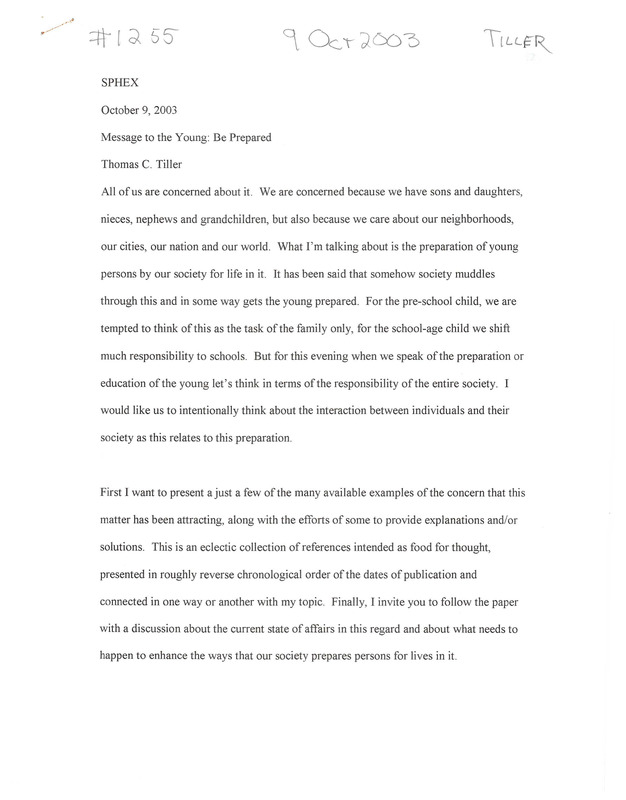
Text of a lecture delivered to the Sphex Club in Lynchburg. This paper by Thomas C. Tiller explores the societal responsibility in preparing young individuals for life within it. Tiller emphasizes the collective role of family, schools, and society at large in nurturing the youth. He references various psychologists and educators to highlight the evolving concerns and methodologies regarding youth development. The paper discusses shifts in focus from gender disparities to broader educational and societal influences, incorporating insights from historical, psychological, and educational perspectives. Tiller advocates for a holistic approach to youth preparation, considering the influences of family, peer groups, media, schools, religious groups, and the economy. He invites discussion on improving societal mechanisms for equipping the young for future challenges.
George H. Lenz's lecture from March 13, 1997, titled "Millennial Musings-Fire from the Sky," explores the scientific and cultural fascination with meteors and their impact on Earth, alongside societal attitudes towards apocalyptic events. Lenz discusses how recent decades have seen a shift in scientific understanding to accept that catastrophic events, like meteor impacts, have significantly shaped life's evolution on Earth. He references historical mass extinctions and the role of sudden, catastrophic events contrary to the slow, gradual changes posited by Darwinian evolution. The lecture touches on the discovery of the K/T boundary, evidence of a massive meteor impact 65 million years ago, and its global effects, including mass extinctions.
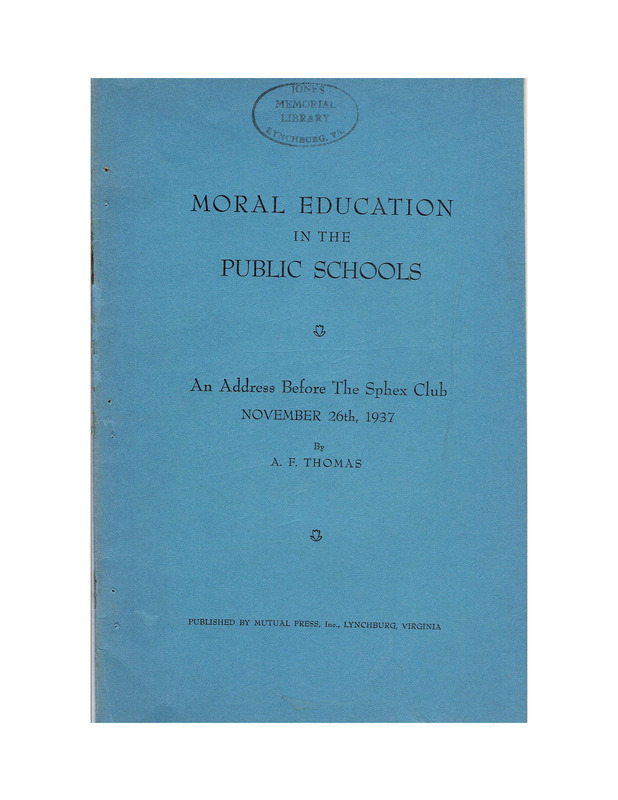
Text of a lecture to the Sphex Club in Lynchburg. This address, delivered by A.F. Thomas, argues for the incorporation of moral education in public schools to develop well-rounded citizens. Thomas emphasizes the need for balanced intellectual, physical, and moral training to prevent societal issues like crime. The paper differentiates between ethics and religion, advocating for state-led ethical instruction while leaving religious education to individuals and religious institutions.
Professor Peter Marcy gives a brief history of modern British historiography, beginning with Sir Walter Raleigh, William Camden and Sir Francis Bacon. He cites a shift away from uncritical acceptance of received knowledge to an emphasis on documentary evidence and scholarly interpretation that sought to establish causation. In the following century, David Hume, William Robertson and Edward Gibbon were influenced by the Enlightenment, particularly Voltaire, and emphasized social history. The theories of Hume, Voltaire and Gibbon are discussed. The later influence of Sir Walter Scott and subsequently Thomas Carlyle and others showed that history could be interesting and involves an imaginative as well as intellectual understanding of the past. The author discusses the contributions of Leopold von Ranke and Thomas Babbington Macauley, and concludes that modern British historiography includes sophisticated analysis of evidence and addresses anthropological, economic, psychological and intellectual dimensions.
Thomas Ledford begins: “I am going to tell a positive story of water and how the need for an abundant supply of clean, healthy water has been acquired through a series of sound public policy decisions made over the course of the last 200 years in Lynchburg.” Ledford describes decisions that Lynchburg made despite opposition. He concludes: “Lynchburg's leaders over the last two centuries have provided our community with safe, clean water today and far into the future.”
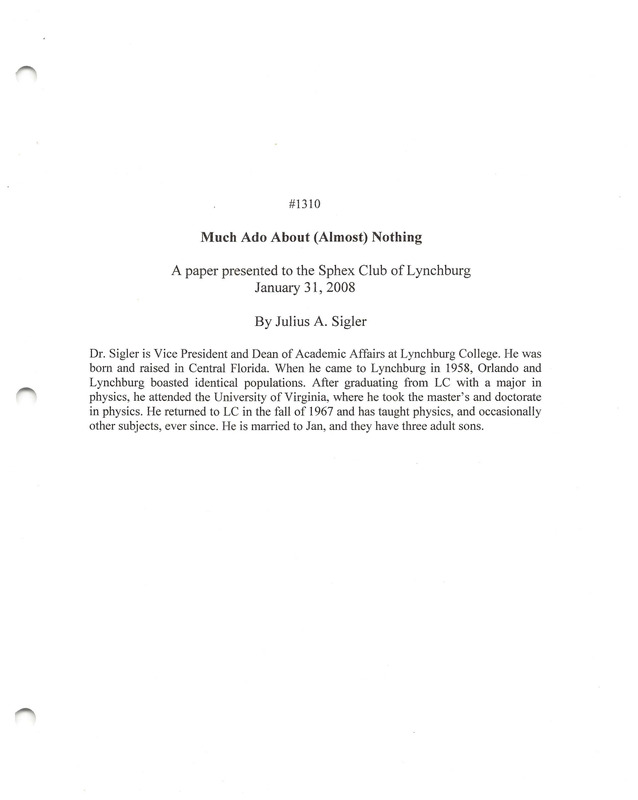
Text of a lecture delivered to the Sphex Club in Lynchburg. This academic paper, titled "Much Ado About (Almost) Nothing: A Sphex Club Paper" by Julius Sigler explores the feasibility and scientific foundation of constructing a space elevator as initially perceived to be an impossible project. Sigler shares his journey from skepticism to discovery, highlighting significant advancements in materials science, particularly in the realm of nanotechnology. The paper delves into the principles of atom behavior, the importance of surface area to volume ratios, quantum physics, and the potential applications of nanoscience in various fields including medicine, electronics, and environmental technology. It concludes with a revisitation of the space elevator concept, now seen as feasible with the advent of carbon nanotube technologies.
J. Everette Fauber’s Sphex Club lecture explores his deep connections with historically significant buildings he worked on as an architect. He personifies these inanimate structures, describing them as intimate friends. Fauber highlights several notable restorations, including the Captain Horton Plantation Home, the John Carlyle House, and the Octagon House, emphasizing their historical and architectural significance.
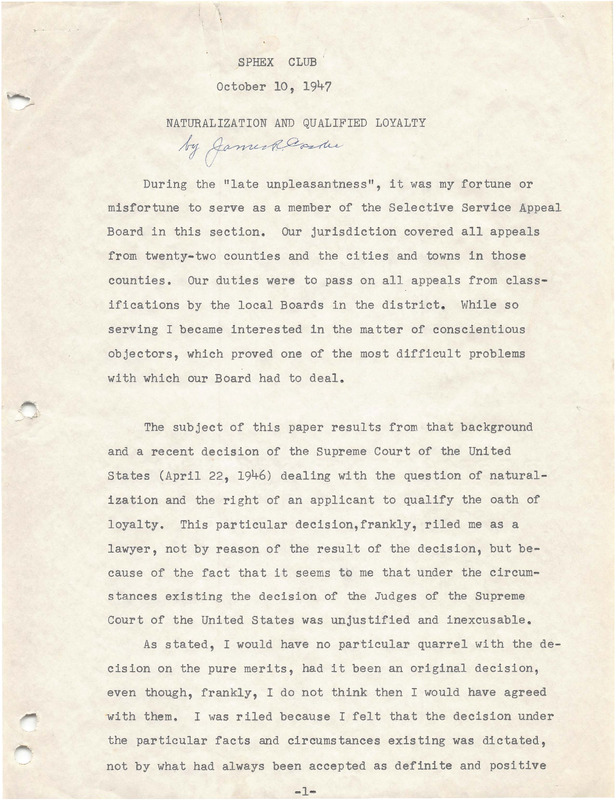
Text of a paper delivered to the Sphex Club in Lynchburg. This paper, delivered to the SPHEX Club on October 10, 1947, explores the complex issue of naturalization, loyalty oaths, and conscientious objectors in the United States, particularly in light of a Supreme Court decision on April 22, 1946. The author, having served on the Selective Service Appeal Board, critiques the Court's decision, which he sees as unjustified and indicative of judicial activism influenced by the New Deal philosophy. The paper meticulously reviews historical cases, legislative responses, and philosophical debates surrounding the oath of allegiance and the implications for both native and naturalized citizens.
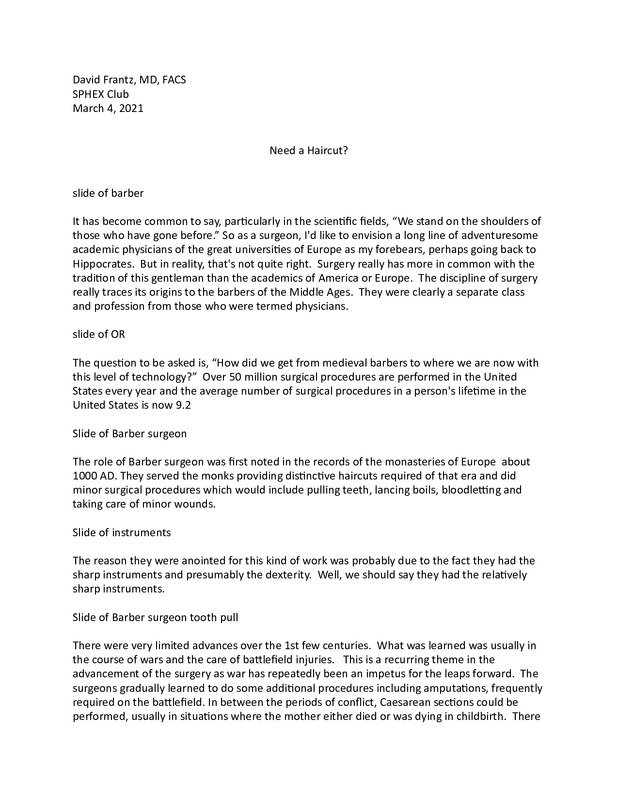
David Frantz's presentation, "Need a Haircut?," delves into the historical evolution of surgery, tracing its roots back to barber-surgeons in the Middle Ages. He discusses the significant advancements in surgical practices, particularly during wartime, and the transition from apprenticeships to academic training. The talk highlights key milestones, including the introduction of anesthesia, antisepsis, and asepsis techniques, as well as advancements in blood transfusion, which collectively overcame major barriers in surgery, transforming it into a crucial aspect of modern medical practice.
Christina Delzingaro's paper, "New Wave. Same as the Old Wave?" presented to the SPHEX Club on February 21, 2019, discusses the history and evolution of feminism, from the late 18th century to the present. It examines the different waves of feminism, their goals, and their challenges, highlighting ongoing issues such as gender-based discrimination and reproductive rights. The paper also reflects on the current fourth wave of feminism, driven by social media and movements like #MeToo, emphasizing its inclusivity and focus on implicit bias.
Text of a lecture to the Sphex Club in Lynchburg. A discussion of the rise of radio and news delivered by radio, its competition with newspapers, its financing, and the mechanisms for gathering and disseminating news by radio.